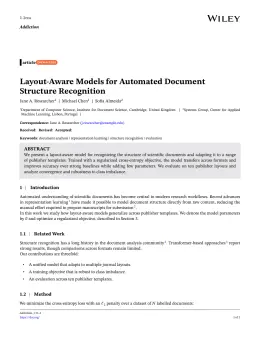
About the Concurrency and Computation Practice and Experience format
Concurrency and Computation Practice and Experience is a peer-reviewed journal published by Wiley, covering Distributed and Parallel Computing Systems, Parallel Computing and Optimization Techniques, Cloud Computing and Resource Management.
| Publisher | Wiley |
|---|
| Reference style | Author–year (Chicago) Author–year — (Smith, 2023) in the text
Smith, Ada, Ben Jones, and Cara Lee. 2023. "A Representative Article Title." Concurrency and Computation Practice and Experience 12 (3): 45–58.
Formats any DOI in Concurrency and Computation Practice and Experience style. No sign-up.
|
|---|
| Publishes research in | Distributed and Parallel Computing Systems Parallel Computing and Optimization Techniques Cloud Computing and Resource Management Advanced Data Storage Technologies IoT and Edge/Fog Computing |
|---|
| ISSN | 1532-0626 |
|---|
| Citation impact (2-yr) | 1.67 |
|---|
| h-index | 97 |
|---|
| i10-index | 2,360 |
|---|
| Total citations | 97,194 |
|---|
| Article processing charge | $4,740 |
|---|
| Top institutions publishing here | Chinese Academy of Sciences |
|---|
| Journal website | onlinelibrary.wiley.com |
|---|
| You get | A submission-ready PDF and the editable LaTeX source — ready to submit. |
|---|
Papers published in Concurrency and Computation Practice and Experience per year
Citation impact of Concurrency and Computation Practice and Experience by publication year
Citations each year’s papers have accumulated so far — the most recent years are still building up.
Most-cited papers in Concurrency and Computation Practice and Experience
Distributed computing in practice: the Condor experience
Douglas Thain, Todd Tannenbaum, Miron Livny · 1 Feb 2005
Abstract Since 1984, the Condor project has enabled ordinary users to do extraordinary computing. Today, the project continues to explore the social and technical problems of cooperative computing on scales ranging from the desktop to the world‐wide computational Grid. In this paper, we provide the history and philosophy of the Condor project and describe how…
Optimal online deterministic algorithms and adaptive heuristics for energy and performance efficient dynamic consolidation of virtual machines in Cloud data centers
Anton Beloglazov, Rajkumar Buyya · 7 Oct 2011
SUMMARY The rapid growth in demand for computational power driven by modern service applications combined with the shift to the Cloud computing model have led to the establishment of large‐scale virtualized data centers. Such data centers consume enormous amounts of electrical energy resulting in high operating costs and carbon dioxide emissions. Dynamic consolidation of virtual…
Scientific workflow management and the Kepler system
Bertram Ludäscher, İlkay Altıntaş, Chad Berkley et al. · 13 Dec 2005
Abstract Many scientific disciplines are now data and information driven, and new scientific knowledge is often gained by scientists putting together data analysis and knowledge discovery ‘pipelines’. A related trend is that more and more scientific communities realize the benefits of sharing their data and computational services, and are thus contributing to a distributed data…
GridSim: a toolkit for the modeling and simulation of distributed resource management and scheduling for Grid computing
Rajkumar Buyya, Manzur Murshed · 1 Nov 2002
Abstract Clusters, Grids, and peer‐to‐peer (P2P) networks have emerged as popular paradigms for next generation parallel and distributed computing. They enable aggregation of distributed resources for solving large‐scale problems in science, engineering, and commerce. In Grid and P2P computing environments, the resources are usually geographically distributed in multiple administrative domains , managed and owned by…
StarPU: a unified platform for task scheduling on heterogeneous multicore architectures
Cédric Augonnet, Samuel Thibault, Raymond Namyst et al. · 4 Nov 2010
Abstract In the field of HPC, the current hardware trend is to design multiprocessor architectures featuring heterogeneous technologies such as specialized coprocessors (e.g. Cell/BE) or data‐parallel accelerators (e.g. GPUs). Approaching the theoretical performance of these architectures is a complex issue. Indeed, substantial efforts have already been devoted to efficiently offload parts of the computations. However,…