
1,028 citations
Cite
SaveGo to paper →
Wiley
Concepts in Magnetic Resonance Part A Template
Write in a clean editor, then format for Concepts in Magnetic Resonance Part A in one click — DocuGuru applies the official Wiley template with author–year references and exports a submission-ready PDF plus the editable LaTeX source. Free to start.
About the Concepts in Magnetic Resonance Part A format
Concepts in Magnetic Resonance Part A is a peer-reviewed journal published by Wiley, covering Advanced NMR Techniques and Applications, NMR spectroscopy and applications, Advanced MRI Techniques and Applications.
| Publisher | Wiley |
|---|---|
| Reference style | Author–year (Chicago) Author–year — (Smith, 2023) in the text Smith, Ada, Ben Jones, and Cara Lee. 2023. "A Representative Article Title." Concepts in Magnetic Resonance Part A 12 (3): 45–58.
Formats any DOI in Concepts in Magnetic Resonance Part A style. No sign-up. |
| Publishes research in | Advanced NMR Techniques and Applications NMR spectroscopy and applications Advanced MRI Techniques and Applications Advanced Neuroimaging Techniques and Applications Molecular spectroscopy and chirality |
| ISSN | 1546-6086 |
| Citation impact (2-yr) | 0.27 |
| h-index | 57 |
| i10-index | 210 |
| Total citations | 11,941 |
| Article processing charge | $1,650 |
| Open access | Yes |
| Top institutions publishing here | Centre National de la Recherche Scientifique |
| Journal website | www.hindawi.com |
| You get | A submission-ready PDF and the editable LaTeX source — ready to submit. |
Papers published in Concepts in Magnetic Resonance Part A per year
Citation impact of Concepts in Magnetic Resonance Part A by publication year
Citations each year’s papers have accumulated so far — the most recent years are still building up.
Most-cited papers in Concepts in Magnetic Resonance Part A
Abstract The combination of structural diversity at several levels and limited chemical shift dispersion ensures that NMR spectra of carbohydrates are relatively difficult to interpret. This introduction to applications of NMR spectroscopy for the study of carbohydrates provides guidelines for interpretation of their 1‐ and 2‐D spectra against a background of their tautomeric, configurational, and…
393 citations
Cite
SaveGo to paper →
Abstract This is a tutorial describing how the time‐dependent diffusion coefficient D ( t ) of mobile molecules confined in pores or cells carries information about the confining geometry. At early times, D ( t ) = D 0 [1 − (4/9 $\sqrt{\pi}$ )( S / V p ) $\sqrt{D_{0}t}$ ] gives, irrespective of details,…
331 citations
Cite
SaveGo to paper →
Abstract For the last 15 years, super‐resolution (SR) algorithms have successfully been applied to magnetic resonance imaging (MRI) data to increase the spatial resolution of scans after acquisition has been performed, thus facilitating the doctors' diagnosis. The variety of application and techniques has grown ever since, especially in the MRI modality, showing the interest of…
265 citations
Cite
SaveGo to paper →
Abstract The widely known Stejskal–Tanner (ST) equation is central to any diffusion NMR or so‐called pulsed gradient spin‐echo experiment, describing the signal attenuation due to loss of coherence caused by diffusion as a function of the experimental parameters. What is less widely known is that the equation itself is not invariable when applying different pulse…
227 citations
Cite
SaveGo to paper →
Related journal templates
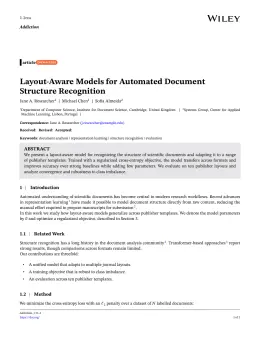
Concepts in Magnetic Resonance Part A template — frequently asked questions
How do I write a paper in the Concepts in Magnetic Resonance Part A format?
In DocuGuru you write your manuscript in a normal editor — no LaTeX setup required — and select the Concepts in Magnetic Resonance Part A template. When you export, DocuGuru compiles the paper into the official Wiley format and hands you a submission-ready PDF along with the editable LaTeX source.
What reference style does Concepts in Magnetic Resonance Part A use?
Concepts in Magnetic Resonance Part A uses Author–year (Chicago) references, shown as author–year markers such as (Smith, 2023) in the text. DocuGuru formats every in-text citation and the reference list in this exact style automatically. A reference appears like this: Smith, Ada, Ben Jones, and Cara Lee. 2023. "A Representative Article Title." Concepts in Magnetic Resonance Part A 12 (3): 45–58.
Do I need to know LaTeX to submit to Concepts in Magnetic Resonance Part A?
No. DocuGuru generates the USG LaTeX class and compiles the PDF for you in the background, so you get a Wiley-ready Concepts in Magnetic Resonance Part A document without writing any LaTeX. If you do want it, the LaTeX source is included in the export.
Can I import an existing draft into the Concepts in Magnetic Resonance Part A template?
Yes. Paste or upload your current manuscript — Word, LaTeX, Markdown, or plain text — and DocuGuru reflows it into the Concepts in Magnetic Resonance Part A format with correct headings, figures, tables, and author–year citations.
Who publishes Concepts in Magnetic Resonance Part A?
Concepts in Magnetic Resonance Part A is a multidisciplinary journal published by Wiley. DocuGuru's Concepts in Magnetic Resonance Part A template matches Wiley's official submission format.
Can I export a submission-ready Concepts in Magnetic Resonance Part A PDF?
Yes — DocuGuru produces a PDF built with the official Concepts in Magnetic Resonance Part A template (the USG class) that is ready to submit to Wiley, together with the matching LaTeX source files.
How much does the Concepts in Magnetic Resonance Part A template cost?
You can start writing in the Concepts in Magnetic Resonance Part A template for free. Exporting the final submission-ready Concepts in Magnetic Resonance Part A PDF and LaTeX source is part of DocuGuru's paid plans — see the app for current pricing.