Wiley

ChemPlusChem Template

Write in a clean editor, then format for ChemPlusChem in one click — DocuGuru applies the official Wiley template with author–year references and exports a submission-ready PDF plus the editable LaTeX source. Free to start.

About the ChemPlusChem format

ChemPlusChem is a peer-reviewed journal published by Wiley, covering Luminescence and Fluorescent Materials, Metal-Organic Frameworks: Synthesis and Applications, Molecular Sensors and Ion Detection.

PublisherWiley
Reference styleAuthor–year (Chicago)
Author–year — (Smith, 2023) in the text
Smith, Ada, Ben Jones, and Cara Lee. 2023. "A Representative Article Title." ChemPlusChem 12 (3): 45–58.

Formats any DOI in ChemPlusChem style. No sign-up.

Publishes research inLuminescence and Fluorescent Materials Metal-Organic Frameworks: Synthesis and Applications Molecular Sensors and Ion Detection Conducting polymers and applications Porphyrin and Phthalocyanine Chemistry
ISSN2192-6506
Citation impact (2-yr)3.55
h-index81
i10-index1,527
Total citations52,861
Top institutions publishing hereCentre National de la Recherche Scientifique
Journal websiteonlinelibrary.wiley.com
You getA submission-ready PDF and the editable LaTeX source — ready to submit.

Papers published in ChemPlusChem per year

324
2014
279
2015
265
2016
174
2017
196
2018
292
2019
349
2020
224
2021
242
2022
331
2023
432
2024
308
2025

Citation impact of ChemPlusChem by publication year

6.2K
2014
4.4K
2015
5.9K
2016
2.8K
2017
2.6K
2018
4.4K
2019
6K
2020
3K
2021
2.2K
2022
2.2K
2023
2.4K
2024
526
2025

Citations each year’s papers have accumulated so far — the most recent years are still building up.

Most-cited papers in ChemPlusChem

Chemical Sensors Based on Metal–Organic Frameworks

Fei‐Yan Yi, Dongxiao Chen, Meng‐Ke Wu et al. · 29 Apr 2016

Metal-organic frameworks (MOFs) as chemical sensors have developed rapidly in recent years. There have been many papers concerning this field and interest is still growing. The reason is that the specific merits of MOFs can be utilized to enhance sensitivity and selectivity by various energy/charge transfers occurring among different ligands, ligand, and metal centers, such…

Development of High‐Drug‐Loading Nanoparticles

Yun Liu, Guangze Yang, Song Jin et al. · 10 Aug 2020

Formulating drugs into nanoparticles offers many attractive advantages over free drugs including improved bioavailability, minimized toxic side effects, enhanced drug delivery, feasibility of incorporating other functions such as controlled release, imaging agents for imaging, targeting delivery, and loading more than one drug for combination therapies. One of the key parameters is drug loading, which is…

Coaxial Electrospinning Formation of Complex Polymer Fibers and their Applications

Daewoo Han, A. J. Steckl · 28 Jun 2019

The formation of fibers by electrospinning has experienced explosive growth in the past decade, recently reaching 4,000 publications and 1,500 patents per year. This impressive growth of interest is due to the ability to form fibers with a variety of materials, which lend themselves to a large and rapidly expanding set of applications. In particular,…

Organic Solid‐State Fluorescence: Strategies for Generating Switchable and Tunable Fluorescent Materials

Savarimuthu Philip Anthony · 8 Jun 2012

Abstract Organic fluorescent materials have been an integral part of recently emerged optoelectronic device technologies owing to their good photophysical properties such as high quantum yields and significant photostability. In particular, switchable and tunable solid‐state fluorescence has attracted increasing attention in recent years both in the field of fundamental research and industrial applications. Unlike in…

A Review of the Iron–Air Secondary Battery for Energy Storage

R. D. McKerracher, Carlos Ponce de León, R.G.A. Wills et al. · 26 Sep 2014

Abstract Recent interest in the iron–air flow battery, known since the 1970s, has been driven by incentives to develop low‐cost, environmentally friendly and robust rechargeable batteries. With a predicted open‐circuit potential of 1.28 V, specific charge capacity of <300 A h kg −1 and reported efficiencies of 96, 40 and 35 % for charge, voltage…

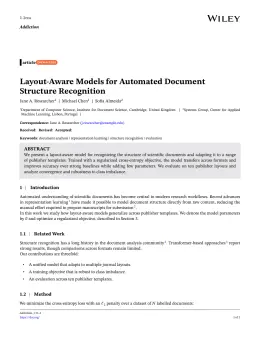
ChemPlusChem template — frequently asked questions

How do I write a paper in the ChemPlusChem format?
In DocuGuru you write your manuscript in a normal editor — no LaTeX setup required — and select the ChemPlusChem template. When you export, DocuGuru compiles the paper into the official Wiley format and hands you a submission-ready PDF along with the editable LaTeX source.
What reference style does ChemPlusChem use?
ChemPlusChem uses Author–year (Chicago) references, shown as author–year markers such as (Smith, 2023) in the text. DocuGuru formats every in-text citation and the reference list in this exact style automatically. A reference appears like this: Smith, Ada, Ben Jones, and Cara Lee. 2023. "A Representative Article Title." ChemPlusChem 12 (3): 45–58.
Do I need to know LaTeX to submit to ChemPlusChem?
No. DocuGuru generates the USG LaTeX class and compiles the PDF for you in the background, so you get a Wiley-ready ChemPlusChem document without writing any LaTeX. If you do want it, the LaTeX source is included in the export.
Can I import an existing draft into the ChemPlusChem template?
Yes. Paste or upload your current manuscript — Word, LaTeX, Markdown, or plain text — and DocuGuru reflows it into the ChemPlusChem format with correct headings, figures, tables, and author–year citations.
Who publishes ChemPlusChem?
ChemPlusChem is a multidisciplinary journal published by Wiley. DocuGuru's ChemPlusChem template matches Wiley's official submission format.
Can I export a submission-ready ChemPlusChem PDF?
Yes — DocuGuru produces a PDF built with the official ChemPlusChem template (the USG class) that is ready to submit to Wiley, together with the matching LaTeX source files.
How much does the ChemPlusChem template cost?
You can start writing in the ChemPlusChem template for free. Exporting the final submission-ready ChemPlusChem PDF and LaTeX source is part of DocuGuru's paid plans — see the app for current pricing.
Use the ChemPlusChem template