Wiley

Cell Proliferation Template

Write in a clean editor, then format for Cell Proliferation in one click — DocuGuru applies the official Wiley template with author–year references and exports a submission-ready PDF plus the editable LaTeX source. Free to start.

About the Cell Proliferation format

Cell Proliferation is a peer-reviewed journal published by Wiley, covering Mesenchymal stem cell research, Cancer Cells and Metastasis, Pluripotent Stem Cells Research.

PublisherWiley
Reference styleAuthor–year (Chicago)
Author–year — (Smith, 2023) in the text
Smith, Ada, Ben Jones, and Cara Lee. 2023. "A Representative Article Title." Cell Proliferation 12 (3): 45–58.

Formats any DOI in Cell Proliferation style. No sign-up.

Publishes research inMesenchymal stem cell research Cancer Cells and Metastasis Pluripotent Stem Cells Research MicroRNA in disease regulation Reproductive Biology and Fertility
ISSN0960-7722
Citation impact (2-yr)5.23
h-index138
i10-index2,726
Total citations138,298
Article processing charge$2,860
Open accessYes
Top institutions publishing hereSichuan University
Journal websiteonlinelibrary.wiley.com
You getA submission-ready PDF and the editable LaTeX source — ready to submit.

Papers published in Cell Proliferation per year

84
2014
74
2015
105
2016
110
2017
139
2018
185
2019
251
2020
211
2021
225
2022
213
2023
220
2024
208
2025

Citation impact of Cell Proliferation by publication year

2.8K
2014
2.5K
2015
4.1K
2016
4.7K
2017
6.1K
2018
8.8K
2019
11.8K
2020
7.8K
2021
4.6K
2022
3.5K
2023
2K
2024
646
2025

Citations each year’s papers have accumulated so far — the most recent years are still building up.

Most-cited papers in Cell Proliferation

THE DEVELOPMENT OF FIBROBLAST COLONIES IN MONOLAYER CULTURES OF GUINEA‐PIG BONE MARROW AND SPLEEN CELLS

A. J. Friedenstein, R. K. Chailakhjan, K. S. Lalykina · 1 Oct 1970

ABSTRACT In monolayer cultures of guinea‐pig bone marrow and spleen the development of discrete fibroblast colonies takes place on days 9–12. The linear increase in the number of colonies with increasing numbers of explanted cells and the distribution of male and female cells in mixed cultures support the view that fibroblast colonies are clones. The…

2,686 citations Cite SaveGo to paper →
The cell cycle: a review of regulation, deregulation and therapeutic targets in cancer

Katrien Vermeulen, Dirk R. Van Bockstaele, Zwi Berneman · 1 Jun 2003

The cell cycle is controlled by numerous mechanisms ensuring correct cell division. This review will focus on these mechanisms, i.e. regulation of cyclin-dependent kinases (CDK) by cyclins, CDK inhibitors and phosphorylating events. The quality checkpoints activated after DNA damage are also discussed. The complexity of the regulation of the cell cycle is also reflected in…

1,775 citations Cite SaveGo to paper →
Programmed cell death pathways in cancer: a review of apoptosis, autophagy and programmed necrosis

L. Ouyang, Zhihong Shi, Shenglin Zhao et al. · 3 Oct 2012

Programmed cell death (PCD), referring to apoptosis, autophagy and programmed necrosis, is proposed to be death of a cell in any pathological format, when mediated by an intracellular program. These three forms of PCD may jointly decide the fate of cells of malignant neoplasms; apoptosis and programmed necrosis invariably contribute to cell death, whereas autophagy…

1,457 citations Cite SaveGo to paper →
Bone marrow osteogenic stem cells: <i>in vitro</i> cultivation and transplantation in diffusion chambers

A. J. Friedenstein, R. K. Chailakhyan, U. V. Gerasimov · 1 May 1987

Fibroblast colonies (clones) were obtained by explantation of bone marrow single-cell suspensions and were used to establish multicolony and single-colony derived fibroblast cultures by successive passaging of either pooled or individual colonies. When transplanted in diffusion chambers after 20-30 cell doublings in vitro, the descendants of fibroblast colony-forming cells (FCFC), whether grown from single or…

Dose‐dependent induction of apoptosis in human tumour cell lines by widely diverging stimuli

SEAMUS V. LENNON, Séamus J. Martin, Thomas G. Cotter · 1 Mar 1991

Cell death may occur by either of two mechanisms: apoptosis or necrosis. Necrosis, the first type of cell death to be recognized, is an uncontrolled degenerative phenomenon invariably caused by noxious stimuli and is the result of irreversible failure of membrane function. Apoptosis, on the other hand, is a death process which involves a series…

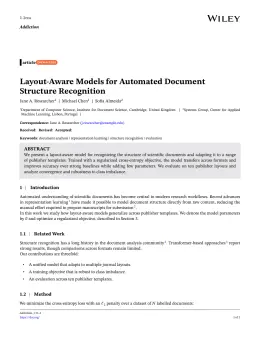
Cell Proliferation template — frequently asked questions

How do I write a paper in the Cell Proliferation format?
In DocuGuru you write your manuscript in a normal editor — no LaTeX setup required — and select the Cell Proliferation template. When you export, DocuGuru compiles the paper into the official Wiley format and hands you a submission-ready PDF along with the editable LaTeX source.
What reference style does Cell Proliferation use?
Cell Proliferation uses Author–year (Chicago) references, shown as author–year markers such as (Smith, 2023) in the text. DocuGuru formats every in-text citation and the reference list in this exact style automatically. A reference appears like this: Smith, Ada, Ben Jones, and Cara Lee. 2023. "A Representative Article Title." Cell Proliferation 12 (3): 45–58.
Do I need to know LaTeX to submit to Cell Proliferation?
No. DocuGuru generates the USG LaTeX class and compiles the PDF for you in the background, so you get a Wiley-ready Cell Proliferation document without writing any LaTeX. If you do want it, the LaTeX source is included in the export.
Can I import an existing draft into the Cell Proliferation template?
Yes. Paste or upload your current manuscript — Word, LaTeX, Markdown, or plain text — and DocuGuru reflows it into the Cell Proliferation format with correct headings, figures, tables, and author–year citations.
Who publishes Cell Proliferation?
Cell Proliferation is a multidisciplinary journal published by Wiley. DocuGuru's Cell Proliferation template matches Wiley's official submission format.
Can I export a submission-ready Cell Proliferation PDF?
Yes — DocuGuru produces a PDF built with the official Cell Proliferation template (the USG class) that is ready to submit to Wiley, together with the matching LaTeX source files.
How much does the Cell Proliferation template cost?
You can start writing in the Cell Proliferation template for free. Exporting the final submission-ready Cell Proliferation PDF and LaTeX source is part of DocuGuru's paid plans — see the app for current pricing.
Use the Cell Proliferation template