
4,454 citations
Cite
SaveGo to paper →
Wiley
Canadian Geographies / Géographies canadiennes Template
Write in a clean editor, then format for Canadian Geographies / Géographies canadiennes in one click — DocuGuru applies the official Wiley template with author–year references and exports a submission-ready PDF plus the editable LaTeX source. Free to start.
About the Canadian Geographies / Géographies canadiennes format
Canadian Geographies / Géographies canadiennes is a peer-reviewed journal published by Wiley, covering Canadian Identity and History, Geographic Information Systems Studies, Arctic and Russian Policy Studies.
| Publisher | Wiley |
|---|---|
| Reference style | Author–year (Chicago) Author–year — (Smith, 2023) in the text Smith, Ada, Ben Jones, and Cara Lee. 2023. "A Representative Article Title." Canadian Geographies / Géographies canadiennes 12 (3): 45–58.
Formats any DOI in Canadian Geographies / Géographies canadiennes style. No sign-up. |
| Publishes research in | Canadian Identity and History Geographic Information Systems Studies Arctic and Russian Policy Studies Indigenous Studies and Ecology Historical Geography and Geographical Thought |
| ISSN | 0008-3658 |
| Citation impact (2-yr) | 0.68 |
| h-index | 81 |
| i10-index | 942 |
| Total citations | 44,712 |
| Top institutions publishing here | University of Toronto |
| Journal website | onlinelibrary.wiley.com |
| You get | A submission-ready PDF and the editable LaTeX source — ready to submit. |
Papers published in Canadian Geographies / Géographies canadiennes per year
Citation impact of Canadian Geographies / Géographies canadiennes by publication year
Citations each year’s papers have accumulated so far — the most recent years are still building up.
Most-cited papers in Canadian Geographies / Géographies canadiennes
838 citations
Cite
SaveGo to paper →
In this essay a method of computing tourism climatic indices (TCIS) is described. These indices represent a quantitative evaluation of world climate for the purposes of international tourism. A series of rating systems is developed to provide a systematic basis for assessing the climatic elements that most affect the quality of the tour‐ ism experience.…
605 citations
Cite
SaveGo to paper →
Community‐based participatory research (CBPR) is generally understood as a process by which decision‐making power and ownership are shared between the researcher and the community involved, bi‐directional research capacity and co‐learning are promoted, and new knowledge is co‐created and disseminated in a manner that is mutually beneficial for those involved. Within the field of Canadian geography…
411 citations
Cite
SaveGo to paper →
Key Messages This article investigates processes of neoliberalization of the academy. It argues that neoliberalism entails shifts from exchange to competition, from equality to inequality, and turns academics into human capital. It suggests that auditing systems are key mechanisms of neoliberalization that produce unhealthy levels of anxiety and stress in the academy.
358 citations
Cite
SaveGo to paper →
Related journal templates
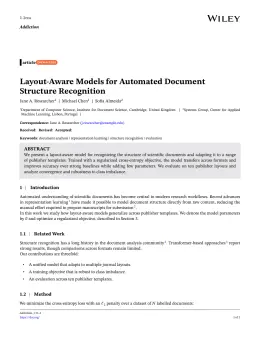
Canadian Geographies / Géographies canadiennes template — frequently asked questions
How do I write a paper in the Canadian Geographies / Géographies canadiennes format?
In DocuGuru you write your manuscript in a normal editor — no LaTeX setup required — and select the Canadian Geographies / Géographies canadiennes template. When you export, DocuGuru compiles the paper into the official Wiley format and hands you a submission-ready PDF along with the editable LaTeX source.
What reference style does Canadian Geographies / Géographies canadiennes use?
Canadian Geographies / Géographies canadiennes uses Author–year (Chicago) references, shown as author–year markers such as (Smith, 2023) in the text. DocuGuru formats every in-text citation and the reference list in this exact style automatically. A reference appears like this: Smith, Ada, Ben Jones, and Cara Lee. 2023. "A Representative Article Title." Canadian Geographies / Géographies canadiennes 12 (3): 45–58.
Do I need to know LaTeX to submit to Canadian Geographies / Géographies canadiennes?
No. DocuGuru generates the USG LaTeX class and compiles the PDF for you in the background, so you get a Wiley-ready Canadian Geographies / Géographies canadiennes document without writing any LaTeX. If you do want it, the LaTeX source is included in the export.
Can I import an existing draft into the Canadian Geographies / Géographies canadiennes template?
Yes. Paste or upload your current manuscript — Word, LaTeX, Markdown, or plain text — and DocuGuru reflows it into the Canadian Geographies / Géographies canadiennes format with correct headings, figures, tables, and author–year citations.
Who publishes Canadian Geographies / Géographies canadiennes?
Canadian Geographies / Géographies canadiennes is a multidisciplinary journal published by Wiley. DocuGuru's Canadian Geographies / Géographies canadiennes template matches Wiley's official submission format.
Can I export a submission-ready Canadian Geographies / Géographies canadiennes PDF?
Yes — DocuGuru produces a PDF built with the official Canadian Geographies / Géographies canadiennes template (the USG class) that is ready to submit to Wiley, together with the matching LaTeX source files.
How much does the Canadian Geographies / Géographies canadiennes template cost?
You can start writing in the Canadian Geographies / Géographies canadiennes template for free. Exporting the final submission-ready Canadian Geographies / Géographies canadiennes PDF and LaTeX source is part of DocuGuru's paid plans — see the app for current pricing.