Wiley

British Journal of Pharmacology Template

Write in a clean editor, then format for British Journal of Pharmacology in one click — DocuGuru applies the official Wiley template with author–year references and exports a submission-ready PDF plus the editable LaTeX source. Free to start.

About the British Journal of Pharmacology format

British Journal of Pharmacology is a peer-reviewed journal published by Wiley, covering Receptor Mechanisms and Signaling, Ion channel regulation and function, Neuroscience and Neuropharmacology Research.

PublisherWiley
Reference styleAuthor–year (Chicago)
Author–year — (Smith, 2023) in the text
Smith, Ada, Ben Jones, and Cara Lee. 2023. "A Representative Article Title." British Journal of Pharmacology 12 (3): 45–58.

Formats any DOI in British Journal of Pharmacology style. No sign-up.

Publishes research inReceptor Mechanisms and Signaling Ion channel regulation and function Neuroscience and Neuropharmacology Research Nitric Oxide and Endothelin Effects Neuropeptides and Animal Physiology
ISSN0007-1188
Citation impact (2-yr)4.5
h-index317
i10-index19,935
Total citations1,229,122
Article processing charge$4,330
Top institutions publishing hereUniversity College London
Journal websitebpspubs.onlinelibrary.wiley.com
You getA submission-ready PDF and the editable LaTeX source — ready to submit.

Papers published in British Journal of Pharmacology per year

525
2014
384
2015
314
2016
462
2017
358
2018
425
2019
424
2020
461
2021
265
2022
313
2023
343
2024
403
2025

Citation impact of British Journal of Pharmacology by publication year

25.2K
2014
24.5K
2015
20K
2016
25.6K
2017
18.5K
2018
20.3K
2019
16.5K
2020
14.2K
2021
5.4K
2022
5.7K
2023
2.7K
2024
1.5K
2025

Citations each year’s papers have accumulated so far — the most recent years are still building up.

Most-cited papers in British Journal of Pharmacology

Animal research: Reporting <i>in vivo</i> experiments: The ARRIVE guidelines

Carol Kilkenny, William J. Browne, Innes C. Cuthill et al. · 6 Jul 2010

The NC3Rs gratefully acknowledges the expertise and advice that all the contributors have given to developing the guidelines. We would particularly like to acknowledge the contribution of the NC3Rs Reporting Guidelines Working Group-– Professor Doug Altman, Centre for Statistics in Medicine, University of Oxford UK, Professor David Balding, Department of Epidemiology & Public Health, Imperial…

3,635 citations Cite SaveGo to paper →
Principles of early drug discovery

J. P. HUGHES, S. Rees, S. Barret Kalindjian et al. · 22 Nov 2010

Developing a new drug from original idea to the launch of a finished product is a complex process which can take 12-15 years and cost in excess of $1 billion. The idea for a target can come from a variety of sources including academic and clinical research and from the commercial sector. It may take…

2,835 citations Cite SaveGo to paper →
Measuring reactive species and oxidative damage<i>in vivo</i>and in cell culture: how should you do it and what do the results mean?

Barry Halliwell, Matthew Whiteman · 1 May 2004

Free radicals and other reactive species (RS) are thought to play an important role in many human diseases. Establishing their precise role requires the ability to measure them and the oxidative damage that they cause. This article first reviews what is meant by the terms free radical, RS, antioxidant, oxidative damage and oxidative stress. It…

2,221 citations Cite SaveGo to paper →
Microglial <scp>M1/M2</scp> polarization and metabolic states

Rubén Orihuela, Christopher A. McPherson, G. Jean Harry · 20 Mar 2015

Microglia are critical nervous system-specific immune cells serving as tissue-resident macrophages influencing brain development, maintenance of the neural environment, response to injury and repair. As influenced by their environment, microglia assume a diversity of phenotypes and retain the capability to shift functions to maintain tissue homeostasis. In comparison with peripheral macrophages, microglia demonstrate similar and…

2,077 citations Cite SaveGo to paper →
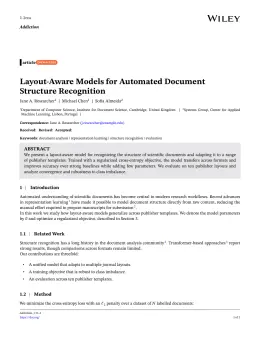
Guide to Receptors and Channels (GRAC), 5th edition

SPH Alexander, Alistair Mathie, JA Peters · 1 Nov 2011

The Fifth Edition of the 'Guide to Receptors and Channels' is a compilation of the major pharmacological targets divided into seven sections: G protein-coupled receptors, ligand-gated ion channels, ion channels, catalytic receptors, nuclear receptors, transporters and enzymes. These are presented with nomenclature guidance and summary information on the best available pharmacological tools, alongside suggestions for…

1,942 citations Cite SaveGo to paper →

British Journal of Pharmacology template — frequently asked questions

How do I write a paper in the British Journal of Pharmacology format?
In DocuGuru you write your manuscript in a normal editor — no LaTeX setup required — and select the British Journal of Pharmacology template. When you export, DocuGuru compiles the paper into the official Wiley format and hands you a submission-ready PDF along with the editable LaTeX source.
What reference style does British Journal of Pharmacology use?
British Journal of Pharmacology uses Author–year (Chicago) references, shown as author–year markers such as (Smith, 2023) in the text. DocuGuru formats every in-text citation and the reference list in this exact style automatically. A reference appears like this: Smith, Ada, Ben Jones, and Cara Lee. 2023. "A Representative Article Title." British Journal of Pharmacology 12 (3): 45–58.
Do I need to know LaTeX to submit to British Journal of Pharmacology?
No. DocuGuru generates the USG LaTeX class and compiles the PDF for you in the background, so you get a Wiley-ready British Journal of Pharmacology document without writing any LaTeX. If you do want it, the LaTeX source is included in the export.
Can I import an existing draft into the British Journal of Pharmacology template?
Yes. Paste or upload your current manuscript — Word, LaTeX, Markdown, or plain text — and DocuGuru reflows it into the British Journal of Pharmacology format with correct headings, figures, tables, and author–year citations.
Who publishes British Journal of Pharmacology?
British Journal of Pharmacology is a multidisciplinary journal published by Wiley. DocuGuru's British Journal of Pharmacology template matches Wiley's official submission format.
Can I export a submission-ready British Journal of Pharmacology PDF?
Yes — DocuGuru produces a PDF built with the official British Journal of Pharmacology template (the USG class) that is ready to submit to Wiley, together with the matching LaTeX source files.
How much does the British Journal of Pharmacology template cost?
You can start writing in the British Journal of Pharmacology template for free. Exporting the final submission-ready British Journal of Pharmacology PDF and LaTeX source is part of DocuGuru's paid plans — see the app for current pricing.
Use the British Journal of Pharmacology template