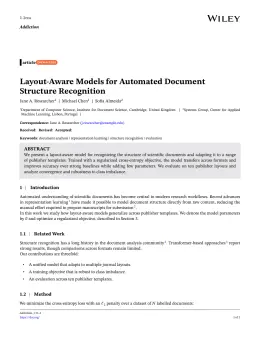
About the Australian Alcohol/Drug Review format
Australian Alcohol/Drug Review is a peer-reviewed journal published by Wiley, covering Substance Abuse Treatment and Outcomes, Alcohol Consumption and Health Effects, Alcoholism and Thiamine Deficiency.
| Publisher | Wiley |
|---|
| Reference style | Author–year (Chicago) Author–year — (Smith, 2023) in the text
Smith, Ada, Ben Jones, and Cara Lee. 2023. "A Representative Article Title." Australian Alcohol/Drug Review 12 (3): 45–58.
Formats any DOI in Australian Alcohol/Drug Review style. No sign-up.
|
|---|
| Publishes research in | Substance Abuse Treatment and Outcomes Alcohol Consumption and Health Effects Alcoholism and Thiamine Deficiency Pharmaceutical Practices and Patient Outcomes Opioid Use Disorder Treatment |
|---|
| ISSN | 0726-4550 |
|---|
| h-index | 9 |
|---|
| i10-index | 9 |
|---|
| Total citations | 414 |
|---|
| Top institutions publishing here | Alcohol and Drug Foundation |
|---|
| You get | A submission-ready PDF and the editable LaTeX source — ready to submit. |
|---|
Papers published in Australian Alcohol/Drug Review per year
Citation impact of Australian Alcohol/Drug Review by publication year
Citations each year’s papers have accumulated so far — the most recent years are still building up.
Most-cited papers in Australian Alcohol/Drug Review
Drugs and the Media
Philip Bell · 1 Jul 1985
Abstract: “Drugs” are extremely newsworthy: each year they are the subject of literally thousands of items produced by the Australian media. Most of these items are repetitious, stereotypical and narrowly focused on crime, deviance and rectification. Illegal drug consumption by individuals and the efforts of medical and social welfare professionals to eradicate the “problem” so…
PRINCIPLES OF ADULT EDUCATION
W. E. Fabb · 1 Jan 1984
Abstract In working with adult learners, the application of some well established principles will enhance the potential for learning. Adult learners work best in a non‐threatening atmosphere where they enjoy a good relationship with their teachers; they need opportunities to assess themselves against a standard, and having done so, prefer to select their own learning…
ALCOHOL CONTROL POLICIES
Alex Wodak, S.P.H. de Burgh · 1 Jul 1983
EFFECTIVENESS OF RESTRICTIONS ON AVAILABILITY AS A MEANS OF REDUCING THE USE AND ABUSE OF ALCOHOL#
D I Smith · 1 Jul 1983
Abstract The effect of changes in the legal minimum drinking age, hours of sale of alcoholic beverages and number and type of liquor outlets on variables for the use and abuse of alcohol are reviewed. Implications for research and preventive education of the conclusions drawn are briefly discussed.
NOMENCLATURE AND CLASSIFICATION OF DRUG‐ AND ALCOHOL‐RELATED PROBLEMS‘ A SHORTENED VERSION OF A WHO MEMORANDUM*
1 Jul 1984