Wiley

Aquatic Conservation Marine and Freshwater Ecosystems Template

Write in a clean editor, then format for Aquatic Conservation Marine and Freshwater Ecosystems in one click — DocuGuru applies the official Wiley template with author–year references and exports a submission-ready PDF plus the editable LaTeX source. Free to start.

About the Aquatic Conservation Marine and Freshwater Ecosystems format

Aquatic Conservation Marine and Freshwater Ecosystems is a peer-reviewed journal published by Wiley, covering Fish Ecology and Management Studies, Marine and fisheries research, Coral and Marine Ecosystems Studies.

PublisherWiley
Reference styleAuthor–year (Chicago)
Author–year — (Smith, 2023) in the text
Smith, Ada, Ben Jones, and Cara Lee. 2023. "A Representative Article Title." Aquatic Conservation Marine and Freshwater Ecosystems 12 (3): 45–58.

Formats any DOI in Aquatic Conservation Marine and Freshwater Ecosystems style. No sign-up.

Publishes research inFish Ecology and Management Studies Marine and fisheries research Coral and Marine Ecosystems Studies Marine animal studies overview Aquatic Invertebrate Ecology and Behavior
ISSN1052-7613
Citation impact (2-yr)1.99
h-index113
i10-index2,109
Total citations94,970
Article processing charge$4,840
Top institutions publishing hereCentre National de la Recherche Scientifique
Journal websiteonlinelibrary.wiley.com
You getA submission-ready PDF and the editable LaTeX source — ready to submit.

Papers published in Aquatic Conservation Marine and Freshwater Ecosystems per year

126
2014
76
2015
120
2016
147
2017
129
2018
278
2019
251
2020
282
2021
161
2022
156
2023
240
2024
281
2025

Citation impact of Aquatic Conservation Marine and Freshwater Ecosystems by publication year

4.8K
2014
1.9K
2015
4.8K
2016
3.8K
2017
2.9K
2018
5.4K
2019
4.3K
2020
3.8K
2021
1.4K
2022
1K
2023
892
2024
348
2025

Citations each year’s papers have accumulated so far — the most recent years are still building up.

Most-cited papers in Aquatic Conservation Marine and Freshwater Ecosystems

You can swim but you can't hide: the global status and conservation of oceanic pelagic sharks and rays

Nicholas K. Dulvy, Julia K. Baum, Shelley Clarke et al. · 22 May 2008

1. Fishing spans all oceans and the impact on ocean predators such as sharks and rays is largely unknown. A lack of data and complicated jurisdictional issues present particular challenges for assessing and conserving high seas biodiversity. It is clear, however, that pelagic sharks and rays of the open ocean are subject to high and…

Environmental effects of marine fishing

Paul K. Dayton, Simon F. Thrush, M. Tundi Agardy et al. · 1 Sep 1995

Abstract Some effects of fisheries on the associated biological systems are reviewed and management options and their inherent risks are considered. In addition to the effects on target species, other sensitive groups impacted by fishing are considered including marine mammals, turtles, sea birds, elasmobranchs and some invertebrates with low reproductive rates. Other impacts discussed include…

Brazilian wetlands: their definition, delineation, and classification for research, sustainable management, and protection

Wolfgang J. Junk, María Teresa Fernández Piedade, Reinaldo Lourival et al. · 15 Aug 2013

ABSTRACT Although 20% of Brazilian territory is covered by wetlands, wetland inventories are still incomplete. In 1993, Brazil signed the Ramsar Convention but a coherent national policy for the sustainable management and protection of wetlands has yet to be established. Major gaps in the definition of a specific wetland policy are twofold: (1) the lack…

Fish conservation in freshwater and marine realms: status, threats and management

Angela H. Arthington, Nicholas K. Dulvy, William Ewart Gladstone et al. · 1 Sep 2016

Abstract Despite the disparities in size and volume of marine and freshwater realms, a strikingly similar number of species is found in each – with 15 150 Actinopterygian fishes in fresh water and 14 740 in the marine realm. Their ecological and societal values are widely recognized yet many marine and freshwater fishes increasingly risk…

The effects of introduced tilapias on native biodiversity

Gabrielle Canonico, Angela H. Arthington, Jeffrey K. McCrary et al. · 1 Sep 2005

Abstract The common name ‘tilapia’ refers to a group of tropical freshwater fish in the family Cichlidae ( Oreochromis, Tilapia , and Sarotherodon spp.) that are indigenous to Africa and the southwestern Middle East. Since the 1930s, tilapias have been intentionally dispersed worldwide for the biological control of aquatic weeds and insects, as baitfish for…

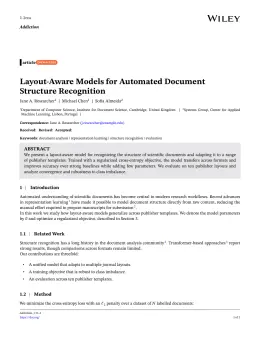
Aquatic Conservation Marine and Freshwater Ecosystems template — frequently asked questions

How do I write a paper in the Aquatic Conservation Marine and Freshwater Ecosystems format?
In DocuGuru you write your manuscript in a normal editor — no LaTeX setup required — and select the Aquatic Conservation Marine and Freshwater Ecosystems template. When you export, DocuGuru compiles the paper into the official Wiley format and hands you a submission-ready PDF along with the editable LaTeX source.
What reference style does Aquatic Conservation Marine and Freshwater Ecosystems use?
Aquatic Conservation Marine and Freshwater Ecosystems uses Author–year (Chicago) references, shown as author–year markers such as (Smith, 2023) in the text. DocuGuru formats every in-text citation and the reference list in this exact style automatically. A reference appears like this: Smith, Ada, Ben Jones, and Cara Lee. 2023. "A Representative Article Title." Aquatic Conservation Marine and Freshwater Ecosystems 12 (3): 45–58.
Do I need to know LaTeX to submit to Aquatic Conservation Marine and Freshwater Ecosystems?
No. DocuGuru generates the USG LaTeX class and compiles the PDF for you in the background, so you get a Wiley-ready Aquatic Conservation Marine and Freshwater Ecosystems document without writing any LaTeX. If you do want it, the LaTeX source is included in the export.
Can I import an existing draft into the Aquatic Conservation Marine and Freshwater Ecosystems template?
Yes. Paste or upload your current manuscript — Word, LaTeX, Markdown, or plain text — and DocuGuru reflows it into the Aquatic Conservation Marine and Freshwater Ecosystems format with correct headings, figures, tables, and author–year citations.
Who publishes Aquatic Conservation Marine and Freshwater Ecosystems?
Aquatic Conservation Marine and Freshwater Ecosystems is a multidisciplinary journal published by Wiley. DocuGuru's Aquatic Conservation Marine and Freshwater Ecosystems template matches Wiley's official submission format.
Can I export a submission-ready Aquatic Conservation Marine and Freshwater Ecosystems PDF?
Yes — DocuGuru produces a PDF built with the official Aquatic Conservation Marine and Freshwater Ecosystems template (the USG class) that is ready to submit to Wiley, together with the matching LaTeX source files.
How much does the Aquatic Conservation Marine and Freshwater Ecosystems template cost?
You can start writing in the Aquatic Conservation Marine and Freshwater Ecosystems template for free. Exporting the final submission-ready Aquatic Conservation Marine and Freshwater Ecosystems PDF and LaTeX source is part of DocuGuru's paid plans — see the app for current pricing.
Use the Aquatic Conservation Marine and Freshwater Ecosystems template