Wiley

Analytical Science Advances Template

Write in a clean editor, then format for Analytical Science Advances in one click — DocuGuru applies the official Wiley template with author–year references and exports a submission-ready PDF plus the editable LaTeX source. Free to start.

About the Analytical Science Advances format

Analytical Science Advances is a peer-reviewed journal published by Wiley, covering Metabolomics and Mass Spectrometry Studies, Mass Spectrometry Techniques and Applications, Analytical Chemistry and Chromatography.

PublisherWiley
Reference styleAuthor–year (Chicago)
Author–year — (Smith, 2023) in the text
Smith, Ada, Ben Jones, and Cara Lee. 2023. "A Representative Article Title." Analytical Science Advances 12 (3): 45–58.

Formats any DOI in Analytical Science Advances style. No sign-up.

Publishes research inMetabolomics and Mass Spectrometry Studies Mass Spectrometry Techniques and Applications Analytical Chemistry and Chromatography Analytical chemistry methods development Spectroscopy and Chemometric Analyses
ISSN2628-5452
Citation impact (2-yr)3.76
h-index25
i10-index84
Total citations2,832
Open accessYes
Top institutions publishing hereTabriz University of Medical Sciences
Journal websitechemistry-europe.onlinelibrary.wiley.com
You getA submission-ready PDF and the editable LaTeX source — ready to submit.

Papers published in Analytical Science Advances per year

1
1996
56
2020
53
2021
39
2022
38
2023
31
2024
63
2025

Citation impact of Analytical Science Advances by publication year

0
1996
517
2020
896
2021
461
2022
437
2023
197
2024
207
2025

Citations each year’s papers have accumulated so far — the most recent years are still building up.

Most-cited papers in Analytical Science Advances

Trends in artificial intelligence, machine learning, and chemometrics applied to chemical data

Rola Houhou, Thomas Bocklitz · 2 Feb 2021

Artificial intelligence-based methods such as chemometrics, machine learning, and deep learning are promising tools that lead to a clearer and better understanding of data. Only with these tools, data can be used to its full extent, and the gained knowledge on processes, interactions, and characteristics of the sample is maximized. Therefore, scientists are developing data…

Cross‐validated permutation feature importance considering correlation between features

Hiromasa Kaneko · 7 Sep 2022

In molecular design, material design, process design, and process control, it is important not only to construct a model with high predictive ability between explanatory features x and objective features y using a dataset but also to interpret the constructed model. An index of feature importance in x is permutation feature importance (PFI), which can…

Applications of surface‐enhanced Raman spectroscopy in environmental detection

Lynn R. Terry, Sage Sanders, Rebecca H. Potoff et al. · 23 Mar 2022

As the human population grows, the anthropogenic impacts from various agricultural and industrial processes produce unwanted contaminants in the environment. The accurate, sensitive and rapid detection of such contaminants is vital for human health and safety. Surface-enhanced Raman spectroscopy (SERS) is a valuable analytical tool with wide applications in environmental contaminant monitoring. The aim of…

Blood microsampling technologies: Innovations and applications in 2022

M. Thangavelu, Bert Wouters, Alida Kindt et al. · 18 May 2023

With the development of highly sensitive bioanalytical techniques, the volume of samples necessary for accurate analysis has reduced. Microsampling, the process of obtaining small amounts of blood, has thus gained popularity as it offers minimal-invasiveness, reduced logistical costs and biohazard risks while simultaneously showing increased sample stability and a potential for the decentralization of the…

The rise of single‐cell proteomics

Claudia Ctortecka, Karl Mechtler · 1 Feb 2021

Mass spectrometry-based proteomics comprehensively defines proteome expression patterns in thousands of cells majorly contributing to our current understanding of many biological processes. More recently, single-cell transcriptome and genome studies, however, have demonstrated overwhelming heterogeneity of tissues and cellular subpopulations. These studies have indicated different cellular functionality and identity, which are mainly driven by proteins and…

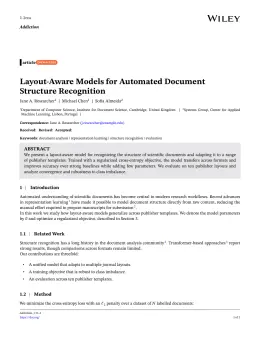
Analytical Science Advances template — frequently asked questions

How do I write a paper in the Analytical Science Advances format?
In DocuGuru you write your manuscript in a normal editor — no LaTeX setup required — and select the Analytical Science Advances template. When you export, DocuGuru compiles the paper into the official Wiley format and hands you a submission-ready PDF along with the editable LaTeX source.
What reference style does Analytical Science Advances use?
Analytical Science Advances uses Author–year (Chicago) references, shown as author–year markers such as (Smith, 2023) in the text. DocuGuru formats every in-text citation and the reference list in this exact style automatically. A reference appears like this: Smith, Ada, Ben Jones, and Cara Lee. 2023. "A Representative Article Title." Analytical Science Advances 12 (3): 45–58.
Do I need to know LaTeX to submit to Analytical Science Advances?
No. DocuGuru generates the USG LaTeX class and compiles the PDF for you in the background, so you get a Wiley-ready Analytical Science Advances document without writing any LaTeX. If you do want it, the LaTeX source is included in the export.
Can I import an existing draft into the Analytical Science Advances template?
Yes. Paste or upload your current manuscript — Word, LaTeX, Markdown, or plain text — and DocuGuru reflows it into the Analytical Science Advances format with correct headings, figures, tables, and author–year citations.
Who publishes Analytical Science Advances?
Analytical Science Advances is a multidisciplinary journal published by Wiley. DocuGuru's Analytical Science Advances template matches Wiley's official submission format.
Can I export a submission-ready Analytical Science Advances PDF?
Yes — DocuGuru produces a PDF built with the official Analytical Science Advances template (the USG class) that is ready to submit to Wiley, together with the matching LaTeX source files.
How much does the Analytical Science Advances template cost?
You can start writing in the Analytical Science Advances template for free. Exporting the final submission-ready Analytical Science Advances PDF and LaTeX source is part of DocuGuru's paid plans — see the app for current pricing.
Use the Analytical Science Advances template