Taylor & Francis

Synthetic Communications Template

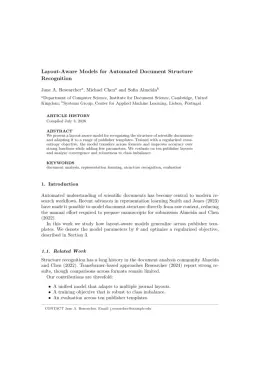
Write in a clean editor, then format for Synthetic Communications in one click — DocuGuru applies the official Taylor & Francis template with author–year references and exports a submission-ready PDF plus the editable LaTeX source. Free to start.

About the Synthetic Communications format

Synthetic Communications is a peer-reviewed journal published by Taylor & Francis, covering Chemical Synthesis and Reactions, Chemical Synthesis and Analysis, Multicomponent Synthesis of Heterocycles.

PublisherTaylor & Francis
Reference styleAuthor–year (Chicago, T&F)
Author–year — (Smith, 2023) in the text
Smith, Ada, Ben Jones, and Cara Lee. 2023. "A Representative Article Title." Synthetic Communications 12 (3): 45–58.

Formats any DOI in Synthetic Communications style. No sign-up.

Publishes research inChemical Synthesis and Reactions Chemical Synthesis and Analysis Multicomponent Synthesis of Heterocycles Asymmetric Synthesis and Catalysis Synthesis and biological activity
ISSN0039-7911
Citation impact (2-yr)2.65
h-index91
i10-index8,442
Total citations233,607
Top institutions publishing hereCentre National de la Recherche Scientifique
Journal websitewww.tandfonline.com
You getA submission-ready PDF and the editable LaTeX source — ready to submit.

Papers published in Synthetic Communications per year

309
2014
204
2015
255
2016
226
2017
268
2018
320
2019
317
2020
230
2021
181
2022
162
2023
146
2024
115
2025

Citation impact of Synthetic Communications by publication year

5.2K
2014
2.1K
2015
3.4K
2016
2.6K
2017
4K
2018
4.3K
2019
3.9K
2020
2K
2021
1.2K
2022
824
2023
587
2024
213
2025

Citations each year’s papers have accumulated so far — the most recent years are still building up.

Most-cited papers in Synthetic Communications

The Palladium-Catalyzed Cross-Coupling Reaction of Phenylboronic Acid with Haloarenes in the Presence of Bases

Norio Miyaura, Teiji Yanagi, Atsushi Suzuki · 1 Jan 1981

Abstract The transition metal-catalyzed reactions of organometallics with organic halides have been extensively studied to prove a new approach to selective formation of carbon-carbon bonds. Recently, such coupling reactions of haloarenes with aryl magnesium1–3 and zinc4 compounds in the presence of palladium or nickel complexes have been reported for the synthesis of biaryls. Davidson and…

1,864 citations Cite SaveGo to paper →
Recent Advances in the Synthesis of Coumarin Derivatives via Knoevenagel Condensation: A Review

Rajesh H. Vekariya, Hitesh D. Patel · 8 Aug 2014

Abstract The synthesis of coumarins through Knoevenagel condensation is one of the most important processes in synthetic organic chemistry and medicinal chemistry. Compounds including a coumarin (2-oxo-2H-1-benzopyran) backbone have a wide range of application in the pharmaceutical field. Thus, many methodologies have been developed for the synthesis of this important class of compounds. However, some…

Review of synthesis and various biological activities of spiro heterocyclic compounds comprising oxindole and pyrrolidine moities

Pankaj Saraswat, G. Jeyabalan, Mohd. Zaheen Hassan et al. · 18 Jul 2016

Spirocyclic compounds isolated from plant and animal origins have important applications in medicinal chemistry. Spiro compounds having cyclic structures fused at a central carbon are of recent interest because of their interesting conformational features and their structural implications for biological systems. Spiro heterocycles like spiropyrrolidines and oxindole moieties have been found to play fundamental roles…

Synthetic Communications template — frequently asked questions

How do I write a paper in the Synthetic Communications format?
In DocuGuru you write your manuscript in a normal editor — no LaTeX setup required — and select the Synthetic Communications template. When you export, DocuGuru compiles the paper into the official Taylor & Francis format and hands you a submission-ready PDF along with the editable LaTeX source.
What reference style does Synthetic Communications use?
Synthetic Communications uses Author–year (Chicago, T&F) references, shown as author–year markers such as (Smith, 2023) in the text. DocuGuru formats every in-text citation and the reference list in this exact style automatically. A reference appears like this: Smith, Ada, Ben Jones, and Cara Lee. 2023. "A Representative Article Title." Synthetic Communications 12 (3): 45–58.
Do I need to know LaTeX to submit to Synthetic Communications?
No. DocuGuru generates the interact LaTeX class and compiles the PDF for you in the background, so you get a Taylor & Francis-ready Synthetic Communications document without writing any LaTeX. If you do want it, the LaTeX source is included in the export.
Can I import an existing draft into the Synthetic Communications template?
Yes. Paste or upload your current manuscript — Word, LaTeX, Markdown, or plain text — and DocuGuru reflows it into the Synthetic Communications format with correct headings, figures, tables, and author–year citations.
Who publishes Synthetic Communications?
Synthetic Communications is a multidisciplinary journal published by Taylor & Francis. DocuGuru's Synthetic Communications template matches Taylor & Francis's official submission format.
Can I export a submission-ready Synthetic Communications PDF?
Yes — DocuGuru produces a PDF built with the official Synthetic Communications template (the interact class) that is ready to submit to Taylor & Francis, together with the matching LaTeX source files.
How much does the Synthetic Communications template cost?
You can start writing in the Synthetic Communications template for free. Exporting the final submission-ready Synthetic Communications PDF and LaTeX source is part of DocuGuru's paid plans — see the app for current pricing.

Use the Synthetic Communications template