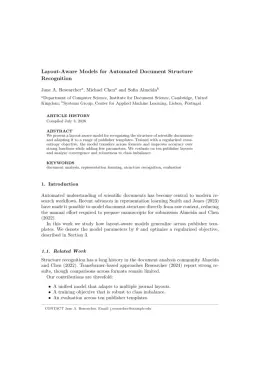
About the Psychology Crime and Law format
Psychology Crime and Law is a peer-reviewed journal published by Taylor & Francis, covering Psychopathy, Forensic Psychiatry, Sexual Offending, Deception detection and forensic psychology, Criminal Justice and Corrections Analysis.
| Publisher | Taylor & Francis |
|---|
| Reference style | Author–year (Chicago, T&F) Author–year — (Smith, 2023) in the text
Smith, Ada, Ben Jones, and Cara Lee. 2023. "A Representative Article Title." Psychology Crime and Law 12 (3): 45–58.
Formats any DOI in Psychology Crime and Law style. No sign-up.
|
|---|
| Publishes research in | Psychopathy, Forensic Psychiatry, Sexual Offending Deception detection and forensic psychology Criminal Justice and Corrections Analysis Crime Patterns and Interventions Memory Processes and Influences |
|---|
| ISSN | 1068-316X |
|---|
| Citation impact (2-yr) | 1.4 |
|---|
| h-index | 86 |
|---|
| i10-index | 900 |
|---|
| Total citations | 41,988 |
|---|
| Top institutions publishing here | University of Portsmouth |
|---|
| Journal website | www.tandfonline.com |
|---|
| You get | A submission-ready PDF and the editable LaTeX source — ready to submit. |
|---|
Papers published in Psychology Crime and Law per year
Citation impact of Psychology Crime and Law by publication year
Citations each year’s papers have accumulated so far — the most recent years are still building up.
Most-cited papers in Psychology Crime and Law
The good lives model and conceptual issues in offender rehabilitation
Tony Ward, Mark Brown · 7 Jun 2004
There has been a profound shift in attitudes toward offender rehabilitation in the last two decades from a conviction that nothing works to the confident announcement that certain kinds of treatment strategies reliably reduce reoffending rates. The treatment approach currently dominant in the corrections area is the risk–need model where dynamic risk factors associated with…
Toward a comprehensive theory of child sexual abuse: A theory knitting perspective
Tony Ward, Richard J. Siegert · 1 Dec 2002
Abstract In recent years a number of multifactorial theories of child sexual abuse have been developed. The most influential are Finkelhor's (1984) Precondition Model of child sexual abuse; Hall and Hirschman's (1992) Quadripartite Model; and Marshall and Barbaree's Integrated Theory (1990). While all three of these important theories have a number of strengths, each has…
Pygmalion in the reintegration process: Desistance from crime through the looking glass
Shadd Maruna, Thomas P. LeBel, Nick Mitchell et al. · 7 Jun 2004
Abstract The study of desistance from crime has come of age in recent years, and there are now several, competing theories to account for the ability of long-term offenders to abstain from criminal behavior. Most prominently, recent explanations have borrowed elements from informal social control theory, differential association theory and cognitive psychology. In the following,…
Criminogenic needs and human needs: A theoretical model
Tony Ward, Claire Stewart · 1 Jun 2003
Abstract Over the last two decades, empirical evidence has increasingly supported the view that it is possible to reduce reoffending rates by treating or rehabilitating offenders rather than simply punishing them. In fact, this shift from a punishment to a rehabilitation model is arguably one of the most significant events in modern correctional policy. Criminogenic…
Guilty and innocent suspects’ strategies during police interrogations
Maria Hartwig, Pär Anders Granhag, Leif A. Strömwall · 23 Aug 2006
Abstract Deception detection has largely failed to investigate guilty and innocent suspects’ strategies. In this study, mock suspects (n=82) were interrogated by police trainees (n=82) who either were or were not trained in the technique to strategically use the evidence (the SUE technique). Analyses revealed that guilty suspects to a higher degree than innocent suspects…