Taylor & Francis

Plastics Rubber and Composites Macromolecular Engineering Template

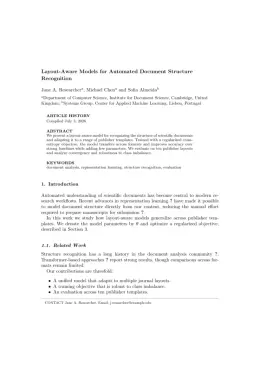
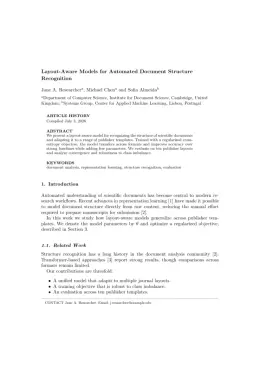
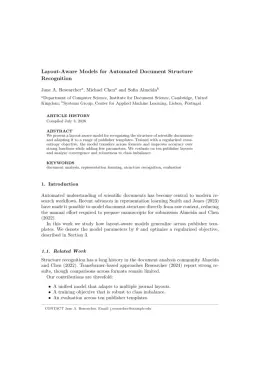
Write in a clean editor, then format for Plastics Rubber and Composites Macromolecular Engineering in one click — DocuGuru applies the official Taylor & Francis template with author–year references and exports a submission-ready PDF plus the editable LaTeX source. Free to start.

About the Plastics Rubber and Composites Macromolecular Engineering format

Plastics Rubber and Composites Macromolecular Engineering is a peer-reviewed journal published by Taylor & Francis, covering Polymer Nanocomposites and Properties, Polymer crystallization and properties, Mechanical Behavior of Composites.

PublisherTaylor & Francis
Reference styleAuthor–year (Chicago, T&F)
Author–year — (Smith, 2023) in the text
Smith, Ada, Ben Jones, and Cara Lee. 2023. "A Representative Article Title." Plastics Rubber and Composites Macromolecular Engineering 12 (3): 45–58.

Formats any DOI in Plastics Rubber and Composites Macromolecular Engineering style. No sign-up.

Publishes research inPolymer Nanocomposites and Properties Polymer crystallization and properties Mechanical Behavior of Composites Natural Fiber Reinforced Composites Epoxy Resin Curing Processes
ISSN1465-8011
Citation impact (2-yr)1.75
h-index47
i10-index641
Total citations19,805
Top institutions publishing hereSichuan University
Journal websitewww.tandfonline.com
You getA submission-ready PDF and the editable LaTeX source — ready to submit.

Papers published in Plastics Rubber and Composites Macromolecular Engineering per year

49
2014
51
2015
58
2016
65
2017
52
2018
52
2019
65
2020
67
2021
25
2022
27
2023
27
2024
30
2025

Citation impact of Plastics Rubber and Composites Macromolecular Engineering by publication year

644
2014
538
2015
741
2016
1.6K
2017
641
2018
532
2019
782
2020
778
2021
111
2022
134
2023
44
2024
76
2025

Citations each year’s papers have accumulated so far — the most recent years are still building up.

Most-cited papers in Plastics Rubber and Composites Macromolecular Engineering

A review on the characterisation of natural fibres and their composites after alkali treatment and water absorption

Chandrasekar Muthukumar, Mohamad Ridzwan Ishak, S. M. Sapuan et al. · 13 Mar 2017

Natural fibre-reinforced polymer matrix composites are gaining increased attention among the researchers due to their low density, biodegradability, abundance, good mechanical properties, etc. Significant amount of research works can be found on the material characterisation of natural fibres like hemp, flax, sisal, kenaf, coir and jute and their composites based on the polymer matrices. Natural…

Effect of the printing bed temperature on the adhesion of parts produced by fused filament fabrication

Martin Spoerk, Joamin González-Gutiérrez, Janak Sapkota et al. · 8 Nov 2017

For parts produced by fused filament fabrication (FFF) the adhesion between the first printed layer and the printing bed is crucial, since it provides the foundation to the subsequent layers. Inadequate adhesion can result in poor printing quality or destroyed bed surfaces. This study aims at understanding and optimising the adhesion process for parts produced…

Mode II fracture toughness evaluation using four point bend, end notched flexure test

Richard Martin, Barry D. Davidson · 1 Aug 1999

A four point bend, end notched flexure test is described for determining the mode II fracture toughness of laminated composites. The test consists of a unidirectional laminate with a midplane delamination loaded in four point bending. The test configuration is analysed by beam theory and by finite element analysis. When the delamination front is in…

Characterisation of carbon fibres recycled from scrap composites using fluidised bed process

H. L. H. Yip, S. Pickering, C.D. Rudd · 1 Jun 2002

A carbon fibre recycling process for scrap composites based on fluidised bed technology has been developed. This paper describes the recycling process and the characterisation methods used to analyse the quality of recycled fibre. They include: the measurement of fibre length distribution by image analysis; tensile properties by single fibre testing; and the examination of…

17th International Conference on Composite Materials

Geoff Gibson · 1 Jun 2010

A layerwise theory is used to analyze analytically displacements and stresses in functionally graded (FG) composite plates in cylindrical bending subjected to thermomechanical loadings. The plates are assumed to have isotropic, two-constituent material distribution through the thickness, and the modulus of elasticity of the plate is assumed to vary according to a power-law distribution in…

Plastics Rubber and Composites Macromolecular Engineering template — frequently asked questions

How do I write a paper in the Plastics Rubber and Composites Macromolecular Engineering format?
In DocuGuru you write your manuscript in a normal editor — no LaTeX setup required — and select the Plastics Rubber and Composites Macromolecular Engineering template. When you export, DocuGuru compiles the paper into the official Taylor & Francis format and hands you a submission-ready PDF along with the editable LaTeX source.
What reference style does Plastics Rubber and Composites Macromolecular Engineering use?
Plastics Rubber and Composites Macromolecular Engineering uses Author–year (Chicago, T&F) references, shown as author–year markers such as (Smith, 2023) in the text. DocuGuru formats every in-text citation and the reference list in this exact style automatically. A reference appears like this: Smith, Ada, Ben Jones, and Cara Lee. 2023. "A Representative Article Title." Plastics Rubber and Composites Macromolecular Engineering 12 (3): 45–58.
Do I need to know LaTeX to submit to Plastics Rubber and Composites Macromolecular Engineering?
No. DocuGuru generates the interact LaTeX class and compiles the PDF for you in the background, so you get a Taylor & Francis-ready Plastics Rubber and Composites Macromolecular Engineering document without writing any LaTeX. If you do want it, the LaTeX source is included in the export.
Can I import an existing draft into the Plastics Rubber and Composites Macromolecular Engineering template?
Yes. Paste or upload your current manuscript — Word, LaTeX, Markdown, or plain text — and DocuGuru reflows it into the Plastics Rubber and Composites Macromolecular Engineering format with correct headings, figures, tables, and author–year citations.
Who publishes Plastics Rubber and Composites Macromolecular Engineering?
Plastics Rubber and Composites Macromolecular Engineering is a multidisciplinary journal published by Taylor & Francis. DocuGuru's Plastics Rubber and Composites Macromolecular Engineering template matches Taylor & Francis's official submission format.
Can I export a submission-ready Plastics Rubber and Composites Macromolecular Engineering PDF?
Yes — DocuGuru produces a PDF built with the official Plastics Rubber and Composites Macromolecular Engineering template (the interact class) that is ready to submit to Taylor & Francis, together with the matching LaTeX source files.
How much does the Plastics Rubber and Composites Macromolecular Engineering template cost?
You can start writing in the Plastics Rubber and Composites Macromolecular Engineering template for free. Exporting the final submission-ready Plastics Rubber and Composites Macromolecular Engineering PDF and LaTeX source is part of DocuGuru's paid plans — see the app for current pricing.

Use the Plastics Rubber and Composites Macromolecular Engineering template