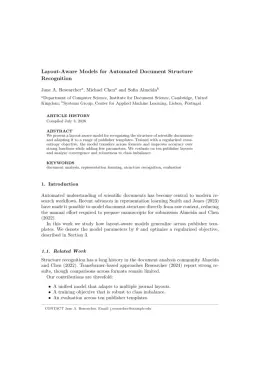
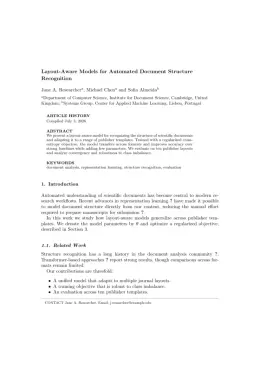
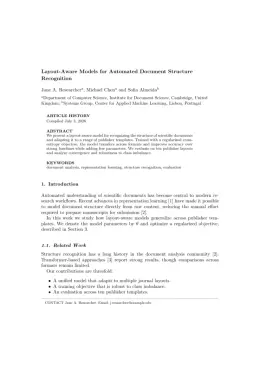
Taylor & Francis

Plant Signaling & Behavior Template

Write in a clean editor, then format for Plant Signaling & Behavior in one click — DocuGuru applies the official Taylor & Francis template with author–year references and exports a submission-ready PDF plus the editable LaTeX source. Free to start.

About the Plant Signaling & Behavior format

Plant Signaling & Behavior is a peer-reviewed journal published by Taylor & Francis, covering Plant Molecular Biology Research, Plant Stress Responses and Tolerance, Photosynthetic Processes and Mechanisms.

PublisherTaylor & Francis
Reference styleAuthor–year (Chicago, T&F)
Author–year — (Smith, 2023) in the text
Smith, Ada, Ben Jones, and Cara Lee. 2023. "A Representative Article Title." Plant Signaling & Behavior 12 (3): 45–58.

Formats any DOI in Plant Signaling & Behavior style. No sign-up.

Publishes research inPlant Molecular Biology Research Plant Stress Responses and Tolerance Photosynthetic Processes and Mechanisms Plant nutrient uptake and metabolism Plant Reproductive Biology
ISSN1559-2316
Citation impact (2-yr)4.23
h-index137
i10-index3,250
Total citations156,568
Article processing charge$2,070
Open accessYes
Top institutions publishing hereCentre National de la Recherche Scientifique
You getA submission-ready PDF and the editable LaTeX source — ready to submit.

Papers published in Plant Signaling & Behavior per year

283
2014
303
2015
214
2016
185
2017
152
2018
187
2019
210
2020
179
2021
121
2022
108
2023
104
2024
95
2025

Citation impact of Plant Signaling & Behavior by publication year

8.1K
2014
8.6K
2015
4.9K
2016
3.9K
2017
3.1K
2018
4.5K
2019
4.9K
2020
3.2K
2021
2.2K
2022
1.3K
2023
783
2024
309
2025

Citations each year’s papers have accumulated so far — the most recent years are still building up.

Most-cited papers in Plant Signaling & Behavior

Induced root-secreted phenolic compounds as a belowground plant defense

Arnaud Lanoue, Vincent Burlat, Ulrich Schurr et al. · 1 Aug 2010

Rhizosphere is the complex place of numerous interactions between plant roots, microbes and soil fauna. Whereas plant interactions with aboveground organisms are largely described, unravelling plant belowground interactions remains challenging. Plant root chemical communication can lead to positive interactions with nodulating bacteria, mycorriza or biocontrol agents or to negative interactions with pathogens or root herbivores.…

5,468 citations Cite SaveGo to paper →
Role of proline under changing environments

Shamsul Hayat, Qaiser Hayat, Mohammed Nasser Alyemeni et al. · 5 Sep 2012

When exposed to stressful conditions, plants accumulate an array of metabolites, particularly amino acids. Amino acids have traditionally been considered as precursors to and constituents of proteins, and play an important role in plant metabolism and development. A large body of data suggests a positive correlation between proline accumulation and plant stress. Proline, an amino…

2,784 citations Cite SaveGo to paper →
Influence of abiotic stress signals on secondary metabolites in plants

Akula Ramakrishna, G. A. Ravishankar · 1 Nov 2011

Plant secondary metabolites are unique sources for pharmaceuticals, food additives, flavors, and industrially important biochemicals. Accumulation of such metabolites often occurs in plants subjected to stresses including various elicitors or signal molecules. Secondary metabolites play a major role in the adaptation of plants to the environment and in overcoming stress conditions. Environmental factors viz. temperature,…

2,486 citations Cite SaveGo to paper →
Mechanisms of plant defense against insect herbivores

Abdul Rashid War, Michael Gabriel Paulraj, Tariq Ahmad et al. · 30 Sep 2012

Plants respond to herbivory through various morphological, biochemicals, and molecular mechanisms to counter/offset the effects of herbivore attack. The biochemical mechanisms of defense against the herbivores are wide-ranging, highly dynamic, and are mediated both by direct and indirect defenses. The defensive compounds are either produced constitutively or in response to plant damage, and affect feeding,…

2,115 citations Cite SaveGo to paper →
Drought stress and reactive oxygen species

Helena Cruz de Carvalho · 1 Mar 2008

As sessile organisms, plants have evolved mechanisms that allow them to adapt and survive periods of drought stress. One of the inevitable consequences of drought stress is enhanced ROS production in the different cellular compartments, namely in the chloroplasts, the peroxisomes and the mitochondria. This enhanced ROS production is however kept under tight control by…

1,505 citations Cite SaveGo to paper →

Plant Signaling & Behavior template — frequently asked questions

How do I write a paper in the Plant Signaling & Behavior format?
In DocuGuru you write your manuscript in a normal editor — no LaTeX setup required — and select the Plant Signaling & Behavior template. When you export, DocuGuru compiles the paper into the official Taylor & Francis format and hands you a submission-ready PDF along with the editable LaTeX source.
What reference style does Plant Signaling & Behavior use?
Plant Signaling & Behavior uses Author–year (Chicago, T&F) references, shown as author–year markers such as (Smith, 2023) in the text. DocuGuru formats every in-text citation and the reference list in this exact style automatically. A reference appears like this: Smith, Ada, Ben Jones, and Cara Lee. 2023. "A Representative Article Title." Plant Signaling & Behavior 12 (3): 45–58.
Do I need to know LaTeX to submit to Plant Signaling & Behavior?
No. DocuGuru generates the interact LaTeX class and compiles the PDF for you in the background, so you get a Taylor & Francis-ready Plant Signaling & Behavior document without writing any LaTeX. If you do want it, the LaTeX source is included in the export.
Can I import an existing draft into the Plant Signaling & Behavior template?
Yes. Paste or upload your current manuscript — Word, LaTeX, Markdown, or plain text — and DocuGuru reflows it into the Plant Signaling & Behavior format with correct headings, figures, tables, and author–year citations.
Who publishes Plant Signaling & Behavior?
Plant Signaling & Behavior is a multidisciplinary journal published by Taylor & Francis. DocuGuru's Plant Signaling & Behavior template matches Taylor & Francis's official submission format.
Can I export a submission-ready Plant Signaling & Behavior PDF?
Yes — DocuGuru produces a PDF built with the official Plant Signaling & Behavior template (the interact class) that is ready to submit to Taylor & Francis, together with the matching LaTeX source files.
How much does the Plant Signaling & Behavior template cost?
You can start writing in the Plant Signaling & Behavior template for free. Exporting the final submission-ready Plant Signaling & Behavior PDF and LaTeX source is part of DocuGuru's paid plans — see the app for current pricing.
Use the Plant Signaling & Behavior template