Taylor & Francis

Molecular Crystals and Liquid Crystals Template

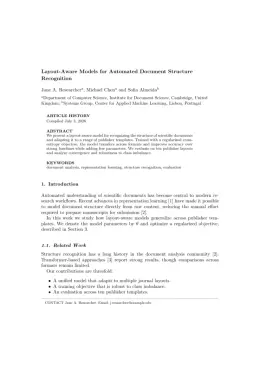
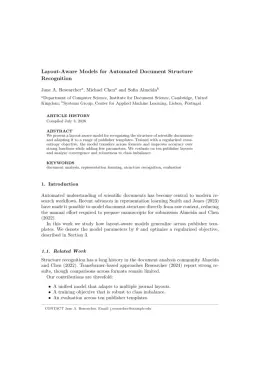
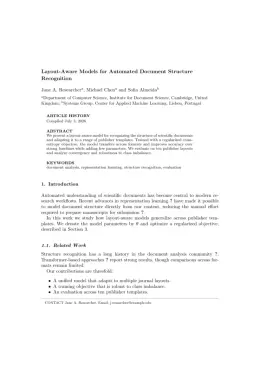
Write in a clean editor, then format for Molecular Crystals and Liquid Crystals in one click — DocuGuru applies the official Taylor & Francis template with author–year references and exports a submission-ready PDF plus the editable LaTeX source. Free to start.

About the Molecular Crystals and Liquid Crystals format

Molecular Crystals and Liquid Crystals is a peer-reviewed journal published by Taylor & Francis, covering Liquid Crystal Research Advancements, Organic Electronics and Photovoltaics, Conducting polymers and applications.

PublisherTaylor & Francis
Reference styleAuthor–year (Chicago, T&F)
Author–year — (Smith, 2023) in the text
Smith, Ada, Ben Jones, and Cara Lee. 2023. "A Representative Article Title." Molecular Crystals and Liquid Crystals 12 (3): 45–58.

Formats any DOI in Molecular Crystals and Liquid Crystals style. No sign-up.

Publishes research inLiquid Crystal Research Advancements Organic Electronics and Photovoltaics Conducting polymers and applications Organic Light-Emitting Diodes Research Molecular spectroscopy and chirality
ISSN1542-1406
Citation impact (2-yr)0.74
h-index56
i10-index1,552
Total citations53,227
Top institutions publishing hereTaras Shevchenko National University of Kyiv
Journal websitewww.tandfonline.com
You getA submission-ready PDF and the editable LaTeX source — ready to submit.

Papers published in Molecular Crystals and Liquid Crystals per year

409
2014
452
2015
415
2016
486
2017
316
2018
201
2019
216
2020
241
2021
265
2022
199
2023
149
2024
140
2025

Citation impact of Molecular Crystals and Liquid Crystals by publication year

2.1K
2014
1.9K
2015
2K
2016
2.5K
2017
2.4K
2018
972
2019
964
2020
916
2021
731
2022
369
2023
199
2024
72
2025

Citations each year’s papers have accumulated so far — the most recent years are still building up.

Most-cited papers in Molecular Crystals and Liquid Crystals

Charge Transport in Porous Silicon/Graphene-Based Nanostructures

I. B. Olenych, Liubomyr S. Monastyrskii, О. І. Aksimentyeva et al. · 22 Sep 2018

In this study hybrid structures were created by deposition of the graphene oxide and the reduced graphene oxide on the porous silicon layer. The charge transport and relaxation processes in obtained structures were analyzed on the basis of comprehensive studies of conductivity and depolarization current in the 90–325 K temperature range within the model of…

Nematic Liquid Crystals: From Maier-Saupe to a Continuum Theory

J. M. Ball, Apala Majumdar · 15 Jul 2010

We define a continuum energy functional that effectively interpolates between the mean-field Maier-Saupe energy and the continuum Landau-de Gennes energy functional and can describe both spatially homogeneous and inhomogeneous systems. In the mean-field approach the main macroscopic variable, the Q-tensor order parameter, is defined in terms of the second moment of a probability distribution function.…

Optical constants of conjugated polymer/fullerene based bulk-heterojunction organic solar cells

Harald Hoppe, Niyazi Serdar Sariçiftçi, D Meißner · 1 Jan 2002

The performance of organic solar cells consisting of multiple layers, which are a few hundred nanometers thick, is determined by strong optical interference effects. In order to model their optical and photoelectrical behavior, we determined the optical constants of all components of this system. This was done by fitting model dielectric functions to reflection and…

Facile microwave-assisted green synthesis of NiO nanoparticles from <i>Andrographis paniculata</i> leaf extract and evaluation of their photocatalytic and anticancer activities

K. Karthik, M. Shashank, V. Revathi et al. · 22 Sep 2018

In the present work, NiO nanoparticles based on Andrographis paniculata (leaf extract) were prepared through the microwave-assisted method. The obtained nanoparticles were analyzed using XRD, FTIR, SEM with EDS, HRTEM, UV-Vis and luminescence studies. XRD exhibits cubic structure with an average crystallite size of 24 nm. The vibrational stretching mode of nickel oxygen bond is…

Electrophysical properties of epoxy-based composites with graphite nanoplatelets and magnetically aligned magnetite

O. S. Yakovenko, L. Yu. Matzui, Л. Л. Вовченко et al. · 22 Jan 2018

Novel graphite nanoplatelets/magnetite (GNP/Fe3O4)/epoxy composites with aligned under external magnetic field fillers and random fillers distribution have been developed. The influence of loading content of GNP nanoparticles and viscosity of composite medium on the alignment degree of fillers and electrical conductivity, shielding properties of GNP/Fe3O4/epoxy composites were considered. The results showed that Fe3O4 addition to…

Molecular Crystals and Liquid Crystals template — frequently asked questions

How do I write a paper in the Molecular Crystals and Liquid Crystals format?
In DocuGuru you write your manuscript in a normal editor — no LaTeX setup required — and select the Molecular Crystals and Liquid Crystals template. When you export, DocuGuru compiles the paper into the official Taylor & Francis format and hands you a submission-ready PDF along with the editable LaTeX source.
What reference style does Molecular Crystals and Liquid Crystals use?
Molecular Crystals and Liquid Crystals uses Author–year (Chicago, T&F) references, shown as author–year markers such as (Smith, 2023) in the text. DocuGuru formats every in-text citation and the reference list in this exact style automatically. A reference appears like this: Smith, Ada, Ben Jones, and Cara Lee. 2023. "A Representative Article Title." Molecular Crystals and Liquid Crystals 12 (3): 45–58.
Do I need to know LaTeX to submit to Molecular Crystals and Liquid Crystals?
No. DocuGuru generates the interact LaTeX class and compiles the PDF for you in the background, so you get a Taylor & Francis-ready Molecular Crystals and Liquid Crystals document without writing any LaTeX. If you do want it, the LaTeX source is included in the export.
Can I import an existing draft into the Molecular Crystals and Liquid Crystals template?
Yes. Paste or upload your current manuscript — Word, LaTeX, Markdown, or plain text — and DocuGuru reflows it into the Molecular Crystals and Liquid Crystals format with correct headings, figures, tables, and author–year citations.
Who publishes Molecular Crystals and Liquid Crystals?
Molecular Crystals and Liquid Crystals is a multidisciplinary journal published by Taylor & Francis. DocuGuru's Molecular Crystals and Liquid Crystals template matches Taylor & Francis's official submission format.
Can I export a submission-ready Molecular Crystals and Liquid Crystals PDF?
Yes — DocuGuru produces a PDF built with the official Molecular Crystals and Liquid Crystals template (the interact class) that is ready to submit to Taylor & Francis, together with the matching LaTeX source files.
How much does the Molecular Crystals and Liquid Crystals template cost?
You can start writing in the Molecular Crystals and Liquid Crystals template for free. Exporting the final submission-ready Molecular Crystals and Liquid Crystals PDF and LaTeX source is part of DocuGuru's paid plans — see the app for current pricing.

Use the Molecular Crystals and Liquid Crystals template