Taylor & Francis

Mitochondrial DNA Template

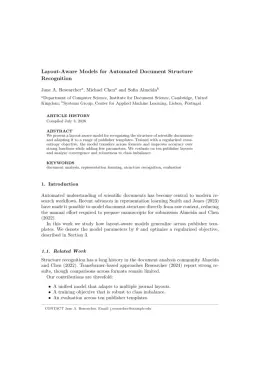
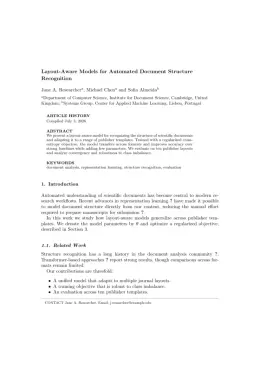
Write in a clean editor, then format for Mitochondrial DNA in one click — DocuGuru applies the official Taylor & Francis template with author–year references and exports a submission-ready PDF plus the editable LaTeX source. Free to start.

About the Mitochondrial DNA format

Mitochondrial DNA is a peer-reviewed journal published by Taylor & Francis, covering Genomics and Phylogenetic Studies, Identification and Quantification in Food, Genetic diversity and population structure.

PublisherTaylor & Francis
Reference styleAuthor–year (Chicago, T&F)
Author–year — (Smith, 2023) in the text
Smith, Ada, Ben Jones, and Cara Lee. 2023. "A Representative Article Title." Mitochondrial DNA 12 (3): 45–58.

Formats any DOI in Mitochondrial DNA style. No sign-up.

Publishes research inGenomics and Phylogenetic Studies Identification and Quantification in Food Genetic diversity and population structure Aquaculture disease management and microbiota Fish Biology and Ecology Studies
ISSN1940-1736
h-index41
i10-index449
Total citations12,782
Top institutions publishing hereChinese Academy of Fishery Sciences
Journal websitewww.informahealthcare.com
You getA submission-ready PDF and the editable LaTeX source — ready to submit.

Papers published in Mitochondrial DNA per year

1
1987
1
1992
27
2003
1
2007
26
2009
38
2010
63
2011
168
2012
449
2013
165
2014
9
2015

Citation impact of Mitochondrial DNA by publication year

1
1987
111
1992
428
2003
0
2007
323
2009
938
2010
2K
2011
2.7K
2012
4.9K
2013
1.2K
2014
78
2015

Citations each year’s papers have accumulated so far — the most recent years are still building up.

Most-cited papers in Mitochondrial DNA

FISH-BOL and seafood identification: Geographically dispersed case studies reveal systemic market substitution across Canada

Robert Hanner, Sven Becker, Natalia V. Ivanova et al. · 1 Oct 2011

BACKGROUND AND AIMS: The Fish Barcode of Life campaign involves a broad international collaboration among scientists working to advance the identification of fishes using DNA barcodes. With over 25% of the world's known ichthyofauna currently profiled, forensic identification of seafood products is now feasible and is becoming routine. MATERIALS AND METHODS: Driven by growing consumer…

Deep barcode divergence in Brazilian freshwater fishes: the case of the São Francisco River basin

Daniel C. Carvalho, D.A.A. Oliveira, Paulo dos Santos Pompeu et al. · 23 Jun 2011

BACKGROUND AND AIMS: The application of DNA barcoding as a global standard for fish identification is probing diverse worldwide realms (Nearctic, Australian and the Neotropics) and environments (e.g. marine and freshwater). Comparing the patterns of sequence divergence among conspecific and congeneric taxa between realms can provide valuable information on recent evolutionary histories of lineages as…

Five years of FISH-BOL: Brief status report

Sven Becker, Robert Hanner, Dirk Steinke · 27 Jan 2011

The Fish Barcode of Life Initiative (FISH-BOL) is a concerted global research project launched in 2005, with the goal to collect and assemble standardized DNA barcode sequences and associated voucher provenance data in a curated reference sequence library to aid the molecular identification of all fish species. This article is a detailed progress report (July…

Development of a DNA barcoding system for the Ixodida (Acari: Ixodida)

Jizhou Lv, Shaoqiang Wu, Yongning Zhang et al. · 30 Apr 2013

To control the spread of tick-borne diseases, there is an urgent need to develop a reliable technique that can distinguish different species of ticks. DNA barcoding has been proved to be a powerful tool to identify species of arthropods, but this technique has not yet been developed for identifying ticks. Here, we screened and analyzed…

Structure and physiological ecology of soil microbial communities.

F. B. Metting · 1 Jan 1992

Misgurnus bipartitus, a small sized freshwater fish species, is one of the most important cultured fish in East Asia. In this study, the complete mitochondrial genome of M. bipartitus is sequenced to be 16,636 bp in length, including 13 protein-coding genes, 2 ribosomal RNAs, 22 transfer RNAs, a control region and the origin of the…

Mitochondrial DNA template — frequently asked questions

How do I write a paper in the Mitochondrial DNA format?
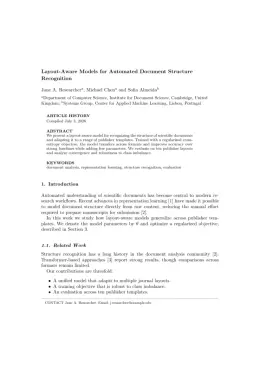
In DocuGuru you write your manuscript in a normal editor — no LaTeX setup required — and select the Mitochondrial DNA template. When you export, DocuGuru compiles the paper into the official Taylor & Francis format and hands you a submission-ready PDF along with the editable LaTeX source.
What reference style does Mitochondrial DNA use?
Mitochondrial DNA uses Author–year (Chicago, T&F) references, shown as author–year markers such as (Smith, 2023) in the text. DocuGuru formats every in-text citation and the reference list in this exact style automatically. A reference appears like this: Smith, Ada, Ben Jones, and Cara Lee. 2023. "A Representative Article Title." Mitochondrial DNA 12 (3): 45–58.
Do I need to know LaTeX to submit to Mitochondrial DNA?
No. DocuGuru generates the interact LaTeX class and compiles the PDF for you in the background, so you get a Taylor & Francis-ready Mitochondrial DNA document without writing any LaTeX. If you do want it, the LaTeX source is included in the export.
Can I import an existing draft into the Mitochondrial DNA template?
Yes. Paste or upload your current manuscript — Word, LaTeX, Markdown, or plain text — and DocuGuru reflows it into the Mitochondrial DNA format with correct headings, figures, tables, and author–year citations.
Who publishes Mitochondrial DNA?
Mitochondrial DNA is a multidisciplinary journal published by Taylor & Francis. DocuGuru's Mitochondrial DNA template matches Taylor & Francis's official submission format.
Can I export a submission-ready Mitochondrial DNA PDF?
Yes — DocuGuru produces a PDF built with the official Mitochondrial DNA template (the interact class) that is ready to submit to Taylor & Francis, together with the matching LaTeX source files.
How much does the Mitochondrial DNA template cost?
You can start writing in the Mitochondrial DNA template for free. Exporting the final submission-ready Mitochondrial DNA PDF and LaTeX source is part of DocuGuru's paid plans — see the app for current pricing.
Use the Mitochondrial DNA template