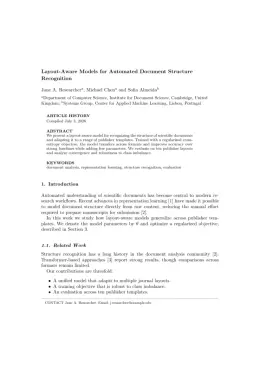
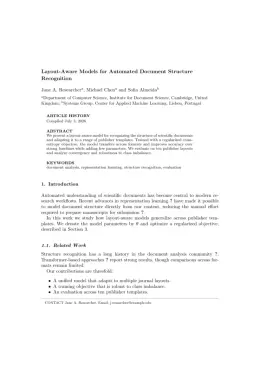
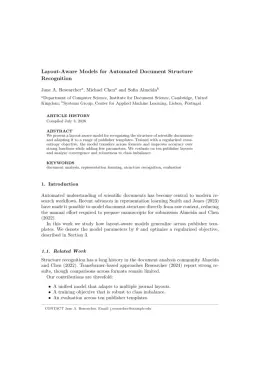
Taylor & Francis

Marine Biology Research Template

Write in a clean editor, then format for Marine Biology Research in one click — DocuGuru applies the official Taylor & Francis template with author–year references and exports a submission-ready PDF plus the editable LaTeX source. Free to start.

About the Marine Biology Research format

Marine Biology Research is a peer-reviewed journal published by Taylor & Francis, covering Marine Biology and Ecology Research, Marine and fisheries research, Coral and Marine Ecosystems Studies.

PublisherTaylor & Francis
Reference styleAuthor–year (Chicago, T&F)
Author–year — (Smith, 2023) in the text
Smith, Ada, Ben Jones, and Cara Lee. 2023. "A Representative Article Title." Marine Biology Research 12 (3): 45–58.

Formats any DOI in Marine Biology Research style. No sign-up.

Publishes research inMarine Biology and Ecology Research Marine and fisheries research Coral and Marine Ecosystems Studies Marine and coastal plant biology Marine Bivalve and Aquaculture Studies
ISSN1745-1000
Citation impact (2-yr)1
h-index60
i10-index725
Total citations24,597
Top institutions publishing hereNorwegian Institute of Marine Research
Journal websitewww.tandfonline.com
You getA submission-ready PDF and the editable LaTeX source — ready to submit.

Papers published in Marine Biology Research per year

118
2014
75
2015
108
2016
101
2017
65
2018
51
2019
57
2020
76
2021
50
2022
48
2023
44
2024
27
2025

Citation impact of Marine Biology Research by publication year

1.7K
2014
1K
2015
1.6K
2016
1.4K
2017
806
2018
564
2019
474
2020
488
2021
213
2022
170
2023
75
2024
20
2025

Citations each year’s papers have accumulated so far — the most recent years are still building up.

Most-cited papers in Marine Biology Research

Oxygen dynamics of marine sediments

Ronnie N. Glud · 1 Aug 2008

Abstract Benthic O2 availability regulates many important biogeochemical processes and has crucial implications for the biology and ecology of benthic communities. Further, the benthic O2 exchange rate represents the most widely used proxy for quantifying mineralization and primary production of marine sediments. Consequently, numerous researchers have investigated the benthic O2 dynamics in a wide range…

Polar cod (<i>Boreogadus saida</i>) and capelin (<i>Mallotus villosus</i>) as key species in marine food webs of the Arctic and the Barents Sea

Haakon Hop, Harald Gjøsæter · 14 Jun 2013

Polar cod and capelin are key species in Arctic and sub-Arctic marine food webs, respectively, and the objective of this study is to compare and contrast the two species.Their distributions are dependent on water masses, with polar cod being associated with cold, sub-zero Arctic water, whereas capelin is distributed further south into Atlantic water masses.The…

Large-scale shift from sugar kelp (<i>Saccharina latissima</i>) to ephemeral algae along the south and west coast of Norway

Frithjof E. Moy, Hartvig Christie · 16 Feb 2012

Abstract Sugar kelp forests (Saccharina latissima) normally dominate the sublittoral rocky sea bed in medium exposed to sheltered areas of the Norwegian coast. In 2002, a large-scale disappearance of sugar kelp was observed, and a survey of more than 600 sites along the coast of southern Norway (58–63°N, 6–11°E) during 2004–2009 recorded a large-scale shift…

Sea urchin grazing and kelp re-vegetation in the NE Atlantic

Kjell Magnus Norderhaug, Hartvig Christie · 16 Aug 2009

Abstract Small-scale grazing events where sea urchins have grazed kelp forests to barren grounds have been reported all along the NE Atlantic coast. One large-scale event has been reported where kelp forests along the Norwegian and Russian coast were grazed by sea urchins during the early 1970s. The barren ground area has persisted since. Different…

Marine Biology Research template — frequently asked questions

How do I write a paper in the Marine Biology Research format?
In DocuGuru you write your manuscript in a normal editor — no LaTeX setup required — and select the Marine Biology Research template. When you export, DocuGuru compiles the paper into the official Taylor & Francis format and hands you a submission-ready PDF along with the editable LaTeX source.
What reference style does Marine Biology Research use?
Marine Biology Research uses Author–year (Chicago, T&F) references, shown as author–year markers such as (Smith, 2023) in the text. DocuGuru formats every in-text citation and the reference list in this exact style automatically. A reference appears like this: Smith, Ada, Ben Jones, and Cara Lee. 2023. "A Representative Article Title." Marine Biology Research 12 (3): 45–58.
Do I need to know LaTeX to submit to Marine Biology Research?
No. DocuGuru generates the interact LaTeX class and compiles the PDF for you in the background, so you get a Taylor & Francis-ready Marine Biology Research document without writing any LaTeX. If you do want it, the LaTeX source is included in the export.
Can I import an existing draft into the Marine Biology Research template?
Yes. Paste or upload your current manuscript — Word, LaTeX, Markdown, or plain text — and DocuGuru reflows it into the Marine Biology Research format with correct headings, figures, tables, and author–year citations.
Who publishes Marine Biology Research?
Marine Biology Research is a multidisciplinary journal published by Taylor & Francis. DocuGuru's Marine Biology Research template matches Taylor & Francis's official submission format.
Can I export a submission-ready Marine Biology Research PDF?
Yes — DocuGuru produces a PDF built with the official Marine Biology Research template (the interact class) that is ready to submit to Taylor & Francis, together with the matching LaTeX source files.
How much does the Marine Biology Research template cost?
You can start writing in the Marine Biology Research template for free. Exporting the final submission-ready Marine Biology Research PDF and LaTeX source is part of DocuGuru's paid plans — see the app for current pricing.

Use the Marine Biology Research template