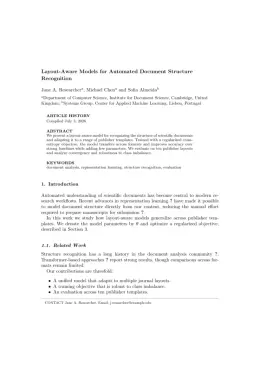
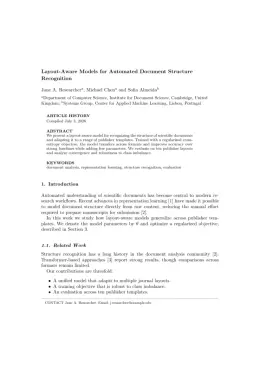
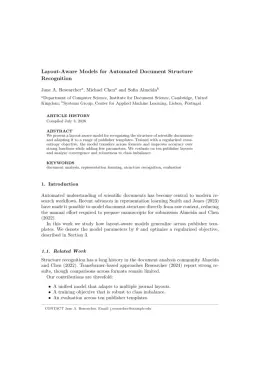
About the Intrinsically Disordered Proteins format
Intrinsically Disordered Proteins is a peer-reviewed journal published by Taylor & Francis, covering Protein Structure and Dynamics, Enzyme Structure and Function, RNA and protein synthesis mechanisms.
| Publisher | Taylor & Francis |
|---|
| Reference style | Author–year (Chicago, T&F) Author–year — (Smith, 2023) in the text
Smith, Ada, Ben Jones, and Cara Lee. 2023. "A Representative Article Title." Intrinsically Disordered Proteins 12 (3): 45–58.
Formats any DOI in Intrinsically Disordered Proteins style. No sign-up.
|
|---|
| Publishes research in | Protein Structure and Dynamics Enzyme Structure and Function RNA and protein synthesis mechanisms Alzheimer's disease research and treatments Muscle metabolism and nutrition |
|---|
| ISSN | 2169-0693 |
|---|
| h-index | 19 |
|---|
| i10-index | 36 |
|---|
| Total citations | 1,937 |
|---|
| Open access | Yes |
|---|
| Top institutions publishing here | University of South Florida |
|---|
| Journal website | www.tandfonline.com |
|---|
| You get | A submission-ready PDF and the editable LaTeX source — ready to submit. |
|---|
Papers published in Intrinsically Disordered Proteins per year
Citation impact of Intrinsically Disordered Proteins by publication year
Citations each year’s papers have accumulated so far — the most recent years are still building up.
Most-cited papers in Intrinsically Disordered Proteins
What’s in a name? Why these proteins are intrinsically disordered
A. Keith Dunker, M. Madan Babu, Elisar Barbar et al. · 1 Jan 2013
This article opens a series of publications on disambiguation of the basic terms used in the field of intrinsically disordered proteins. We start from the beginning, namely from the explanation of what the expression "intrinsically disordered protein" actually means and why this particular term has been chosen as the common denominator for this class of…
The alphabet of intrinsic disorder
François‐Xavier Theillet, Lajos Kalmár, Péter Tompa et al. · 1 Jan 2013
A significant fraction of every proteome is occupied by biologically active proteins that do not form unique three-dimensional structures. These intrinsically disordered proteins (IDPs) and IDP regions (IDPRs) have essential biological functions and are characterized by extensive structural plasticity. Such structural and functional behavior is encoded in the amino acid sequences of IDPs/IDPRs, which are…
The alphabet of intrinsic disorder
Vladimir N. Uversky · 1 Jan 2013
The ability of a protein to fold into unique functional state or to stay intrinsically disordered is encoded in its amino acid sequence. Both ordered and intrinsically disordered proteins (IDPs) are natural polypeptides that use the same arsenal of 20 proteinogenic amino acid residues as their major building blocks. The exceptional structural plasticity of IDPs,…
How disordered is my protein and what is its disorder for? A guide through the “dark side” of the protein universe
Philippe Lieutaud, François Ferrón, Alexey V. Uversky et al. · 1 Jan 2016
In the last 2 decades it has become increasingly evident that a large number of proteins are either fully or partially disordered. Intrinsically disordered proteins lack a stable 3D structure, are ubiquitous and fulfill essential biological functions. Their conformational heterogeneity is encoded in their amino acid sequences, thereby allowing intrinsically disordered proteins or regions to…
MFDp2
Marcin J. Mizianty, Zhenling Peng, Lukasz Kurgan · 1 Jan 2013
Intrinsically disordered proteins (IDPs) are either entirely disordered or contain disordered regions in their native state. IDPs were found to be abundant in complex organisms and implicated in numerous cellular processes. Experimental annotation of disorder lags behind the rapidly growing sizes of the protein databases, and thus computational methods are used to close this gap…