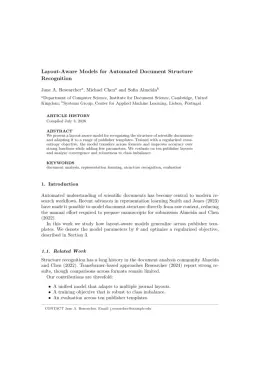
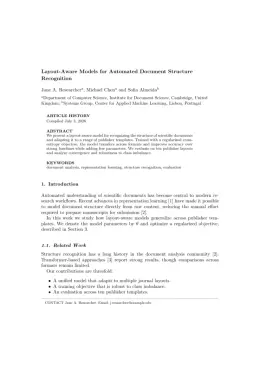
Taylor & Francis

International journal of computational fluid dynamics Template

Write in a clean editor, then format for International journal of computational fluid dynamics in one click — DocuGuru applies the official Taylor & Francis template with author–year references and exports a submission-ready PDF plus the editable LaTeX source. Free to start.

About the International journal of computational fluid dynamics format

International journal of computational fluid dynamics is a peer-reviewed journal published by Taylor & Francis, covering Computational Fluid Dynamics and Aerodynamics, Fluid Dynamics and Turbulent Flows, Advanced Numerical Methods in Computational Mathematics.

PublisherTaylor & Francis
Reference styleAuthor–year (Chicago, T&F)
Author–year — (Smith, 2023) in the text
Smith, Ada, Ben Jones, and Cara Lee. 2023. "A Representative Article Title." International journal of computational fluid dynamics 12 (3): 45–58.

Formats any DOI in International journal of computational fluid dynamics style. No sign-up.

Publishes research inComputational Fluid Dynamics and Aerodynamics Fluid Dynamics and Turbulent Flows Advanced Numerical Methods in Computational Mathematics Lattice Boltzmann Simulation Studies Fluid Dynamics and Vibration Analysis
ISSN1026-7417
Citation impact (2-yr)0.61
h-index54
i10-index521
Total citations19,314
Top institutions publishing hereChuo University
Journal websitewww.tandfonline.com
You getA submission-ready PDF and the editable LaTeX source — ready to submit.

Papers published in International journal of computational fluid dynamics per year

35
2014
32
2015
48
2016
31
2017
28
2018
40
2019
49
2020
43
2021
50
2022
40
2023
33
2024
25
2025

Citation impact of International journal of computational fluid dynamics by publication year

656
2014
414
2015
495
2016
531
2017
297
2018
437
2019
486
2020
267
2021
243
2022
108
2023
22
2024
7
2025

Citations each year’s papers have accumulated so far — the most recent years are still building up.

Most-cited papers in International journal of computational fluid dynamics

Review of the shear-stress transport turbulence model experience from an industrial perspective

Florian Menter · 1 Jan 2009

The present author was asked to provide an update on the status and the more recent developments around the shear-stress transport (SST) turbulence model for this special issue of the journal. The article is therefore not intended as a comprehensive overview of the status of engineering turbulence modelling in general, nor on the overall turbulence…

1,026 citations Cite SaveGo to paper →
High-order Finite Difference and Finite Volume WENO Schemes and Discontinuous Galerkin Methods for CFD

Chi‐Wang Shu · 1 Mar 2003

In recent years, high order numerical methods have been widely used in computational fluid dynamics (CFD), to effectively resolve complex flow features using meshes which are reasonable for today's computers. In this paper, we review and compare three types of high order methods being used in CFD, namely the weighted essentially non-oscillatory (WENO) finite difference…

ANALYSIS AND DESIGN OF NUMERICAL SCHEMES FOR GAS DYNAMICS, 1: ARTIFICIAL DIFFUSION, UPWIND BIASING, LIMITERS AND THEIR EFFECT ON ACCURACY AND MULTIGRID CONVERGENCE

A. Jameson · 1 Jan 1995

SUMMARY The theory of non-oscillatory scalar schemes is developed in this paper in terms of the local extremum diminishing (LED) principle that maxima should not increase and minima should not decrease. This principle can be used for multi-dimensional problems on both structured and unstructured meshes, while it is equivalent to the total variation diminishing (TVD)…

TeraFLOP computing on a desktop PC with GPUs for 3D CFD

Jonas Tölke, Manfred Krafczyk · 24 Jul 2008

A very efficient implementation of a lattice Boltzmann (LB) kernel in 3D on a graphical processing unit using the compute unified device architecture interface developed by nVIDIA is presented. By exploiting the explicit parallelism offered by the graphics hardware, we obtain an efficiency gain of up to two orders of magnitude with respect to the…

Analysis of lattice Boltzmann equation for microscale gas flows: Relaxation times, boundary conditions and the Knudsen layer

Zhaoli Guo, Chuguang Zheng · 24 Jul 2008

AbstractIn this work, we apply the lattice Boltzmann equation (LBE) with multiple relaxation times (MRTs) to simulate the Poiseuille flow in the slip flow regime. We analyse in detail the discrete diffusive and combined bounce-back-specular-reflection boundary conditions for the LBE, the discrete effects at the boundary, and determinations of the relaxation times for the Poiseuille…

International journal of computational fluid dynamics template — frequently asked questions

How do I write a paper in the International journal of computational fluid dynamics format?
In DocuGuru you write your manuscript in a normal editor — no LaTeX setup required — and select the International journal of computational fluid dynamics template. When you export, DocuGuru compiles the paper into the official Taylor & Francis format and hands you a submission-ready PDF along with the editable LaTeX source.
What reference style does International journal of computational fluid dynamics use?
International journal of computational fluid dynamics uses Author–year (Chicago, T&F) references, shown as author–year markers such as (Smith, 2023) in the text. DocuGuru formats every in-text citation and the reference list in this exact style automatically. A reference appears like this: Smith, Ada, Ben Jones, and Cara Lee. 2023. "A Representative Article Title." International journal of computational fluid dynamics 12 (3): 45–58.
Do I need to know LaTeX to submit to International journal of computational fluid dynamics?
No. DocuGuru generates the interact LaTeX class and compiles the PDF for you in the background, so you get a Taylor & Francis-ready International journal of computational fluid dynamics document without writing any LaTeX. If you do want it, the LaTeX source is included in the export.
Can I import an existing draft into the International journal of computational fluid dynamics template?
Yes. Paste or upload your current manuscript — Word, LaTeX, Markdown, or plain text — and DocuGuru reflows it into the International journal of computational fluid dynamics format with correct headings, figures, tables, and author–year citations.
Who publishes International journal of computational fluid dynamics?
International journal of computational fluid dynamics is a multidisciplinary journal published by Taylor & Francis. DocuGuru's International journal of computational fluid dynamics template matches Taylor & Francis's official submission format.
Can I export a submission-ready International journal of computational fluid dynamics PDF?
Yes — DocuGuru produces a PDF built with the official International journal of computational fluid dynamics template (the interact class) that is ready to submit to Taylor & Francis, together with the matching LaTeX source files.
How much does the International journal of computational fluid dynamics template cost?
You can start writing in the International journal of computational fluid dynamics template for free. Exporting the final submission-ready International journal of computational fluid dynamics PDF and LaTeX source is part of DocuGuru's paid plans — see the app for current pricing.

Use the International journal of computational fluid dynamics template