Taylor & Francis

IISE Transactions on Occupational Ergonomics and Human Factors Template

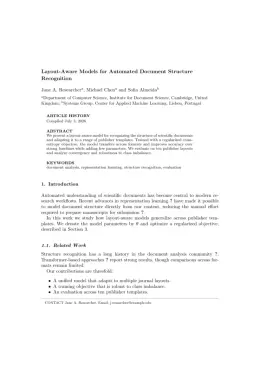
Write in a clean editor, then format for IISE Transactions on Occupational Ergonomics and Human Factors in one click — DocuGuru applies the official Taylor & Francis template with author–year references and exports a submission-ready PDF plus the editable LaTeX source. Free to start.

About the IISE Transactions on Occupational Ergonomics and Human Factors format

IISE Transactions on Occupational Ergonomics and Human Factors is a peer-reviewed journal published by Taylor & Francis, covering Musculoskeletal pain and rehabilitation, Ergonomics and Musculoskeletal Disorders, Occupational Health and Safety Research.

PublisherTaylor & Francis
Reference styleAuthor–year (Chicago, T&F)
Author–year — (Smith, 2023) in the text
Smith, Ada, Ben Jones, and Cara Lee. 2023. "A Representative Article Title." IISE Transactions on Occupational Ergonomics and Human Factors 12 (3): 45–58.

Formats any DOI in IISE Transactions on Occupational Ergonomics and Human Factors style. No sign-up.

Publishes research inMusculoskeletal pain and rehabilitation Ergonomics and Musculoskeletal Disorders Occupational Health and Safety Research Human-Automation Interaction and Safety Ergonomics and Human Factors
ISSN2472-5838
Citation impact (2-yr)2.36
h-index28
i10-index70
Total citations3,289
Top institutions publishing hereUniversity of Waterloo
Journal websitewww.tandfonline.com
You getA submission-ready PDF and the editable LaTeX source — ready to submit.

Papers published in IISE Transactions on Occupational Ergonomics and Human Factors per year

2
2016
13
2017
22
2018
31
2019
21
2020
26
2021
17
2022
15
2023
22
2024
35
2025

Citation impact of IISE Transactions on Occupational Ergonomics and Human Factors by publication year

48
2016
144
2017
276
2018
1.8K
2019
223
2020
284
2021
181
2022
74
2023
127
2024
58
2025

Citations each year’s papers have accumulated so far — the most recent years are still building up.

Most-cited papers in IISE Transactions on Occupational Ergonomics and Human Factors

Back-Support Exoskeletons for Occupational Use: An Overview of Technological Advances and Trends

Stefano Toxiri, Matthias B. Näf, Maria Lazzaroni et al. · 7 Aug 2019

OCCUPATIONAL APPLICATIONSMany new occupational back-support exoskeletons have been developed in the past few years both as research prototypes and as commercial products. These devices are intended to reduce the risk of lower-back pain and injury for workers in various possible application sectors, including assembly in automotive and aerospace, logistics, construction, healthcare, and agriculture. This article…

Occupational Exoskeletons: Overview of Their Benefits and Limitations in Preventing Work-Related Musculoskeletal Disorders

Jean Theurel, Kévin Desbrosses · 2 Jul 2019

OCCUPATIONAL APPLICATIONSThere is a growing interest in industry toward the use of occupational exoskeletons, with claimed efficiency in reducing physical demands at work. In this paper, we review existing evidence regarding the benefits and risks of using these technologies to attenuate the injury mechanisms for occupational musculoskeletal disorders (MSDs). More specifically, we focus on the…

Potential of Exoskeleton Technologies to Enhance Safety, Health, and Performance in Construction: Industry Perspectives and Future Research Directions

Sunwook Kim, Albert Moore, Divya Srinivasan et al. · 11 Jan 2019

OCCUPATIONAL APPLICATIONSWork-related musculoskeletal injuries and disorders remain an important problem in the construction industry. Exoskeletons are an emerging wearable technology that assists or augments a user’s physical activity or capacity. This technology is a potential solution to reduce the physical demands and fatigue experienced by construction workers and help improve worker safety, health, and performance.…

Subjective Evaluation of a Passive Industrial Exoskeleton for Lower-back Support: A Field Study in the Automotive Sector

Ralph Hensel, Mathias Keil · 8 Feb 2019

OCCUPATIONAL APPLICATIONSA passive, low-back support exoskeleton (Laevo) was tested in a four-week field study with workers in several automobile manufacturing workplaces that included both static trunk postures (forward bending) and dynamic repositioning (manual material handling). The aims of the study were to obtain subjective evaluations of the impacts of exoskeleton use, including discomfort, usability, and…

A Field Evaluation of Arm-Support Exoskeletons for Overhead Work Applications in Automotive Assembly

Marty Smets · 1 Mar 2019

OCCUPATIONAL APPLICATIONSThe results of this field trial suggest that when made available for optional usage during overhead automotive assembly, arm-support exoskeletons can lead to a substantial decrease in self-reported musculoskeletal discomfort in the neck and shoulders. Participants (assembly operators) chose to use the device for 86% of their shift and indicated they would continue to…

IISE Transactions on Occupational Ergonomics and Human Factors template — frequently asked questions

How do I write a paper in the IISE Transactions on Occupational Ergonomics and Human Factors format?
In DocuGuru you write your manuscript in a normal editor — no LaTeX setup required — and select the IISE Transactions on Occupational Ergonomics and Human Factors template. When you export, DocuGuru compiles the paper into the official Taylor & Francis format and hands you a submission-ready PDF along with the editable LaTeX source.
What reference style does IISE Transactions on Occupational Ergonomics and Human Factors use?
IISE Transactions on Occupational Ergonomics and Human Factors uses Author–year (Chicago, T&F) references, shown as author–year markers such as (Smith, 2023) in the text. DocuGuru formats every in-text citation and the reference list in this exact style automatically. A reference appears like this: Smith, Ada, Ben Jones, and Cara Lee. 2023. "A Representative Article Title." IISE Transactions on Occupational Ergonomics and Human Factors 12 (3): 45–58.
Do I need to know LaTeX to submit to IISE Transactions on Occupational Ergonomics and Human Factors?
No. DocuGuru generates the interact LaTeX class and compiles the PDF for you in the background, so you get a Taylor & Francis-ready IISE Transactions on Occupational Ergonomics and Human Factors document without writing any LaTeX. If you do want it, the LaTeX source is included in the export.
Can I import an existing draft into the IISE Transactions on Occupational Ergonomics and Human Factors template?
Yes. Paste or upload your current manuscript — Word, LaTeX, Markdown, or plain text — and DocuGuru reflows it into the IISE Transactions on Occupational Ergonomics and Human Factors format with correct headings, figures, tables, and author–year citations.
Who publishes IISE Transactions on Occupational Ergonomics and Human Factors?
IISE Transactions on Occupational Ergonomics and Human Factors is a multidisciplinary journal published by Taylor & Francis. DocuGuru's IISE Transactions on Occupational Ergonomics and Human Factors template matches Taylor & Francis's official submission format.
Can I export a submission-ready IISE Transactions on Occupational Ergonomics and Human Factors PDF?
Yes — DocuGuru produces a PDF built with the official IISE Transactions on Occupational Ergonomics and Human Factors template (the interact class) that is ready to submit to Taylor & Francis, together with the matching LaTeX source files.
How much does the IISE Transactions on Occupational Ergonomics and Human Factors template cost?
You can start writing in the IISE Transactions on Occupational Ergonomics and Human Factors template for free. Exporting the final submission-ready IISE Transactions on Occupational Ergonomics and Human Factors PDF and LaTeX source is part of DocuGuru's paid plans — see the app for current pricing.

Use the IISE Transactions on Occupational Ergonomics and Human Factors template