Taylor & Francis

Hypermedia Template

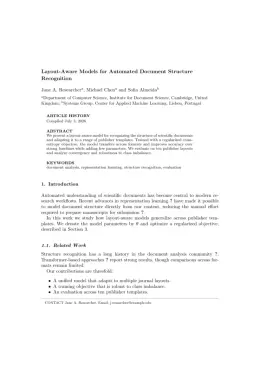
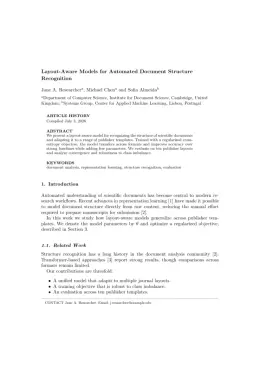
Write in a clean editor, then format for Hypermedia in one click — DocuGuru applies the official Taylor & Francis template with author–year references and exports a submission-ready PDF plus the editable LaTeX source. Free to start.

About the Hypermedia format

Hypermedia is a peer-reviewed journal published by Taylor & Francis, covering Usability and User Interface Design, Semantic Web and Ontologies, Multimedia Communication and Technology.

PublisherTaylor & Francis
Reference styleAuthor–year (Chicago, T&F)
Author–year — (Smith, 2023) in the text
Smith, Ada, Ben Jones, and Cara Lee. 2023. "A Representative Article Title." Hypermedia 12 (3): 45–58.

Formats any DOI in Hypermedia style. No sign-up.

Publishes research inUsability and User Interface Design Semantic Web and Ontologies Multimedia Communication and Technology Personal Information Management and User Behavior Advanced Database Systems and Queries
ISSN0955-8543
h-index20
i10-index37
Total citations1,177
Top institutions publishing hereUniversity of Strathclyde
Journal websitewww.tandfonline.com
You getA submission-ready PDF and the editable LaTeX source — ready to submit.

Papers published in Hypermedia per year

19
1989
17
1990
12
1991
12
1992
12
1993
13
1994

Citation impact of Hypermedia by publication year

323
1989
274
1990
153
1991
157
1992
171
1993
98
1994

Citations each year’s papers have accumulated so far — the most recent years are still building up.

Most-cited papers in Hypermedia

A Model for Information Exploration

John Waterworth, Mark Chignell · 1 Jan 1991

A three-dimensional model of information exploration is presented. By pointing to three distinct dimensions of exploration, we attempt to clarify the respective roles of the human and the system in browsing and information retrieval, and to characterise alternative interaction styles to maximise retrieval effectiveness. We illustrate the applicability of our model of exploration by describing…

Real and Virtual Spaces: Mapping from Spatial Cognition to Hypertext

Simon Buckingham Shum · 1 Jan 1990

Parallels arc frequently drawn between navigating through everyday spatial environments and information systems, hypertexts being a particular case in point. This paper examines the cognitive mapping theory often borrowed implicitly from spatial cognition research, which has a bearing on the appropriateness of using spatial imagery in hypertext. Conceptual differences between euclidean and virtual spaces are…

The Amsterdam Hypermedia Model: Extending Hypertext to Support <i>Real</i> Multimedia

Lynda Hardman, Dick C. A. Bulterman, Guido van Rossum · 1 Jan 1993

We present a model of hypermedia that allows the combination of ‘hyper-structured’ information with dynamic multimedia information. The model is derived by extending the Dexter hypertext reference model and the CMIF multimedia model. The Amsterdam hypermedia model allows the following, in addition to the model provided by Dexter: * the composition of multiple dynamic media,…

A Spectrum of Automatic Hypertext Constructions

Richard Furuta, Catherine Plaisant, Ben Shneiderman · 1 Jan 1989

We describe our experiences with four separate conversions from paper documents into hypertext and discuss the lessons we have learned. The paper document's organisation affects the ease with which it can be converted and the appropriateness of the resulting hypertext. The form of the paper document's machine-readable ‘markup’ description affects the ability to transform the…

Searching Versus Browsing in Hypertext

Roy Rada, Clare Murphy · 1 Jan 1992

Our goal is to elaborate the relationships among tasks, user types, and tools for hypertext. We built a computer system for automatically converting books into hypertext and then converted one book into Emacs-Info, Guide, HyperTies, and a variant of SuperBook, called MaxiBook. Three classes of users were studied: experts, novices, and trainees. Users performed two…

Hypermedia template — frequently asked questions

How do I write a paper in the Hypermedia format?
In DocuGuru you write your manuscript in a normal editor — no LaTeX setup required — and select the Hypermedia template. When you export, DocuGuru compiles the paper into the official Taylor & Francis format and hands you a submission-ready PDF along with the editable LaTeX source.
What reference style does Hypermedia use?
Hypermedia uses Author–year (Chicago, T&F) references, shown as author–year markers such as (Smith, 2023) in the text. DocuGuru formats every in-text citation and the reference list in this exact style automatically. A reference appears like this: Smith, Ada, Ben Jones, and Cara Lee. 2023. "A Representative Article Title." Hypermedia 12 (3): 45–58.
Do I need to know LaTeX to submit to Hypermedia?
No. DocuGuru generates the interact LaTeX class and compiles the PDF for you in the background, so you get a Taylor & Francis-ready Hypermedia document without writing any LaTeX. If you do want it, the LaTeX source is included in the export.
Can I import an existing draft into the Hypermedia template?
Yes. Paste or upload your current manuscript — Word, LaTeX, Markdown, or plain text — and DocuGuru reflows it into the Hypermedia format with correct headings, figures, tables, and author–year citations.
Who publishes Hypermedia?
Hypermedia is a multidisciplinary journal published by Taylor & Francis. DocuGuru's Hypermedia template matches Taylor & Francis's official submission format.
Can I export a submission-ready Hypermedia PDF?
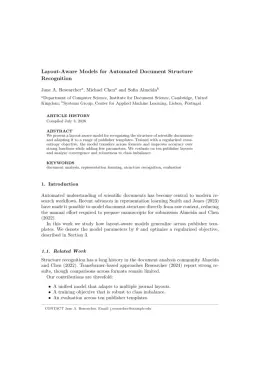
Yes — DocuGuru produces a PDF built with the official Hypermedia template (the interact class) that is ready to submit to Taylor & Francis, together with the matching LaTeX source files.
How much does the Hypermedia template cost?
You can start writing in the Hypermedia template for free. Exporting the final submission-ready Hypermedia PDF and LaTeX source is part of DocuGuru's paid plans — see the app for current pricing.
Use the Hypermedia template