
262 citations
Cite
SaveGo to paper →
Taylor & Francis
High Temperature Technology Template
Write in a clean editor, then format for High Temperature Technology in one click — DocuGuru applies the official Taylor & Francis template with author–year references and exports a submission-ready PDF plus the editable LaTeX source. Free to start.
About the High Temperature Technology format
High Temperature Technology is a peer-reviewed journal published by Taylor & Francis, covering High Temperature Alloys and Creep, High-Temperature Coating Behaviors, Spacecraft and Cryogenic Technologies.
| Publisher | Taylor & Francis |
|---|---|
| Reference style | Author–year (Chicago, T&F) Author–year — (Smith, 2023) in the text Smith, Ada, Ben Jones, and Cara Lee. 2023. "A Representative Article Title." High Temperature Technology 12 (3): 45–58.
Formats any DOI in High Temperature Technology style. No sign-up. |
| Publishes research in | High Temperature Alloys and Creep High-Temperature Coating Behaviors Spacecraft and Cryogenic Technologies Fatigue and fracture mechanics Metallurgical Processes and Thermodynamics |
| ISSN | 0261-9180 |
| h-index | 22 |
| i10-index | 55 |
| Total citations | 1,964 |
| Top institutions publishing here | Central Electricity Generating Board |
| Journal website | www.tandfonline.com |
| You get | A submission-ready PDF and the editable LaTeX source — ready to submit. |
Papers published in High Temperature Technology per year
Citation impact of High Temperature Technology by publication year
Citations each year’s papers have accumulated so far — the most recent years are still building up.
Most-cited papers in High Temperature Technology
A methodology for automatic measurement of surface tension of liquid metals is presented. The procedure involves the digitization of a television image of a drop of the liquid metal, image processing to obtain the real coordinates of the drop profile, and a final computation of the drop surface tension by a nonlinear regression technique. The…
127 citations
Cite
SaveGo to paper →
The mechanical torsion data in the form of flow curves and strain hardening rates from both as-cast and worked 300 series austenitic stainless steels, tested in the range 1200-900°C and 0.1 to 5.0 s-1, have been analysed to deepen understanding of dynamic softening mechanisms. The critical strain for dynamic recrystallization (DRX) is determined from the…
83 citations
Cite
SaveGo to paper →
The current status of thermal barrier coatings (TBGs) is reveiewed with reference to gas turbine applications. The principal methods of TBC deposition are outlined and failure processes based on thermomechanical stress effect, bond coat oxidation, corrosion of constituents of the ceramic, and eroswn are described. The performance of TBG systems in engine trials is described…
54 citations
Cite
SaveGo to paper →
Stress-strain curves, generated through continuous hot torsion tests of as-cast and worked type 304 austenitic stainless steel in the range 1200-:900°C and.0.1-5.0s-1, were analysed with respect to the characteristics of work harder:mg, dynamic recovery, dynamic recrystallization and ductility. The work-hardemng behavwur was related to the Kocks-Mecking model where the saturatwn stress is due to dynamw…
53 citations
Cite
SaveGo to paper →
Related journal templates
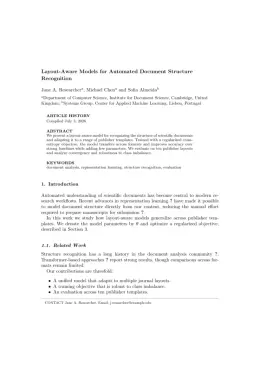 Cartography and Geographic Information Science
 Combustion Science and Technology
 Combustion Theory and Modelling
Communications in Algebra
Communications in Partial Differential Equations
Communications in Statistics - Simulation and Computation
Communications in Statistics - Theory and Methods
Computer Methods in Biomechanics and Biomedical Engineering
Combustion Theory and Modelling
Communications in Algebra
Communications in Partial Differential Equations
Communications in Statistics - Simulation and Computation
Communications in Statistics - Theory and Methods
Computer Methods in Biomechanics and Biomedical Engineering
High Temperature Technology template — frequently asked questions
How do I write a paper in the High Temperature Technology format?
In DocuGuru you write your manuscript in a normal editor — no LaTeX setup required — and select the High Temperature Technology template. When you export, DocuGuru compiles the paper into the official Taylor & Francis format and hands you a submission-ready PDF along with the editable LaTeX source.
What reference style does High Temperature Technology use?
High Temperature Technology uses Author–year (Chicago, T&F) references, shown as author–year markers such as (Smith, 2023) in the text. DocuGuru formats every in-text citation and the reference list in this exact style automatically. A reference appears like this: Smith, Ada, Ben Jones, and Cara Lee. 2023. "A Representative Article Title." High Temperature Technology 12 (3): 45–58.
Do I need to know LaTeX to submit to High Temperature Technology?
No. DocuGuru generates the interact LaTeX class and compiles the PDF for you in the background, so you get a Taylor & Francis-ready High Temperature Technology document without writing any LaTeX. If you do want it, the LaTeX source is included in the export.
Can I import an existing draft into the High Temperature Technology template?
Yes. Paste or upload your current manuscript — Word, LaTeX, Markdown, or plain text — and DocuGuru reflows it into the High Temperature Technology format with correct headings, figures, tables, and author–year citations.
Who publishes High Temperature Technology?
High Temperature Technology is a multidisciplinary journal published by Taylor & Francis. DocuGuru's High Temperature Technology template matches Taylor & Francis's official submission format.
Can I export a submission-ready High Temperature Technology PDF?
Yes — DocuGuru produces a PDF built with the official High Temperature Technology template (the interact class) that is ready to submit to Taylor & Francis, together with the matching LaTeX source files.
How much does the High Temperature Technology template cost?
You can start writing in the High Temperature Technology template for free. Exporting the final submission-ready High Temperature Technology PDF and LaTeX source is part of DocuGuru's paid plans — see the app for current pricing.