Taylor & Francis

Free Radical Research Communications Template

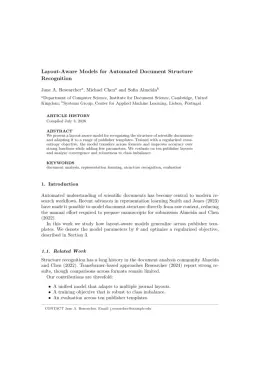
Write in a clean editor, then format for Free Radical Research Communications in one click — DocuGuru applies the official Taylor & Francis template with author–year references and exports a submission-ready PDF plus the editable LaTeX source. Free to start.

About the Free Radical Research Communications format

Free Radical Research Communications is a peer-reviewed journal published by Taylor & Francis, covering Electron Spin Resonance Studies, Free Radicals and Antioxidants, Antioxidant Activity and Oxidative Stress.

PublisherTaylor & Francis
Reference styleAuthor–year (Chicago, T&F)
Author–year — (Smith, 2023) in the text
Smith, Ada, Ben Jones, and Cara Lee. 2023. "A Representative Article Title." Free Radical Research Communications 12 (3): 45–58.

Formats any DOI in Free Radical Research Communications style. No sign-up.

Publishes research inElectron Spin Resonance Studies Free Radicals and Antioxidants Antioxidant Activity and Oxidative Stress Electrochemical Analysis and Applications Environmental Toxicology and Ecotoxicology
ISSN8755-0199
h-index79
i10-index583
Total citations35,562
Top institutions publishing hereHebrew University of Jerusalem
Journal websitewww.tandfonline.com
You getA submission-ready PDF and the editable LaTeX source — ready to submit.

Papers published in Free Radical Research Communications per year

93
1987
55
1988
158
1989
157
1990
197
1991
92
1992
112
1993
1
2006
1
2008
1
2010
1
2014
1
2016

Citation impact of Free Radical Research Communications by publication year

2.6K
1987
1.5K
1988
5.7K
1989
6.3K
1990
6K
1991
4.8K
1992
6.1K
1993
0
2006
5
2008
0
2010
0
2014
0
2016

Citations each year’s papers have accumulated so far — the most recent years are still building up.

Most-cited papers in Free Radical Research Communications

The Reaction of no With Superoxide

Robert E. Huie, S. Padmaja · 1 Jan 1993

The rate constant for the reaction of NO with .O2- was determined to be (6.7 +/- 0.9) x 10(9) l mol-1 s-1, considerably higher than previously reported. Rate measurements were made from pH 5.6 to 12.5 both by monitoring the loss of .O2- and the formation of the product -OONO. The decay rate of -OONO,…

2,121 citations Cite SaveGo to paper →
Continuous Monitoring of<i>in Vztro</i>Oxidation of Human Low Density Lipoprotein

H. Esterbauer, G Striegl, Herbert Puhl et al. · 1 Jan 1989

The kinetics of the oxidation of human low density lipoprotein (LDL) can be measured continuously by monitoring the change of the 234 nm diene absorption. The time-course shows three consecutive phases, a lag-phase during which the diene absorption increases only weakly, a propagation phase with a rapid increase of the diene absorption and finally a…

1,791 citations Cite SaveGo to paper →
Nuclear Factor Kb: An Oxidative Stress-Responsive Transcription Factor of Eukaryotic Cells (A Review)

Ralf Schreck, Kaj Albermann, Patrick A. Baeuerle · 1 Jan 1992

NF-kappa B is a multiprotein complex that can activate a great variety of genes involved in early defence reactions of higher organisms. In nonstimulated cells, NF-kappa B resides in the cytoplasm in an inactive complex with the inhibitor I kappa B. Pathogenic stimuli cause release of I kappa B and allow NF-kappa B to enter…

1,408 citations Cite SaveGo to paper →
How to Characterize a Biological Antioxidant

Barry Halliwell · 1 Jan 1990

An antioxidant is a substance that, when present at low concentrations compared to those of an oxidizable substrate, significantly delays or prevents oxidation of that substrate. Many substances have been suggested to act as antioxidants in vivo, but few have been proved to do so. The present review addresses the criteria necessary to evaluate a…

Endogenous Oxidative DNA Damage, Aging, and Cancer

Bruce N. Ames · 1 Jan 1989

Progress in identifying the important endogenous processes damaging DNA and developing methods to assay this damage in individuals is presented. This approach may aid studies on modulation of cancer and aging. The endogenous background level of oxidant-induced DNA damage in vivo has been assayed by measuring 8-hydroxydeoxyguanosine (oh8dG), thymine glycol and thymidine glycol in urine…

Free Radical Research Communications template — frequently asked questions

How do I write a paper in the Free Radical Research Communications format?
In DocuGuru you write your manuscript in a normal editor — no LaTeX setup required — and select the Free Radical Research Communications template. When you export, DocuGuru compiles the paper into the official Taylor & Francis format and hands you a submission-ready PDF along with the editable LaTeX source.
What reference style does Free Radical Research Communications use?
Free Radical Research Communications uses Author–year (Chicago, T&F) references, shown as author–year markers such as (Smith, 2023) in the text. DocuGuru formats every in-text citation and the reference list in this exact style automatically. A reference appears like this: Smith, Ada, Ben Jones, and Cara Lee. 2023. "A Representative Article Title." Free Radical Research Communications 12 (3): 45–58.
Do I need to know LaTeX to submit to Free Radical Research Communications?
No. DocuGuru generates the interact LaTeX class and compiles the PDF for you in the background, so you get a Taylor & Francis-ready Free Radical Research Communications document without writing any LaTeX. If you do want it, the LaTeX source is included in the export.
Can I import an existing draft into the Free Radical Research Communications template?
Yes. Paste or upload your current manuscript — Word, LaTeX, Markdown, or plain text — and DocuGuru reflows it into the Free Radical Research Communications format with correct headings, figures, tables, and author–year citations.
Who publishes Free Radical Research Communications?
Free Radical Research Communications is a multidisciplinary journal published by Taylor & Francis. DocuGuru's Free Radical Research Communications template matches Taylor & Francis's official submission format.
Can I export a submission-ready Free Radical Research Communications PDF?
Yes — DocuGuru produces a PDF built with the official Free Radical Research Communications template (the interact class) that is ready to submit to Taylor & Francis, together with the matching LaTeX source files.
How much does the Free Radical Research Communications template cost?
You can start writing in the Free Radical Research Communications template for free. Exporting the final submission-ready Free Radical Research Communications PDF and LaTeX source is part of DocuGuru's paid plans — see the app for current pricing.

Use the Free Radical Research Communications template