Taylor & Francis

Ergonomics Template

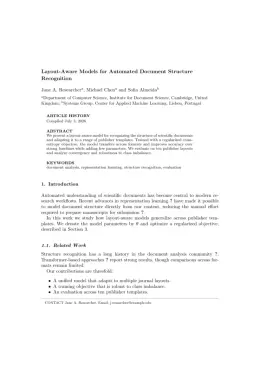
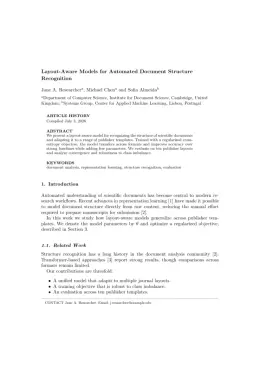
Write in a clean editor, then format for Ergonomics in one click — DocuGuru applies the official Taylor & Francis template with author–year references and exports a submission-ready PDF plus the editable LaTeX source. Free to start.

About the Ergonomics format

Ergonomics is a peer-reviewed journal published by Taylor & Francis, covering Ergonomics and Musculoskeletal Disorders, Musculoskeletal pain and rehabilitation, Human-Automation Interaction and Safety.

PublisherTaylor & Francis
Reference styleAuthor–year (Chicago, T&F)
Author–year — (Smith, 2023) in the text
Smith, Ada, Ben Jones, and Cara Lee. 2023. "A Representative Article Title." Ergonomics 12 (3): 45–58.

Formats any DOI in Ergonomics style. No sign-up.

Publishes research inErgonomics and Musculoskeletal Disorders Musculoskeletal pain and rehabilitation Human-Automation Interaction and Safety Occupational Health and Safety Research Ergonomics and Human Factors
ISSN0014-0139
Citation impact (2-yr)2.62
h-index200
i10-index5,030
Total citations299,315
Top institutions publishing hereLoughborough University
Journal websitewww.tandfonline.com
You getA submission-ready PDF and the editable LaTeX source — ready to submit.

Papers published in Ergonomics per year

223
2014
221
2015
158
2016
143
2017
139
2018
132
2019
151
2020
145
2021
154
2022
126
2023
182
2024
201
2025

Citation impact of Ergonomics by publication year

8.9K
2014
8.6K
2015
4.7K
2016
3.6K
2017
3.8K
2018
2.6K
2019
2.7K
2020
3.2K
2021
1.7K
2022
1.2K
2023
882
2024
279
2025

Citations each year’s papers have accumulated so far — the most recent years are still building up.

Most-cited papers in Ergonomics

Revised NIOSH equation for the design and evaluation of manual lifting tasks

Thomas Waters, Vern Putz‐Anderson, Arun Garg et al. · 1 Jul 1993

In 1985, the National Institute for Occupational Safety and Health (NIOSH) convened an ad hoc committee of experts who reviewed the current literature on lifting, recommend criteria for defining lifting capacity, and in 1991 developed a revised lifting equation. Subsequently, NIOSH developed the documentation for the equation and played a prominent role in recommending methods…

2,034 citations Cite SaveGo to paper →
Errors and violations on the roads: a real distinction?

James Reason, Antony S. R. Manstead, Stephen G. Stradling et al. · 1 Oct 1990

In considering the human contribution to accidents, it seems necessary to make a distinction between errors and violations; two forms of aberration which may have different psychological origins and demand different modes of remediation. The present study investigated whether this distinction was justified for self-reported driver behaviour. Five hundred and twenty drivers completed a driver…

1,907 citations Cite SaveGo to paper →
Trust, control strategies and allocation of function in human-machine systems

John D. Lee, Neville Moray · 1 Oct 1992

As automated controllers supplant human intervention in controlling complex systems, the operators' role often changes from that of an active controller to that of a supervisory controller. Acting as supervisors, operators can choose between automatic and manual control. Improperly allocating function between automatic and manual control can have negative consequences for the performance of a…

1,443 citations Cite SaveGo to paper →
Activity theory as a framework for analyzing and redesigning work

Yrjö Engeström · 1 Jul 2000

Cultural-historical activity theory is a new framework aimed at transcending the dichotomies of micro- and macro-, mental and material, observation and intervention in analysis and redesign of work. The approach distinguishes between short-lived goal-directed actions and durable, object-oriented activity systems. A historically evolving collective activity system, seen in its network relations to other activity systems,…

1,361 citations Cite SaveGo to paper →
SEIPS 2.0: a human factors framework for studying and improving the work of healthcare professionals and patients

Richard Holden, Pascale Carayon, Ayşe P. Gürses et al. · 3 Oct 2013

Healthcare practitioners, patient safety leaders, educators and researchers increasingly recognise the value of human factors/ergonomics and make use of the discipline's person-centred models of sociotechnical systems. This paper first reviews one of the most widely used healthcare human factors systems models, the Systems Engineering Initiative for Patient Safety (SEIPS) model, and then introduces an extended…

1,187 citations Cite SaveGo to paper →

Ergonomics template — frequently asked questions

How do I write a paper in the Ergonomics format?
In DocuGuru you write your manuscript in a normal editor — no LaTeX setup required — and select the Ergonomics template. When you export, DocuGuru compiles the paper into the official Taylor & Francis format and hands you a submission-ready PDF along with the editable LaTeX source.
What reference style does Ergonomics use?
Ergonomics uses Author–year (Chicago, T&F) references, shown as author–year markers such as (Smith, 2023) in the text. DocuGuru formats every in-text citation and the reference list in this exact style automatically. A reference appears like this: Smith, Ada, Ben Jones, and Cara Lee. 2023. "A Representative Article Title." Ergonomics 12 (3): 45–58.
Do I need to know LaTeX to submit to Ergonomics?
No. DocuGuru generates the interact LaTeX class and compiles the PDF for you in the background, so you get a Taylor & Francis-ready Ergonomics document without writing any LaTeX. If you do want it, the LaTeX source is included in the export.
Can I import an existing draft into the Ergonomics template?
Yes. Paste or upload your current manuscript — Word, LaTeX, Markdown, or plain text — and DocuGuru reflows it into the Ergonomics format with correct headings, figures, tables, and author–year citations.
Who publishes Ergonomics?
Ergonomics is a multidisciplinary journal published by Taylor & Francis. DocuGuru's Ergonomics template matches Taylor & Francis's official submission format.
Can I export a submission-ready Ergonomics PDF?
Yes — DocuGuru produces a PDF built with the official Ergonomics template (the interact class) that is ready to submit to Taylor & Francis, together with the matching LaTeX source files.
How much does the Ergonomics template cost?
You can start writing in the Ergonomics template for free. Exporting the final submission-ready Ergonomics PDF and LaTeX source is part of DocuGuru's paid plans — see the app for current pricing.
Use the Ergonomics template