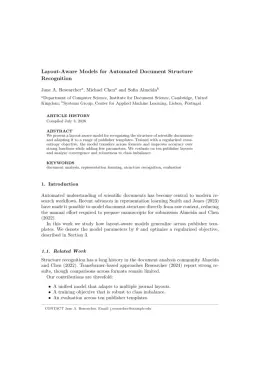
Taylor & Francis

Environmental Archaeology Template

Write in a clean editor, then format for Environmental Archaeology in one click — DocuGuru applies the official Taylor & Francis template with author–year references and exports a submission-ready PDF plus the editable LaTeX source. Free to start.

About the Environmental Archaeology format

Environmental Archaeology is a peer-reviewed journal published by Taylor & Francis, covering Archaeology and ancient environmental studies, Pleistocene-Era Hominins and Archaeology, Geology and Paleoclimatology Research.

PublisherTaylor & Francis
Reference styleAuthor–year (Chicago, T&F)
Author–year — (Smith, 2023) in the text
Smith, Ada, Ben Jones, and Cara Lee. 2023. "A Representative Article Title." Environmental Archaeology 12 (3): 45–58.

Formats any DOI in Environmental Archaeology style. No sign-up.

Publishes research inArchaeology and ancient environmental studies Pleistocene-Era Hominins and Archaeology Geology and Paleoclimatology Research Pacific and Southeast Asian Studies Isotope Analysis in Ecology
ISSN1461-4103
Citation impact (2-yr)1.27
h-index49
i10-index362
Total citations12,627
Top institutions publishing hereCentre National de la Recherche Scientifique
Journal websitewww.tandfonline.com
You getA submission-ready PDF and the editable LaTeX source — ready to submit.

Papers published in Environmental Archaeology per year

46
2014
39
2015
38
2016
58
2017
51
2018
39
2019
42
2020
55
2021
35
2022
44
2023
35
2024
48
2025

Citation impact of Environmental Archaeology by publication year

1.2K
2014
700
2015
525
2016
712
2017
712
2018
490
2019
534
2020
464
2021
149
2022
163
2023
83
2024
35
2025

Citations each year’s papers have accumulated so far — the most recent years are still building up.

Most-cited papers in Environmental Archaeology

Reconstructing Woodland Vegetation and its Exploitation by Past Societies, based on the Analysis and Interpretation of Archaeological Wood Charcoal Macro-Remains

Eleni Asouti, Phil Austin · 1 Apr 2005

In this paper the significance of the analysis of archaeological wood charcoal macro-remains as a tool for the reconstruction of woodland vegetation and its exploitation is discussed. Drawing from both older and more recent publications a number of theoretical and methodological approaches are examined. It is suggested that greater integration of charcoal and archaeological data…

The archaeobotany of Indian pulses: identification, processing and evidence for cultivation

Dorian Q. Fuller, Emma L. Harvey · 1 Oct 2006

Pulses are a significant component of traditional subsistence in South Asia. Reliable identification criteria for identifying these from archaeological seed remains are reviewed. The botanical evidence relating to the wild progenitors and their distribution, especially of Indian natives (Macrotyloma uniflorum, Vigna radiata, Vigna mungo) is summarised, including new evidence from primary botanical research. The problem…

New Plant Foods in Roman Britain — Dispersal and Social Access

Marijke van der Veen, Alexandra Livarda, Alistair Hill · 1 Apr 2008

This paper was published as Environmental Archaeology, 2008, 13 (1), pp. 11-36. © 2008 Association for Environmental Archaeology. It is available from http://www.ingentaconnect.com/content/maney/env/2008/00000013/00000001/art00002. Doi: 10.1179/174963108X279193

Oxygen isotopes in Molluscan shell: Applications in environmental archaeology

Melanie J. Leng, Jonathan P. Lewis · 19 Nov 2014

Oxygen isotope geochemistry of Molluscan shell is an essential part of environmental archaeology and over the last decade has contributed significantly to the understanding of the past inhabitants of our planet. From the analysis of collected (and disposed of) shells we can gain information on environmental data from the species assemblages and also from the…

Environmental Archaeology template — frequently asked questions

How do I write a paper in the Environmental Archaeology format?
In DocuGuru you write your manuscript in a normal editor — no LaTeX setup required — and select the Environmental Archaeology template. When you export, DocuGuru compiles the paper into the official Taylor & Francis format and hands you a submission-ready PDF along with the editable LaTeX source.
What reference style does Environmental Archaeology use?
Environmental Archaeology uses Author–year (Chicago, T&F) references, shown as author–year markers such as (Smith, 2023) in the text. DocuGuru formats every in-text citation and the reference list in this exact style automatically. A reference appears like this: Smith, Ada, Ben Jones, and Cara Lee. 2023. "A Representative Article Title." Environmental Archaeology 12 (3): 45–58.
Do I need to know LaTeX to submit to Environmental Archaeology?
No. DocuGuru generates the interact LaTeX class and compiles the PDF for you in the background, so you get a Taylor & Francis-ready Environmental Archaeology document without writing any LaTeX. If you do want it, the LaTeX source is included in the export.
Can I import an existing draft into the Environmental Archaeology template?
Yes. Paste or upload your current manuscript — Word, LaTeX, Markdown, or plain text — and DocuGuru reflows it into the Environmental Archaeology format with correct headings, figures, tables, and author–year citations.
Who publishes Environmental Archaeology?
Environmental Archaeology is a multidisciplinary journal published by Taylor & Francis. DocuGuru's Environmental Archaeology template matches Taylor & Francis's official submission format.
Can I export a submission-ready Environmental Archaeology PDF?
Yes — DocuGuru produces a PDF built with the official Environmental Archaeology template (the interact class) that is ready to submit to Taylor & Francis, together with the matching LaTeX source files.
How much does the Environmental Archaeology template cost?
You can start writing in the Environmental Archaeology template for free. Exporting the final submission-ready Environmental Archaeology PDF and LaTeX source is part of DocuGuru's paid plans — see the app for current pricing.

Use the Environmental Archaeology template