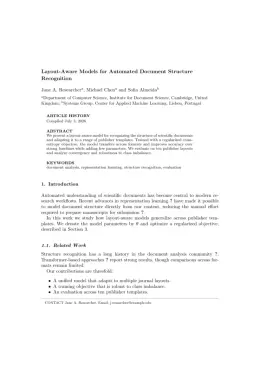
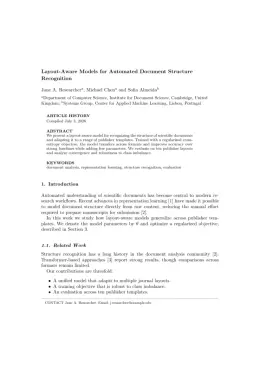
Taylor & Francis

Ecosystems and People Template

Write in a clean editor, then format for Ecosystems and People in one click — DocuGuru applies the official Taylor & Francis template with author–year references and exports a submission-ready PDF plus the editable LaTeX source. Free to start.

About the Ecosystems and People format

Ecosystems and People is a peer-reviewed journal published by Taylor & Francis, covering Land Use and Ecosystem Services, Conservation, Biodiversity, and Resource Management, Urban Green Space and Health.

PublisherTaylor & Francis
Reference styleAuthor–year (Chicago, T&F)
Author–year — (Smith, 2023) in the text
Smith, Ada, Ben Jones, and Cara Lee. 2023. "A Representative Article Title." Ecosystems and People 12 (3): 45–58.

Formats any DOI in Ecosystems and People style. No sign-up.

Publishes research inLand Use and Ecosystem Services Conservation, Biodiversity, and Resource Management Urban Green Space and Health Sustainability and Climate Change Governance Economic and Environmental Valuation
ISSN2639-5908
Citation impact (2-yr)5.16
h-index40
i10-index163
Total citations6,569
Article processing charge$1,165
Open accessYes
Top institutions publishing hereStockholm University
Journal websitewww.tandfonline.com
You getA submission-ready PDF and the editable LaTeX source — ready to submit.

Papers published in Ecosystems and People per year

6
2018
24
2019
30
2020
44
2021
46
2022
52
2023
69
2024
47
2025

Citation impact of Ecosystems and People by publication year

129
2018
928
2019
2K
2020
1.2K
2021
837
2022
669
2023
566
2024
100
2025

Citations each year’s papers have accumulated so far — the most recent years are still building up.

Most-cited papers in Ecosystems and People

A relational turn for sustainability science? Relational thinking, leverage points and transformations

Simon West, L. Jamila Haider, Sanna Stålhammar et al. · 1 Jan 2020

In sustainability science, revising the paradigms that separate humans from nature is considered a powerful 'leverage point' in pursuit of transformations. The coupled social-ecological and human-environment systems perspectives at the heart of sustainability science have, in many ways, enhanced recognition across academic, civil, policy and business spheres that humans and nature are inextricably connected. However,…

Disentangling ‘ecosystem services’ and ‘nature’s contributions to people’

Andrew N. Kadykalo, María D. López‐Rodríguez, Jacob Ainscough et al. · 1 Jan 2019

People depend on functioning ecosystems, which provide benefits that support human existence and wellbeing. The relationship between people and nature has been experienced and conceptualized in multiple ways. Recently, ecosystem services (ES) concepts have permeated science, government policies, multi-national environmental agreements, and science–policy interfaces. In 2017, the Intergovernmental Science-Policy Platform on Biodiversity and Ecosystem Services…

The 10 Elements of Agroecology: enabling transitions towards sustainable agriculture and food systems through visual narratives

Edmundo Barrios, Barbara Gemmill‐Herren, Abram Bicksler et al. · 1 Jan 2020

The magnitude and urgency of the challenges facing agriculture and food systems demand profound modifications in different aspects of human activity to achieve real transformative change and sustainability. Recognizing that the inherent complexity of achieving sustainability is commonly seen as a deterrent to decision-making, the Food and Agriculture Organization of the United Nations (FAO) has…

Applying the pathways to nature connectedness at a societal scale: a leverage points perspective

Miles Richardson, Julian Dobson, David J. Abson et al. · 1 Jan 2020

The climate emergency and crisis of biodiversity loss show that the human–nature relationship is failing. This paper introduces the psychological construct of nature connectedness as a measurable target for improving the human–nature relationship, and therefore helping tackle the warming climate and loss of wildlife. The ‘pathways to nature connectedness’ (sensory contact, emotion, meaning, beauty and…

Incorporating geodiversity in ecosystem service decisions

Nathan Fox, Laura Graham, Felix Eigenbrod et al. · 1 Jan 2020

Holistic conservation of ecosystem services (ES) requires a greater understanding of how the interactions of biotic and abiotic aspects of nature provide them. Currently, geodiversity, the diversity of geology, geomorphology, sediments and soils and hydrology, as well as the services that they provide in isolation of interactions with biotic nature – geosystem services (GS) –…

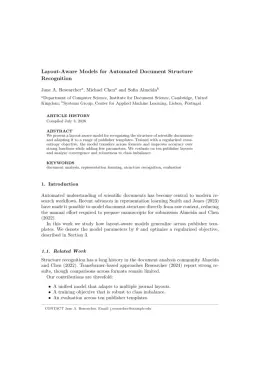
Ecosystems and People template — frequently asked questions

How do I write a paper in the Ecosystems and People format?
In DocuGuru you write your manuscript in a normal editor — no LaTeX setup required — and select the Ecosystems and People template. When you export, DocuGuru compiles the paper into the official Taylor & Francis format and hands you a submission-ready PDF along with the editable LaTeX source.
What reference style does Ecosystems and People use?
Ecosystems and People uses Author–year (Chicago, T&F) references, shown as author–year markers such as (Smith, 2023) in the text. DocuGuru formats every in-text citation and the reference list in this exact style automatically. A reference appears like this: Smith, Ada, Ben Jones, and Cara Lee. 2023. "A Representative Article Title." Ecosystems and People 12 (3): 45–58.
Do I need to know LaTeX to submit to Ecosystems and People?
No. DocuGuru generates the interact LaTeX class and compiles the PDF for you in the background, so you get a Taylor & Francis-ready Ecosystems and People document without writing any LaTeX. If you do want it, the LaTeX source is included in the export.
Can I import an existing draft into the Ecosystems and People template?
Yes. Paste or upload your current manuscript — Word, LaTeX, Markdown, or plain text — and DocuGuru reflows it into the Ecosystems and People format with correct headings, figures, tables, and author–year citations.
Who publishes Ecosystems and People?
Ecosystems and People is a multidisciplinary journal published by Taylor & Francis. DocuGuru's Ecosystems and People template matches Taylor & Francis's official submission format.
Can I export a submission-ready Ecosystems and People PDF?
Yes — DocuGuru produces a PDF built with the official Ecosystems and People template (the interact class) that is ready to submit to Taylor & Francis, together with the matching LaTeX source files.
How much does the Ecosystems and People template cost?
You can start writing in the Ecosystems and People template for free. Exporting the final submission-ready Ecosystems and People PDF and LaTeX source is part of DocuGuru's paid plans — see the app for current pricing.
Use the Ecosystems and People template