
119 citations
Cite
SaveGo to paper →
Taylor & Francis
de arte Template
Write in a clean editor, then format for de arte in one click — DocuGuru applies the official Taylor & Francis template with author–year references and exports a submission-ready PDF plus the editable LaTeX source. Free to start.
About the de arte format
de arte is a peer-reviewed journal published by Taylor & Francis, covering South African History and Culture, Art, Politics, and Modernism, Archaeology and Rock Art Studies.
| Publisher | Taylor & Francis |
|---|---|
| Reference style | Author–year (Chicago, T&F) Author–year — (Smith, 2023) in the text Smith, Ada, Ben Jones, and Cara Lee. 2023. "A Representative Article Title." de arte 12 (3): 45–58.
Formats any DOI in de arte style. No sign-up. |
| Publishes research in | South African History and Culture Art, Politics, and Modernism Archaeology and Rock Art Studies African history and culture studies Public Spaces through Art |
| ISSN | 0004-3389 |
| Citation impact (2-yr) | 0.02 |
| h-index | 10 |
| i10-index | 11 |
| Total citations | 855 |
| Top institutions publishing here | University of the Witwatersrand |
| Journal website | www.tandfonline.com |
| You get | A submission-ready PDF and the editable LaTeX source — ready to submit. |
Papers published in de arte per year
Citation impact of de arte by publication year
Citations each year’s papers have accumulated so far — the most recent years are still building up.
Most-cited papers in de arte
The title The African photographic archive creates the expectation of a large volume with detailed information of photographic archiving practices throughout the continent: in these terms, the information contained in this book is highly selective in relation to both geography and variety of archiving practices and, particularly, the involvement of the many states in the…
68 citations
Cite
SaveGo to paper →
24 citations
Cite
SaveGo to paper →
There are historical events that remain charged with trauma, thereby resisting the logic of causal progress conventionally ascribed to historical narratives. As obstacles to cohesive representations of history and national identities, these events remain ambiguous and problematic. Prompted by art historian and philosopher Georges Didi-Huberman’s proclamation “In order to know, we must imagine for ourselves”…
17 citations
Cite
SaveGo to paper →
In The New Parthenon, as with her other films, Penny Siopis pieces together fragments of found footage of anonymous home videos, shot handheld on 8 or 16 mm film. The films are digitised first for sampling, but not digitally remastered, and are then combined with music and subtitles from various sources. These films narrate the…
17 citations
Cite
SaveGo to paper →
Related journal templates
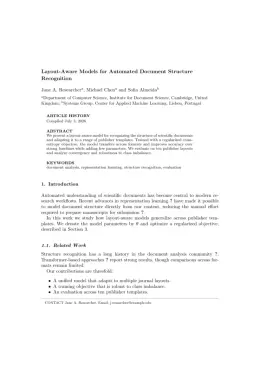
de arte template — frequently asked questions
How do I write a paper in the de arte format?
In DocuGuru you write your manuscript in a normal editor — no LaTeX setup required — and select the de arte template. When you export, DocuGuru compiles the paper into the official Taylor & Francis format and hands you a submission-ready PDF along with the editable LaTeX source.
What reference style does de arte use?
de arte uses Author–year (Chicago, T&F) references, shown as author–year markers such as (Smith, 2023) in the text. DocuGuru formats every in-text citation and the reference list in this exact style automatically. A reference appears like this: Smith, Ada, Ben Jones, and Cara Lee. 2023. "A Representative Article Title." de arte 12 (3): 45–58.
Do I need to know LaTeX to submit to de arte?
No. DocuGuru generates the interact LaTeX class and compiles the PDF for you in the background, so you get a Taylor & Francis-ready de arte document without writing any LaTeX. If you do want it, the LaTeX source is included in the export.
Can I import an existing draft into the de arte template?
Yes. Paste or upload your current manuscript — Word, LaTeX, Markdown, or plain text — and DocuGuru reflows it into the de arte format with correct headings, figures, tables, and author–year citations.
Who publishes de arte?
de arte is a multidisciplinary journal published by Taylor & Francis. DocuGuru's de arte template matches Taylor & Francis's official submission format.
Can I export a submission-ready de arte PDF?
Yes — DocuGuru produces a PDF built with the official de arte template (the interact class) that is ready to submit to Taylor & Francis, together with the matching LaTeX source files.
How much does the de arte template cost?
You can start writing in the de arte template for free. Exporting the final submission-ready de arte PDF and LaTeX source is part of DocuGuru's paid plans — see the app for current pricing.