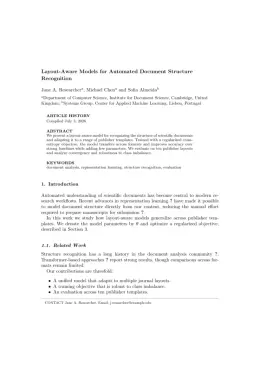
Taylor & Francis

Cognition & Emotion Template

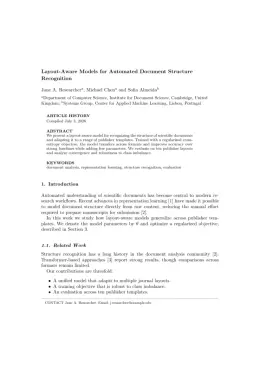
Write in a clean editor, then format for Cognition & Emotion in one click — DocuGuru applies the official Taylor & Francis template with author–year references and exports a submission-ready PDF plus the editable LaTeX source. Free to start.

About the Cognition & Emotion format

Cognition & Emotion is a peer-reviewed journal published by Taylor & Francis, covering Anxiety, Depression, Psychometrics, Treatment, Cognitive Processes, Neural and Behavioral Psychology Studies, Emotions and Moral Behavior.

PublisherTaylor & Francis
Reference styleAuthor–year (Chicago, T&F)
Author–year — (Smith, 2023) in the text
Smith, Ada, Ben Jones, and Cara Lee. 2023. "A Representative Article Title." Cognition & Emotion 12 (3): 45–58.

Formats any DOI in Cognition & Emotion style. No sign-up.

Publishes research inAnxiety, Depression, Psychometrics, Treatment, Cognitive Processes Neural and Behavioral Psychology Studies Emotions and Moral Behavior Face Recognition and Perception Mental Health Research Topics
ISSN0269-9931
Citation impact (2-yr)2.27
h-index218
i10-index2,333
Total citations239,109
Top institutions publishing hereUniversity of Amsterdam
Journal websitewww.tandfonline.com
You getA submission-ready PDF and the editable LaTeX source — ready to submit.

Papers published in Cognition & Emotion per year

152
2014
157
2015
138
2016
120
2017
134
2018
120
2019
107
2020
110
2021
106
2022
121
2023
186
2024
144
2025

Citation impact of Cognition & Emotion by publication year

6.8K
2014
5.9K
2015
5.8K
2016
4K
2017
3.3K
2018
2.6K
2019
2K
2020
2K
2021
1.2K
2022
763
2023
716
2024
140
2025

Citations each year’s papers have accumulated so far — the most recent years are still building up.

Most-cited papers in Cognition & Emotion

An argument for basic emotions

Paul Ekman · 1 May 1992

Abstract Emotions are viewed as having evolved through their adaptive value in dealing with fundamental life-tasks. Each emotion has unique features: signal, physiology, and antecedent events. Each emotion also has characteristics in common with other emotions: rapid onset, short duration, unbidden occurrence, automatic appraisal, and coherence among responses. These shared and unique characteristics are the…

9,427 citations Cite SaveGo to paper →
Positive emotions broaden the scope of attention and thought‐action repertoires

Barbara L. Fredrickson, Christine Branigan · 1 Mar 2005

The broaden-and-build theory (Fredrickson, 1998, 2001) hypothesises that positive emotions broaden the scope of attention and thought-action repertoires. Two experiments with 104 college students tested these hypotheses. In each, participants viewed a film that elicited (a) amusement, (b) contentment, (c) neutrality, (d) anger, or (e) anxiety. Scope of attention was assessed using a global-local visual…

3,483 citations Cite SaveGo to paper →
Beyond valence: Toward a model of emotion-specific influences on judgement and choice

Jennifer S. Lerner, Dacher Keltner · 1 Jul 2000

Most theories of affective in ¯ uences on judgement and choice take a valencebased approach, contrasting the effects of positive versus negative feeling states. These approaches have not speci ® ed if and when distinct emotions of the same valence have different effects on judgement. In this article, we propose a model of emotion-speci ®…

3,007 citations Cite SaveGo to paper →
Presentation and validation of the Radboud Faces Database

Oliver Langner, Ron Dotsch, Gijsbert Bijlstra et al. · 8 Apr 2010

Many research fields concerned with the processing of information contained in human faces would benefit from face stimulus sets in which specific facial characteristics are systematically varied while other important picture characteristics are kept constant. Specifically, a face database in which displayed expressions, gaze direction, and head orientation are parametrically varied in a complete factorial…

2,471 citations Cite SaveGo to paper →
Anxiety and Performance: The Processing Efficiency Theory

Michael W. Eysenck, Manuel G. Calvo · 1 Nov 1992

Abstract Anxiety often impairs performance of “difficult” tasks (especially under test conditions), but there are numerous exceptions. Theories of anxiety and performance need to address at least two major issues: (1) the complexity and apparent inconsistency of the findings; and (2) the conceptual definition of task difficulty. Some theorists (e.g. Humphreys & Revelle, 1984; Sarason,…

2,401 citations Cite SaveGo to paper →

Cognition & Emotion template — frequently asked questions

How do I write a paper in the Cognition & Emotion format?
In DocuGuru you write your manuscript in a normal editor — no LaTeX setup required — and select the Cognition & Emotion template. When you export, DocuGuru compiles the paper into the official Taylor & Francis format and hands you a submission-ready PDF along with the editable LaTeX source.
What reference style does Cognition & Emotion use?
Cognition & Emotion uses Author–year (Chicago, T&F) references, shown as author–year markers such as (Smith, 2023) in the text. DocuGuru formats every in-text citation and the reference list in this exact style automatically. A reference appears like this: Smith, Ada, Ben Jones, and Cara Lee. 2023. "A Representative Article Title." Cognition & Emotion 12 (3): 45–58.
Do I need to know LaTeX to submit to Cognition & Emotion?
No. DocuGuru generates the interact LaTeX class and compiles the PDF for you in the background, so you get a Taylor & Francis-ready Cognition & Emotion document without writing any LaTeX. If you do want it, the LaTeX source is included in the export.
Can I import an existing draft into the Cognition & Emotion template?
Yes. Paste or upload your current manuscript — Word, LaTeX, Markdown, or plain text — and DocuGuru reflows it into the Cognition & Emotion format with correct headings, figures, tables, and author–year citations.
Who publishes Cognition & Emotion?
Cognition & Emotion is a multidisciplinary journal published by Taylor & Francis. DocuGuru's Cognition & Emotion template matches Taylor & Francis's official submission format.
Can I export a submission-ready Cognition & Emotion PDF?
Yes — DocuGuru produces a PDF built with the official Cognition & Emotion template (the interact class) that is ready to submit to Taylor & Francis, together with the matching LaTeX source files.
How much does the Cognition & Emotion template cost?
You can start writing in the Cognition & Emotion template for free. Exporting the final submission-ready Cognition & Emotion PDF and LaTeX source is part of DocuGuru's paid plans — see the app for current pricing.
Use the Cognition & Emotion template