Taylor & Francis

Cell Communication & Adhesion Template

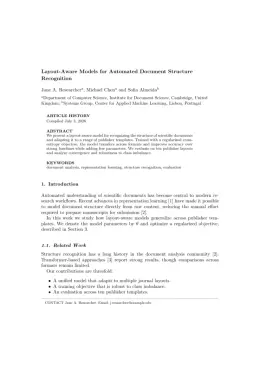
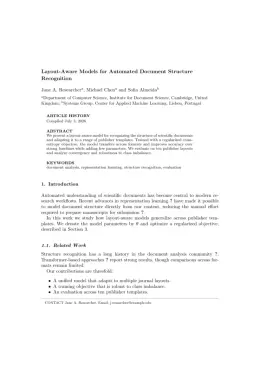
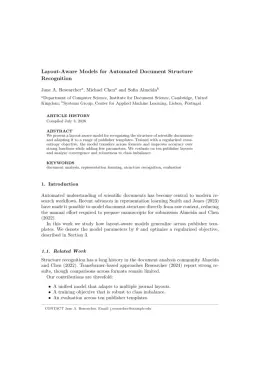
Write in a clean editor, then format for Cell Communication & Adhesion in one click — DocuGuru applies the official Taylor & Francis template with author–year references and exports a submission-ready PDF plus the editable LaTeX source. Free to start.

About the Cell Communication & Adhesion format

Cell Communication & Adhesion is a peer-reviewed journal published by Taylor & Francis, covering Connexins and lens biology, Heat shock proteins research, Cell Adhesion Molecules Research.

PublisherTaylor & Francis
Reference styleAuthor–year (Chicago, T&F)
Author–year — (Smith, 2023) in the text
Smith, Ada, Ben Jones, and Cara Lee. 2023. "A Representative Article Title." Cell Communication & Adhesion 12 (3): 45–58.

Formats any DOI in Cell Communication & Adhesion style. No sign-up.

Publishes research inConnexins and lens biology Heat shock proteins research Cell Adhesion Molecules Research Nicotinic Acetylcholine Receptors Study Cellular Mechanics and Interactions
ISSN1541-9061
h-index54
i10-index275
Total citations10,986
Top institutions publishing hereUniversity of Bonn
Journal websitewww.informapharmascience.com
You getA submission-ready PDF and the editable LaTeX source — ready to submit.

Papers published in Cell Communication & Adhesion per year

24
2006
23
2007
30
2008
16
2009
12
2010
12
2011
11
2012
25
2013
33
2014
7
2015
2
2017
3
2018

Citation impact of Cell Communication & Adhesion by publication year

766
2006
648
2007
1.3K
2008
91
2009
379
2010
301
2011
233
2012
548
2013
742
2014
240
2015
18
2017
41
2018

Citations each year’s papers have accumulated so far — the most recent years are still building up.

Most-cited papers in Cell Communication & Adhesion

An Update on Connexin Genes and their Nomenclature in Mouse and Man

Goran Söhl, Klaus Willecke · 1 Jan 2003

Gap junctions, composed of connexin protein subunits, allow direct communication through conduits between neighboring cells. Twenty and twenty-one members of the connexin gene family are likely to be expressed in the mouse and human genome, respectively, 19 of which can be grouped into sequence-orthologous pairs. Their gene structure appears to be relatively simple. In most…

Identification of Cells Expressing Cx43, Cx30, Cx26, Cx32 and Cx36 in Gap Junctions of Rat Brain and Spinal Cord

John E. Rash, Thomas Yasumura, Kimberly G. V. Davidson et al. · 1 Jan 2001

We have identified cells expressing Cx26, Cx30, Cx32, Cx36 and Cx43 in gap junctions of rat central nervous system (CNS) using confocal light microscopic immunocytochemistry and freeze-fracture replica immunogold labeling (FRIL). Confocal microscopy was used to assess general distributions of connexins, whereas the 100-fold higher resolution of FRIL allowed co-localization of several different connexins within…

Connexin43 Mimetic Peptides Reduce Swelling, Astrogliosis, and Neuronal Cell Death after Spinal Cord Injury

Simon J. O’Carroll, Mamoun Alkadhi, Louise Nicholson et al. · 1 Jan 2008

Connexin 43 (Cx43) is up-regulated after spinal cord injury (SCI). The authors tested whether mimetic peptides, corresponding to short sequences of rat Cx43, would reduce the severity of damage in a rodent ex vivo model of SCI. Eleven peptides (peptides 1 to 11) corresponding to short amino acid sequences of the extracellular loops of rat…

Mimetic Peptides as Blockers of Connexin Channel-Facilitated Intercellular Communication

William Evans, Luc Leybaert · 1 Jan 2007

There is a dearth of chemical inhibitors of connexin-mediated intercellular communication. The advent of short "designer" connexin mimetic peptides has provided new tools to inhibit connexin channels quickly and reversibly. This perspective describes the development of mimetic peptides, especially Gap 26 and 27 that are the most popular and correspond to specific sequences in the…

ERK Signaling Pathways Regulate the Osteogenic Differentiation of Human Mesenchymal Stem Cells on Collagen I and Vitronectin

Roman M. Salasznyk, Robert F. Klees, Mariah K. Hughlock et al. · 1 Jan 2004

Adhesion to the extracellular matrix (ECM) proteins collagen I and vitronectin is sufficient to drive human mesenchymal stem cells (hMSCs) into an osteogenic differentiation pathway, but the mechanisms underlying this stimulation are not well understood. We found that addition of beta1 and alpha(v)beta3 integrin blocking antibodies inhibited ECM-induced ERK activation, while addition of the MEK…

Cell Communication & Adhesion template — frequently asked questions

How do I write a paper in the Cell Communication & Adhesion format?
In DocuGuru you write your manuscript in a normal editor — no LaTeX setup required — and select the Cell Communication & Adhesion template. When you export, DocuGuru compiles the paper into the official Taylor & Francis format and hands you a submission-ready PDF along with the editable LaTeX source.
What reference style does Cell Communication & Adhesion use?
Cell Communication & Adhesion uses Author–year (Chicago, T&F) references, shown as author–year markers such as (Smith, 2023) in the text. DocuGuru formats every in-text citation and the reference list in this exact style automatically. A reference appears like this: Smith, Ada, Ben Jones, and Cara Lee. 2023. "A Representative Article Title." Cell Communication & Adhesion 12 (3): 45–58.
Do I need to know LaTeX to submit to Cell Communication & Adhesion?
No. DocuGuru generates the interact LaTeX class and compiles the PDF for you in the background, so you get a Taylor & Francis-ready Cell Communication & Adhesion document without writing any LaTeX. If you do want it, the LaTeX source is included in the export.
Can I import an existing draft into the Cell Communication & Adhesion template?
Yes. Paste or upload your current manuscript — Word, LaTeX, Markdown, or plain text — and DocuGuru reflows it into the Cell Communication & Adhesion format with correct headings, figures, tables, and author–year citations.
Who publishes Cell Communication & Adhesion?
Cell Communication & Adhesion is a multidisciplinary journal published by Taylor & Francis. DocuGuru's Cell Communication & Adhesion template matches Taylor & Francis's official submission format.
Can I export a submission-ready Cell Communication & Adhesion PDF?
Yes — DocuGuru produces a PDF built with the official Cell Communication & Adhesion template (the interact class) that is ready to submit to Taylor & Francis, together with the matching LaTeX source files.
How much does the Cell Communication & Adhesion template cost?
You can start writing in the Cell Communication & Adhesion template for free. Exporting the final submission-ready Cell Communication & Adhesion PDF and LaTeX source is part of DocuGuru's paid plans — see the app for current pricing.

Use the Cell Communication & Adhesion template