
377 citations
Cite
SaveGo to paper →
Taylor & Francis
Australian Planner Template
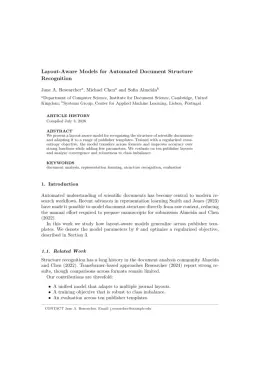
Write in a clean editor, then format for Australian Planner in one click — DocuGuru applies the official Taylor & Francis template with author–year references and exports a submission-ready PDF plus the editable LaTeX source. Free to start.
About the Australian Planner format
Australian Planner is a peer-reviewed journal published by Taylor & Francis, covering Urban Planning and Governance, Rural development and sustainability, Earthquake and Disaster Impact Studies.
| Publisher | Taylor & Francis |
|---|---|
| Reference style | Author–year (Chicago, T&F) Author–year — (Smith, 2023) in the text Smith, Ada, Ben Jones, and Cara Lee. 2023. "A Representative Article Title." Australian Planner 12 (3): 45–58.
Formats any DOI in Australian Planner style. No sign-up. |
| Publishes research in | Urban Planning and Governance Rural development and sustainability Earthquake and Disaster Impact Studies Diverse Scientific and Economic Studies Human auditory perception and evaluation |
| ISSN | 0729-3682 |
| Citation impact (2-yr) | 0.91 |
| h-index | 48 |
| i10-index | 307 |
| Total citations | 13,379 |
| Top institutions publishing here | Griffith University |
| Journal website | www.tandfonline.com |
| You get | A submission-ready PDF and the editable LaTeX source — ready to submit. |
Papers published in Australian Planner per year
Citation impact of Australian Planner by publication year
Citations each year’s papers have accumulated so far — the most recent years are still building up.
Most-cited papers in Australian Planner
The gentrification reader, edited by Loretta Leees, Tom Slater and Elvin Wyly Oxford, UK, Routledge, 2010, 617 pp., $116.95 (paperback), ISBN 978-0-415-54840-3 The Gentrification reader is a partne...
274 citations
Cite
SaveGo to paper →
The majority of the world's population now live in urban areas and the proportion is continuing to increase as people move to rapidly growing cities to fulfil their needs and aspirations. The state...
272 citations
Cite
SaveGo to paper →
City-making is an art, not a formula. The skills required to re-enchant the city are far wider than the conventional ones like architecture, engineering and land-use planning. There is no simplistic, ten-point plan, but strong principles can help send good city-making on its way. The vision for 21st century cities must be to be the…
241 citations
Cite
SaveGo to paper →
It is argued that the smart cities model promise solutions to fuel sustainable development and a high quality of life with a wise management of natural resources, through participatory action and engagement. The paper provides a critical review of this model and application attempts of smart urban technologies in contemporary cities by particularly looking into…
218 citations
Cite
SaveGo to paper →
Related journal templates
 Georisk: Assessment and Management of Risk for Engineered Systems and Geohazards
 International Journal of Computer Mathematics
 International Journal of Human-Computer Interaction
International Journal of Systems Science
Journal of Computational and Graphical Statistics
Journal of Nonparametric Statistics
Journal of Statistical Computation and Simulation
Liquid Crystals
International Journal of Human-Computer Interaction
International Journal of Systems Science
Journal of Computational and Graphical Statistics
Journal of Nonparametric Statistics
Journal of Statistical Computation and Simulation
Liquid Crystals
Australian Planner template — frequently asked questions
How do I write a paper in the Australian Planner format?
In DocuGuru you write your manuscript in a normal editor — no LaTeX setup required — and select the Australian Planner template. When you export, DocuGuru compiles the paper into the official Taylor & Francis format and hands you a submission-ready PDF along with the editable LaTeX source.
What reference style does Australian Planner use?
Australian Planner uses Author–year (Chicago, T&F) references, shown as author–year markers such as (Smith, 2023) in the text. DocuGuru formats every in-text citation and the reference list in this exact style automatically. A reference appears like this: Smith, Ada, Ben Jones, and Cara Lee. 2023. "A Representative Article Title." Australian Planner 12 (3): 45–58.
Do I need to know LaTeX to submit to Australian Planner?
No. DocuGuru generates the interact LaTeX class and compiles the PDF for you in the background, so you get a Taylor & Francis-ready Australian Planner document without writing any LaTeX. If you do want it, the LaTeX source is included in the export.
Can I import an existing draft into the Australian Planner template?
Yes. Paste or upload your current manuscript — Word, LaTeX, Markdown, or plain text — and DocuGuru reflows it into the Australian Planner format with correct headings, figures, tables, and author–year citations.
Who publishes Australian Planner?
Australian Planner is a multidisciplinary journal published by Taylor & Francis. DocuGuru's Australian Planner template matches Taylor & Francis's official submission format.
Can I export a submission-ready Australian Planner PDF?
Yes — DocuGuru produces a PDF built with the official Australian Planner template (the interact class) that is ready to submit to Taylor & Francis, together with the matching LaTeX source files.
How much does the Australian Planner template cost?
You can start writing in the Australian Planner template for free. Exporting the final submission-ready Australian Planner PDF and LaTeX source is part of DocuGuru's paid plans — see the app for current pricing.