
451 citations
Cite
SaveGo to paper →
Taylor & Francis
Australian Journal of Linguistics Template
Write in a clean editor, then format for Australian Journal of Linguistics in one click — DocuGuru applies the official Taylor & Francis template with author–year references and exports a submission-ready PDF plus the editable LaTeX source. Free to start.
About the Australian Journal of Linguistics format
Australian Journal of Linguistics is a peer-reviewed journal published by Taylor & Francis, covering Linguistic Variation and Morphology, Language, Discourse, Communication Strategies, Syntax, Semantics, Linguistic Variation.
| Publisher | Taylor & Francis |
|---|---|
| Reference style | Author–year (Chicago, T&F) Author–year — (Smith, 2023) in the text Smith, Ada, Ben Jones, and Cara Lee. 2023. "A Representative Article Title." Australian Journal of Linguistics 12 (3): 45–58.
Formats any DOI in Australian Journal of Linguistics style. No sign-up. |
| Publishes research in | Linguistic Variation and Morphology Language, Discourse, Communication Strategies Syntax, Semantics, Linguistic Variation Multilingual Education and Policy Language, Metaphor, and Cognition |
| ISSN | 0726-8602 |
| Citation impact (2-yr) | 1.22 |
| h-index | 91 |
| i10-index | 339 |
| Total citations | 21,264 |
| Top institutions publishing here | Australian National University |
| Journal website | www.tandfonline.com |
| You get | A submission-ready PDF and the editable LaTeX source — ready to submit. |
Papers published in Australian Journal of Linguistics per year
Citation impact of Australian Journal of Linguistics by publication year
Citations each year’s papers have accumulated so far — the most recent years are still building up.
Most-cited papers in Australian Journal of Linguistics
Acknowledgements Notations 1. A functional approach to writing development 2. Writing stories in subject English 3. Writing to respond to and evaluate other texts 4. Reconstructing the past: recording and describing historical events 5.Reviewing the past: interpreting, explaining, arguing and debating historical events 6. Observing and writing about the natural world 7. Interpreting phenomena of…
338 citations
Cite
SaveGo to paper →
Abstract This paper investigates the grammar of reported speech and thought in Gooniyandi, a Bunuban language of the southern Kimberley, Western Australia. According to a traditional analysis, indirect speech reports would be embedded in the clause of speech; such an analysis cannot be maintained for Gooniyandi. Nor can recent proposals such as those of Foley…
327 citations
Cite
SaveGo to paper →
1. IntroductionBakker (2003: 129) claims that ‘mixed languages’ do not arise from code-switching.The language spoken most frequently by Gurindji people between the ages of 3 andabout 45, termed ‘Gurindji Kriol’ here, is a counter-example to this generalization.This language is made up of elements of Kriol, an English based creole spoken acrossthe middle of the Northern…
316 citations
Cite
SaveGo to paper →
not speakers of Kriol, but elements that could be identified as Kriol (or Aboriginal English) appear in their Warlpiri through borrowing and code-mixing.The codemixing of older Warlpiri speakers both resembles and differs from the combination of elements in LW.A specific difference is that, when code-mixing, older Warlpiri speakers do not produce the LW auxiliary system,…
315 citations
Cite
SaveGo to paper →
Related journal templates
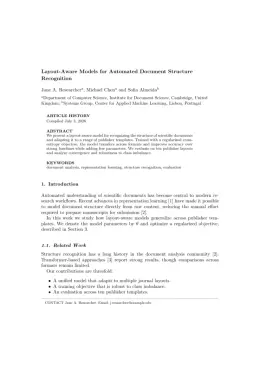
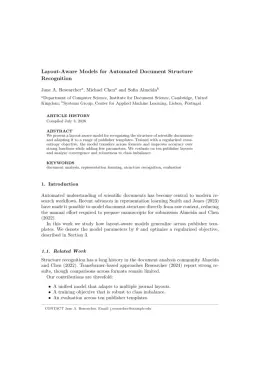
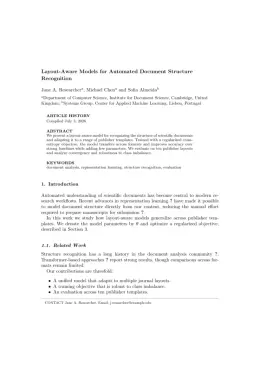
Australian Journal of Linguistics template — frequently asked questions
How do I write a paper in the Australian Journal of Linguistics format?
In DocuGuru you write your manuscript in a normal editor — no LaTeX setup required — and select the Australian Journal of Linguistics template. When you export, DocuGuru compiles the paper into the official Taylor & Francis format and hands you a submission-ready PDF along with the editable LaTeX source.
What reference style does Australian Journal of Linguistics use?
Australian Journal of Linguistics uses Author–year (Chicago, T&F) references, shown as author–year markers such as (Smith, 2023) in the text. DocuGuru formats every in-text citation and the reference list in this exact style automatically. A reference appears like this: Smith, Ada, Ben Jones, and Cara Lee. 2023. "A Representative Article Title." Australian Journal of Linguistics 12 (3): 45–58.
Do I need to know LaTeX to submit to Australian Journal of Linguistics?
No. DocuGuru generates the interact LaTeX class and compiles the PDF for you in the background, so you get a Taylor & Francis-ready Australian Journal of Linguistics document without writing any LaTeX. If you do want it, the LaTeX source is included in the export.
Can I import an existing draft into the Australian Journal of Linguistics template?
Yes. Paste or upload your current manuscript — Word, LaTeX, Markdown, or plain text — and DocuGuru reflows it into the Australian Journal of Linguistics format with correct headings, figures, tables, and author–year citations.
Who publishes Australian Journal of Linguistics?
Australian Journal of Linguistics is a multidisciplinary journal published by Taylor & Francis. DocuGuru's Australian Journal of Linguistics template matches Taylor & Francis's official submission format.
Can I export a submission-ready Australian Journal of Linguistics PDF?
Yes — DocuGuru produces a PDF built with the official Australian Journal of Linguistics template (the interact class) that is ready to submit to Taylor & Francis, together with the matching LaTeX source files.
How much does the Australian Journal of Linguistics template cost?
You can start writing in the Australian Journal of Linguistics template for free. Exporting the final submission-ready Australian Journal of Linguistics PDF and LaTeX source is part of DocuGuru's paid plans — see the app for current pricing.