Taylor & Francis

Assistive Technology Template

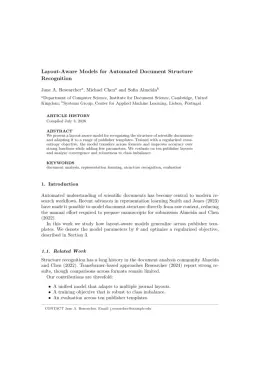
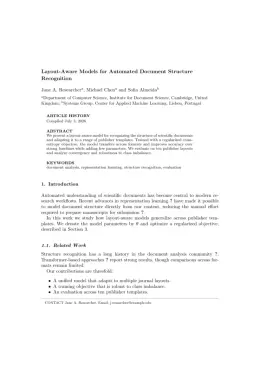
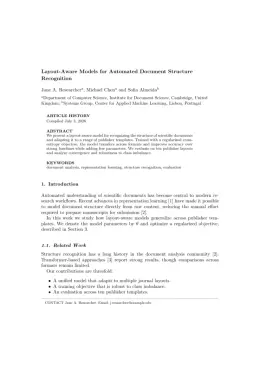
Write in a clean editor, then format for Assistive Technology in one click — DocuGuru applies the official Taylor & Francis template with author–year references and exports a submission-ready PDF plus the editable LaTeX source. Free to start.

About the Assistive Technology format

Assistive Technology is a peer-reviewed journal published by Taylor & Francis, covering Assistive Technology in Communication and Mobility, Cerebral Palsy and Movement Disorders, Spinal Cord Injury Research.

PublisherTaylor & Francis
Reference styleAuthor–year (Chicago, T&F)
Author–year — (Smith, 2023) in the text
Smith, Ada, Ben Jones, and Cara Lee. 2023. "A Representative Article Title." Assistive Technology 12 (3): 45–58.

Formats any DOI in Assistive Technology style. No sign-up.

Publishes research inAssistive Technology in Communication and Mobility Cerebral Palsy and Movement Disorders Spinal Cord Injury Research Tactile and Sensory Interactions Digital Accessibility for Disabilities
ISSN1040-0435
Citation impact (2-yr)1.26
h-index69
i10-index519
Total citations21,197
Top institutions publishing hereUniversity of Pittsburgh
Journal websitewww.tandfonline.com
You getA submission-ready PDF and the editable LaTeX source — ready to submit.

Papers published in Assistive Technology per year

30
2014
34
2015
52
2016
67
2017
39
2018
56
2019
34
2020
77
2021
45
2022
52
2023
54
2024
73
2025

Citation impact of Assistive Technology by publication year

673
2014
575
2015
905
2016
1.2K
2017
509
2018
1.1K
2019
521
2020
1.3K
2021
501
2022
342
2023
130
2024
72
2025

Citations each year’s papers have accumulated so far — the most recent years are still building up.

Most-cited papers in Assistive Technology

Predictors of Assistive Technology Abandonment

Betsy Phillips, Hongxin Zhao · 30 Jun 1993

Technology abandonment may have serious repercussions for individuals with disabilities and for society. The purpose of this study was to determine how technology users decide to accept or reject assistive devices. Two hundred twenty-seven adults with various disabilities responded to a survey on device selection, acquisition, performance, and use. Results showed that 29.3% of all…

Maximizing Usability: The Principles of Universal Design

Molly Follette Story · 30 Jun 1998

The Center for Universal Design at North Carolina State University has developed a set of seven Principles of Universal Design that may be used to guide the design process, to evaluate existing or new designs, and to teach students and practitioners. This article presents preceding design guidelines and evaluation criteria, describes the process of developing…

Development of the Quebec User Evaluation of Satisfaction with assistive Technology (QUEST)

Louise Demers, Rhoda Weiss‐Lambrou, Bernadette Ska · 30 Jun 1996

This study's purpose was to develop a clinical instrument designed to evaluate user satisfaction with assistive technology devices. This paper describes the methodology used to develop the instrument entitled the Quebec User Evaluation of Satisfaction with assistive Technology (QUEST). Based on the theoretical and practical foundations of assistive technology as well as on the concept…

Building Robota, a Mini-Humanoid Robot for the Rehabilitation of Children With Autism

Aude Billard, Ben Robins, Jacqueline Nadel et al. · 31 Mar 2007

The Robota project constructs a series of multiple-degrees-of-freedom, doll-shaped humanoid robots, whose physical features resemble those of a human baby. The Robota robots have been applied as assistive technologies in behavioral studies with low-functioning children with autism. These studies investigate the potential of using an imitator robot to assess children's imitation ability and to teach…

Supporting the Communication, Language, and Literacy Development of Children with Complex Communication Needs: State of the Science and Future Research Priorities

Janice Light, David McNaughton · 1 Mar 2012

Children with complex communication needs (CCN) resulting from autism spectrum disorders, cerebral palsy, Down syndrome and other disabilities are severely restricted in their participation in educational, vocational, family, and community environments. There is a substantial body of research that demonstrates convincingly that children with CCN derive substantial benefits from augmentative and alternative communication (AAC) in…

Assistive Technology template — frequently asked questions

How do I write a paper in the Assistive Technology format?
In DocuGuru you write your manuscript in a normal editor — no LaTeX setup required — and select the Assistive Technology template. When you export, DocuGuru compiles the paper into the official Taylor & Francis format and hands you a submission-ready PDF along with the editable LaTeX source.
What reference style does Assistive Technology use?
Assistive Technology uses Author–year (Chicago, T&F) references, shown as author–year markers such as (Smith, 2023) in the text. DocuGuru formats every in-text citation and the reference list in this exact style automatically. A reference appears like this: Smith, Ada, Ben Jones, and Cara Lee. 2023. "A Representative Article Title." Assistive Technology 12 (3): 45–58.
Do I need to know LaTeX to submit to Assistive Technology?
No. DocuGuru generates the interact LaTeX class and compiles the PDF for you in the background, so you get a Taylor & Francis-ready Assistive Technology document without writing any LaTeX. If you do want it, the LaTeX source is included in the export.
Can I import an existing draft into the Assistive Technology template?
Yes. Paste or upload your current manuscript — Word, LaTeX, Markdown, or plain text — and DocuGuru reflows it into the Assistive Technology format with correct headings, figures, tables, and author–year citations.
Who publishes Assistive Technology?
Assistive Technology is a multidisciplinary journal published by Taylor & Francis. DocuGuru's Assistive Technology template matches Taylor & Francis's official submission format.
Can I export a submission-ready Assistive Technology PDF?
Yes — DocuGuru produces a PDF built with the official Assistive Technology template (the interact class) that is ready to submit to Taylor & Francis, together with the matching LaTeX source files.
How much does the Assistive Technology template cost?
You can start writing in the Assistive Technology template for free. Exporting the final submission-ready Assistive Technology PDF and LaTeX source is part of DocuGuru's paid plans — see the app for current pricing.

Use the Assistive Technology template