Taylor & Francis

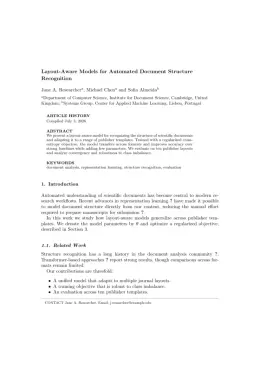
Analytical Letters Template

Write in a clean editor, then format for Analytical Letters in one click — DocuGuru applies the official Taylor & Francis template with author–year references and exports a submission-ready PDF plus the editable LaTeX source. Free to start.

About the Analytical Letters format

Analytical Letters is a peer-reviewed journal published by Taylor & Francis, covering Analytical Chemistry and Sensors, Electrochemical Analysis and Applications, Analytical chemistry methods development.

PublisherTaylor & Francis
Reference styleAuthor–year (Chicago, T&F)
Author–year — (Smith, 2023) in the text
Smith, Ada, Ben Jones, and Cara Lee. 2023. "A Representative Article Title." Analytical Letters 12 (3): 45–58.

Formats any DOI in Analytical Letters style. No sign-up.

Publishes research inAnalytical Chemistry and Sensors Electrochemical Analysis and Applications Analytical chemistry methods development Electrochemical sensors and biosensors Analytical Chemistry and Chromatography
ISSN0003-2719
Citation impact (2-yr)1.97
h-index90
i10-index4,507
Total citations137,319
Top institutions publishing hereChinese Academy of Sciences
Journal websitewww.tandfonline.com
You getA submission-ready PDF and the editable LaTeX source — ready to submit.

Papers published in Analytical Letters per year

303
2014
250
2015
244
2016
253
2017
182
2018
210
2019
258
2020
170
2021
257
2022
235
2023
241
2024
172
2025

Citation impact of Analytical Letters by publication year

4K
2014
2.9K
2015
3K
2016
2.8K
2017
2.6K
2018
3.1K
2019
3.5K
2020
1.5K
2021
1.7K
2022
1.1K
2023
814
2024
178
2025

Citations each year’s papers have accumulated so far — the most recent years are still building up.

Most-cited papers in Analytical Letters

Spectrophotometric Determination of Nitrate with a Single Reagent

Timothy A. Doane, William R. Horwáth · 10 Jan 2003

Abstract A spectrophotometric procedure for determination of nitrate in water, soil extracts, and a variety of other sample types is described using one reagent solution which is easily prepared and stored. Sample and equipment requirements are minimal. Reduced chemical hazard, simplicity, and versatility represent improvements over existing methods. Limit of detection is 0.01 µg N…

1,151 citations Cite SaveGo to paper →
Fluorescence Quantum Yields of Tryptophan and Tyrosine

Raymond F. Chen · 1 Jan 1967

Abstract Fluorescence quantum yields (Q) for tyrosine, tryptophan, and phenylalanine in water at 23° determined by the comparative method using a quinine standard were found to be 0.14, 0.13, and 0.024, respectively. Similar values were obtained with phenol as the standard. The numbers are much lower than those literature values which have been widely used…

Two-Point Calibration of Circular Dichrometer with d-10-Camphorsulfonic Acid

G. Chi Chen, Jen Tsi Yang · 1 Jan 1977

Abstract The circular dichroism (CD) of d-10-camphorsulfonic acid (CSA) in terms of ∊L - ∊R is 2.36 and -4.72 cm2 mmol−1 at 290.5 and 192.5 nm, respectively. The corresponding molar ellipticities, [⊝], are 7,800 and -15,600 deg cm2 dmol−1. A ratio of -2.00 for the negative and positive bands provides a simple two-point calibration. If…

An Electrochemical Detector for Liquid Chromatography with Picogram Sensitivity

Peter T. Kissinger, C. Refshauge, Roger Dreiling et al. · 1 May 1973

Abstract A simple liquid chromatograph with an extremely sensitive electrochemical detector is described. The detector, which can be constructed for lees than $5.00 (excluding electronics), has an actual dead volume of < 1 μl and operates well in the 50–100 picogram region. Routine quantitative work at the 5–10 nanogram level is described. Potential applications to…

Synthesis, Characterization, and Applications of Copper Nanoparticles

Muhammad Imran Din, Rida Rehan · 24 May 2016

Copper nanoparticles with different structural properties and effective biological effects may be fabricated using new green protocols. The control over particle size and in turn size-dependent properties of copper nanoparticles is expected to provide additional applications. Various methods for the synthesis of copper nanoparticles have been reported including chemical methods, physical methods, biological methods, and…

Analytical Letters template — frequently asked questions

How do I write a paper in the Analytical Letters format?
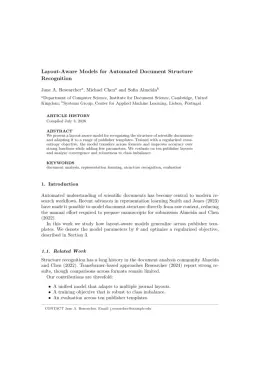
In DocuGuru you write your manuscript in a normal editor — no LaTeX setup required — and select the Analytical Letters template. When you export, DocuGuru compiles the paper into the official Taylor & Francis format and hands you a submission-ready PDF along with the editable LaTeX source.
What reference style does Analytical Letters use?
Analytical Letters uses Author–year (Chicago, T&F) references, shown as author–year markers such as (Smith, 2023) in the text. DocuGuru formats every in-text citation and the reference list in this exact style automatically. A reference appears like this: Smith, Ada, Ben Jones, and Cara Lee. 2023. "A Representative Article Title." Analytical Letters 12 (3): 45–58.
Do I need to know LaTeX to submit to Analytical Letters?
No. DocuGuru generates the interact LaTeX class and compiles the PDF for you in the background, so you get a Taylor & Francis-ready Analytical Letters document without writing any LaTeX. If you do want it, the LaTeX source is included in the export.
Can I import an existing draft into the Analytical Letters template?
Yes. Paste or upload your current manuscript — Word, LaTeX, Markdown, or plain text — and DocuGuru reflows it into the Analytical Letters format with correct headings, figures, tables, and author–year citations.
Who publishes Analytical Letters?
Analytical Letters is a multidisciplinary journal published by Taylor & Francis. DocuGuru's Analytical Letters template matches Taylor & Francis's official submission format.
Can I export a submission-ready Analytical Letters PDF?
Yes — DocuGuru produces a PDF built with the official Analytical Letters template (the interact class) that is ready to submit to Taylor & Francis, together with the matching LaTeX source files.
How much does the Analytical Letters template cost?
You can start writing in the Analytical Letters template for free. Exporting the final submission-ready Analytical Letters PDF and LaTeX source is part of DocuGuru's paid plans — see the app for current pricing.
Use the Analytical Letters template