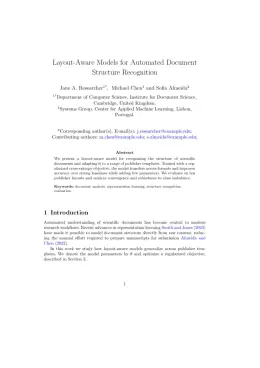
Springer Nature

npj Unconventional Computing Template

Write in a clean editor, then format for npj Unconventional Computing in one click — DocuGuru applies the official Springer Nature template with superscript references and exports a submission-ready PDF plus the editable LaTeX source. Free to start.

About the npj Unconventional Computing format

npj Unconventional Computing is a peer-reviewed journal published by Springer Nature, covering Advanced Memory and Neural Computing, Ferroelectric and Negative Capacitance Devices, Neural Networks and Reservoir Computing. Over its lifetime it has published 72 papers, which have received 316 citations.

PublisherSpringer Nature
Reference styleSuperscript numbered (Nature)
Superscript — small raised numerals in the text
1. Smith, A., Jones, B. & Lee, C. A representative article title. npj Unconventional Computing 12, 45–58 (2023).

Formats any DOI in npj Unconventional Computing style. No sign-up.

Publishes research inAdvanced Memory and Neural Computing Ferroelectric and Negative Capacitance Devices Neural Networks and Reservoir Computing Quantum Computing Algorithms and Architecture CCD and CMOS Imaging Sensors
ISSN3004-8672
Citation impact (2-yr)4.39
h-index11
i10-index12
Top institutions publishing hereUniversity of Tennessee at Knoxville
You getA submission-ready PDF and the editable LaTeX source — ready to submit.

Papers published in npj Unconventional Computing per year

15
2024
29
2025
28
2026

Citation impact of npj Unconventional Computing by publication year

157
2024
151
2025
8
2026

Citations each year’s papers have accumulated so far — the most recent years are still building up.

Most-cited papers in npj Unconventional Computing

Computing with oscillators from theoretical underpinnings to applications and demonstrators

Aida Todri‐Sanial, Corentin Delacour, Madeleine Abernot et al. · 4 Dec 2024

Networks of coupled oscillators have far-reaching implications across various fields, providing insights into a plethora of dynamics. This review offers an in-depth overview of computing with oscillators covering computational capability, synchronization occurrence and mathematical formalism. We discuss numerous circuit design implementations, technology choices and applications from pattern retrieval, combinatorial optimization problems to machine learning algorithms.…

Edge intelligence through in-sensor and near-sensor computing for the artificial intelligence of things

Yongmin Baek, Byungjoon Bae, Hyo‐Jin Shin et al. · 1 Oct 2025

Artificial intelligence technology transforms traditional sensors from passive data collectors into active computing nodes, performing data processing at the edge. This paradigm shift toward in- and near-sensor computing mitigates inherent inefficiencies associated with data traversal between sensing, memory, and processing units. We introduce emerging device technologies, circuit architectures, algorithmic frameworks, and applications implementing artificial intelligence…

Thermodynamic linear algebra

Maxwell Aifer, Kaelan Donatella, Max Hunter Gordon et al. · 5 Nov 2024

Abstract Linear algebra is central to many algorithms in engineering, science, and machine learning; hence, accelerating it would have tremendous economic impact. Quantum computing has been proposed for this purpose, although the resource requirements are far beyond current technological capabilities. We consider an alternative physics-based computing paradigm based on classical thermodynamics, to provide a near-term…

Advanced AI computing enabled by 2D material-based neuromorphic devices

YunSeok Choi, Siwoo Jeong, Hyeonu Jeong et al. · 21 Apr 2025

Neuromorphic systems are emerging as a promising alternative to revolutionize silicon-based computing devices. Two-dimensional materials are considered promising candidates for active materials due to their unique advantages. This review provides a comprehensive overview of neuromorphic computing based on 2D materials, encompassing the development from the synaptic devices based on 2D materials to the neuromorphic system…

PIM GPT a hybrid process in memory accelerator for autoregressive transformers

Yuting Wu, Ziyu Wang, Wei Lü · 25 Jul 2024

Abstract Decoder-only Transformer models such as Generative Pre-trained Transformers (GPT) have demonstrated exceptional performance in text generation by autoregressively predicting the next token. However, the efficiency of running GPT on current hardware systems is bounded by low compute-to-memory-ratio and high memory access. In this work, we propose a Process-in-memory (PIM) GPT accelerator, PIM-GPT, which achieves…

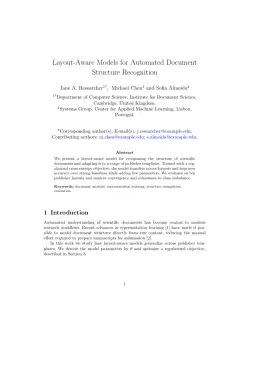
npj Unconventional Computing template — frequently asked questions

How do I write a paper in the npj Unconventional Computing format?
In DocuGuru you write your manuscript in a normal editor — no LaTeX setup required — and select the npj Unconventional Computing template. When you export, DocuGuru compiles the paper into the official Springer Nature format and hands you a submission-ready PDF along with the editable LaTeX source.
What reference style does npj Unconventional Computing use?
npj Unconventional Computing uses Superscript numbered (Nature) references, shown as superscript numerals in the text. DocuGuru formats every in-text citation and the reference list in this exact style automatically. A reference appears like this: 1. Smith, A., Jones, B. & Lee, C. A representative article title. npj Unconventional Computing 12, 45–58 (2023).
Do I need to know LaTeX to submit to npj Unconventional Computing?
No. DocuGuru generates the sn-jnl LaTeX class and compiles the PDF for you in the background, so you get a Springer Nature-ready npj Unconventional Computing document without writing any LaTeX. If you do want it, the LaTeX source is included in the export.
Can I import an existing draft into the npj Unconventional Computing template?
Yes. Paste or upload your current manuscript — Word, LaTeX, Markdown, or plain text — and DocuGuru reflows it into the npj Unconventional Computing format with correct headings, figures, tables, and superscript citations.
What is npj Unconventional Computing?
Nature Portfolio journal (Springer Nature). It is a multidisciplinary journal, published by Springer Nature.
Can I export a submission-ready npj Unconventional Computing PDF?
Yes — DocuGuru produces a PDF built with the official npj Unconventional Computing template (the sn-jnl class) that is ready to submit to Springer Nature, together with the matching LaTeX source files.
How much does the npj Unconventional Computing template cost?
You can start writing in the npj Unconventional Computing template for free. Exporting the final submission-ready npj Unconventional Computing PDF and LaTeX source is part of DocuGuru's paid plans — see the app for current pricing.
Use the npj Unconventional Computing template