
120 citations
Cite
SaveGo to paper →
Springer Nature
Glass Structures & Engineering Template
Write in a clean editor, then format for Glass Structures & Engineering in one click — DocuGuru applies the official Springer Nature template with author–year references and exports a submission-ready PDF plus the editable LaTeX source. Free to start.
About the Glass Structures & Engineering format
Glass Structures & Engineering is a peer-reviewed journal published by Springer Nature, covering Structural Analysis of Composite Materials, Building materials and conservation, Civil and Structural Engineering Research.
| Publisher | Springer Nature |
|---|---|
| Reference style | Author–year (Springer) Author–year — (Smith, 2023) in the text Smith, A., Jones, B. and Lee, C. (2023) 'A representative article title', Glass Structures & Engineering, 12(3), pp. 45–58.
Formats any DOI in the closest standard style — Glass Structures & Engineering has no published style definition, so this is an approximation. No sign-up. |
| Publishes research in | Structural Analysis of Composite Materials Building materials and conservation Civil and Structural Engineering Research Glass properties and applications Building Energy and Comfort Optimization |
| ISSN | 2363-5142 |
| Citation impact (2-yr) | 1.57 |
| h-index | 25 |
| i10-index | 100 |
| Total citations | 2,778 |
| Article processing charge | $2,790 |
| Top institutions publishing here | Technische Universität Darmstadt |
| Journal website | www.springer.com |
| You get | A submission-ready PDF and the editable LaTeX source — ready to submit. |
Papers published in Glass Structures & Engineering per year
Citation impact of Glass Structures & Engineering by publication year
Citations each year’s papers have accumulated so far — the most recent years are still building up.
Most-cited papers in Glass Structures & Engineering
74 citations
Cite
SaveGo to paper →
Abstract ’Big data’ and the use of ’Artificial Intelligence’ (AI) is currently advancing due to the increasing and even cheaper data collection and processing capabilities. Social and economical change is predicted by numerous company leaders, politicians and researchers. Machine and Deep Learning (ML/DL) are sub-types of AI, which are gaining high interest within the community…
52 citations
Cite
SaveGo to paper →
Abstract This paper presents the casting of volumetric glass components from glass waste as an alternative glass-recycling approach. The approach is characterized by its flexibility to accommodate a variety of compositions and ability to yield volumetric (solid or thick-walled) glass products that can tolerate higher contamination rates without a significant compromise to their properties. The…
49 citations
Cite
SaveGo to paper →
48 citations
Cite
SaveGo to paper →
Related journal templates
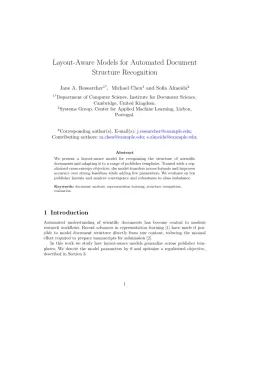
Glass Structures & Engineering template — frequently asked questions
How do I write a paper in the Glass Structures & Engineering format?
In DocuGuru you write your manuscript in a normal editor — no LaTeX setup required — and select the Glass Structures & Engineering template. When you export, DocuGuru compiles the paper into the official Springer Nature format and hands you a submission-ready PDF along with the editable LaTeX source.
What reference style does Glass Structures & Engineering use?
Glass Structures & Engineering uses Author–year (Springer) references, shown as author–year markers such as (Smith, 2023) in the text. DocuGuru formats every in-text citation and the reference list in this exact style automatically. A reference appears like this: Smith, A., Jones, B. and Lee, C. (2023) 'A representative article title', Glass Structures & Engineering, 12(3), pp. 45–58.
Do I need to know LaTeX to submit to Glass Structures & Engineering?
No. DocuGuru generates the sn-jnl LaTeX class and compiles the PDF for you in the background, so you get a Springer Nature-ready Glass Structures & Engineering document without writing any LaTeX. If you do want it, the LaTeX source is included in the export.
Can I import an existing draft into the Glass Structures & Engineering template?
Yes. Paste or upload your current manuscript — Word, LaTeX, Markdown, or plain text — and DocuGuru reflows it into the Glass Structures & Engineering format with correct headings, figures, tables, and author–year citations.
Who publishes Glass Structures & Engineering?
Glass Structures & Engineering is a physics journal published by Springer Nature. DocuGuru's Glass Structures & Engineering template matches Springer Nature's official submission format.
Can I export a submission-ready Glass Structures & Engineering PDF?
Yes — DocuGuru produces a PDF built with the official Glass Structures & Engineering template (the sn-jnl class) that is ready to submit to Springer Nature, together with the matching LaTeX source files.
How much does the Glass Structures & Engineering template cost?
You can start writing in the Glass Structures & Engineering template for free. Exporting the final submission-ready Glass Structures & Engineering PDF and LaTeX source is part of DocuGuru's paid plans — see the app for current pricing.