Springer Nature

Forest Ecosystems Template

Write in a clean editor, then format for Forest Ecosystems in one click — DocuGuru applies the official Springer Nature template with numbered references and exports a submission-ready PDF plus the editable LaTeX source. Free to start.

About the Forest Ecosystems format

Forest Ecosystems is a peer-reviewed journal published by Springer Nature, covering Forest ecology and management, Ecology and Vegetation Dynamics Studies, Plant Water Relations and Carbon Dynamics.

PublisherSpringer Nature
Reference styleNumbered (Springer Basic)
Numbered — [1], [2] in the text
1. Smith A, Jones B, Lee C (2023) A representative article title. Forest Ecosystems 12:45–58

Formats any DOI in Forest Ecosystems style. No sign-up.

Publishes research inForest ecology and management Ecology and Vegetation Dynamics Studies Plant Water Relations and Carbon Dynamics Forest Ecology and Biodiversity Studies Forest Management and Policy
ISSN2095-6355
Citation impact (2-yr)4.42
h-index59
i10-index454
Total citations17,239
Article processing charge$2,000
Open accessYes
Top institutions publishing hereChinese Academy of Sciences
Journal websiteforestecosyst.springeropen.com
You getA submission-ready PDF and the editable LaTeX source — ready to submit.

Papers published in Forest Ecosystems per year

33
2014
35
2015
28
2016
30
2017
40
2018
53
2019
64
2020
75
2021
81
2022
76
2023
125
2024
124
2025

Citation impact of Forest Ecosystems by publication year

603
2014
1.7K
2015
1.1K
2016
1.3K
2017
1.8K
2018
2.4K
2019
1.9K
2020
2K
2021
1.7K
2022
964
2023
1K
2024
323
2025

Citations each year’s papers have accumulated so far — the most recent years are still building up.

Most-cited papers in Forest Ecosystems

Silvicultural alternatives to conventional even-aged forest management - what limits global adoption?

Klaus J. Puettmann, Scott M. Wilson, Susan C. Baker et al. · 8 Apr 2015

The development of forestry as a scientific and management discipline over the last two centuries has mainly emphasized intensive management operations focused on increased commodity production, mostly wood. This “conventional” forest management approach has typically favored production of even-aged, single-species stands. While alternative management regimes have generally received less attention, this has been changing over…

The functional complex network approach to foster forest resilience to global changes

Christian Messier, Jürgen Bauhus, Frédérik Doyon et al. · 9 Apr 2019

Human impacts on Earth’s ecosystems have greatly intensified in the last decades. This is reflected in unexpected disturbance events, as well as new and increasing socio-economic demands, all of which are affecting the resilience of forest ecosystems worldwide and the provision of important ecosystem services. This Anthropocene era is forcing us to reconsider past and…

Negative consequences of positive feedbacks in US wildfire management

David E. Calkin, Matthew P. Thompson, Mark A. Finney · 13 Apr 2015

Over the last two decades wildfire activity, damage, and management cost within the US have increased substantially. These increases have been associated with a number of factors including climate change and fuel accumulation due to a century of active fire suppression. The increased fire activity has occurred during a time of significant ex-urban development of…

Young and old forest in the boreal: critical stages of ecosystem dynamics and management under global change

Timo Kuuluvainen, Sylvie Gauthier · 13 Jun 2018

The circumboreal forest encompasses diverse landscape structures, dynamics and forest age distributions determined by their physical setting, and historical and current disturbance regimes. However, due to intensifying forest utilisation, and in certain areas due to increasing natural disturbances, boreal forest age-class structures have changed rapidly, so that the proportion of old forest has substantially declined,…

Review on carbon storage estimation of forest ecosystem and applications in China

Wanlong Sun, Xuehua Liu · 30 Nov 2019

Abstract Background The accuracy in estimating forest ecosystem carbon storage has drawn extensive attention of researchers in the field of global climate change. However, incomparable data sources and various estimation methods have led to significant differences in the estimation of forest carbon storage at large scales. Methods In this study, we reviewed fundamental types of…

Forest Ecosystems template — frequently asked questions

How do I write a paper in the Forest Ecosystems format?
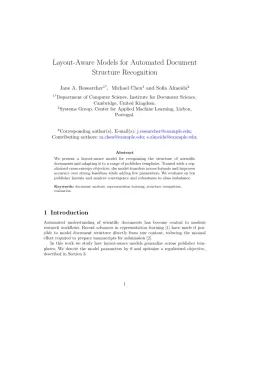
In DocuGuru you write your manuscript in a normal editor — no LaTeX setup required — and select the Forest Ecosystems template. When you export, DocuGuru compiles the paper into the official Springer Nature format and hands you a submission-ready PDF along with the editable LaTeX source.
What reference style does Forest Ecosystems use?
Forest Ecosystems uses Numbered (Springer Basic) references, shown as numbered [1], [2] markers in the text. DocuGuru formats every in-text citation and the reference list in this exact style automatically. A reference appears like this: 1. Smith A, Jones B, Lee C (2023) A representative article title. Forest Ecosystems 12:45–58
Do I need to know LaTeX to submit to Forest Ecosystems?
No. DocuGuru generates the sn-jnl LaTeX class and compiles the PDF for you in the background, so you get a Springer Nature-ready Forest Ecosystems document without writing any LaTeX. If you do want it, the LaTeX source is included in the export.
Can I import an existing draft into the Forest Ecosystems template?
Yes. Paste or upload your current manuscript — Word, LaTeX, Markdown, or plain text — and DocuGuru reflows it into the Forest Ecosystems format with correct headings, figures, tables, and numbered citations.
Who publishes Forest Ecosystems?
Forest Ecosystems is a multidisciplinary journal published by Springer Nature. DocuGuru's Forest Ecosystems template matches Springer Nature's official submission format.
Can I export a submission-ready Forest Ecosystems PDF?
Yes — DocuGuru produces a PDF built with the official Forest Ecosystems template (the sn-jnl class) that is ready to submit to Springer Nature, together with the matching LaTeX source files.
How much does the Forest Ecosystems template cost?
You can start writing in the Forest Ecosystems template for free. Exporting the final submission-ready Forest Ecosystems PDF and LaTeX source is part of DocuGuru's paid plans — see the app for current pricing.
Use the Forest Ecosystems template