Springer Nature

Communications Materials Template

Write in a clean editor, then format for Communications Materials in one click — DocuGuru applies the official Springer Nature template with superscript references and exports a submission-ready PDF plus the editable LaTeX source. Free to start.

About the Communications Materials format

Communications Materials is a peer-reviewed journal published by Springer Nature, covering 2D Materials and Applications, Topological Materials and Phenomena, Advancements in Battery Materials. Over its lifetime it has published 1,224 papers, which have received 23,802 citations.

PublisherSpringer Nature
Reference styleSuperscript numbered (Nature)
Superscript — small raised numerals in the text
1. Smith, A., Jones, B. & Lee, C. A representative article title. Communications Materials 12, 45–58 (2023).

Formats any DOI in Communications Materials style. No sign-up.

Publishes research in2D Materials and Applications Topological Materials and Phenomena Advancements in Battery Materials Advanced Condensed Matter Physics Perovskite Materials and Applications
ISSN2662-4443
Citation impact (2-yr)7.98
h-index67
i10-index549
Article processing charge$2,661
Open accessYes — indexed in DOAJ
Top institutions publishing hereCentre National de la Recherche Scientifique
Journal websitewww.nature.com
You getA submission-ready PDF and the editable LaTeX source — ready to submit.

Papers published in Communications Materials per year

1
2019
103
2020
118
2021
104
2022
111
2023
280
2024
320
2025

Citation impact of Communications Materials by publication year

21
2019
5.2K
2020
4.9K
2021
4.4K
2022
3K
2023
4.5K
2024
1.6K
2025

Citations each year’s papers have accumulated so far — the most recent years are still building up.

Most-cited papers in Communications Materials

Future material demand for automotive lithium-based batteries

Chengjian Xu, Qiang Dai, Linda Gaines et al. · 9 Dec 2020

Abstract The world is shifting to electric vehicles to mitigate climate change. Here, we quantify the future demand for key battery materials, considering potential electric vehicle fleet and battery chemistry developments as well as second-use and recycling of electric vehicle batteries. We find that in a lithium nickel cobalt manganese oxide dominated battery scenario, demand…

Graph neural networks for materials science and chemistry

Patrick Reiser, Marlen Neubert, André Eberhard et al. · 26 Nov 2022

Machine learning plays an increasingly important role in many areas of chemistry and materials science, being used to predict materials properties, accelerate simulations, design new structures, and predict synthesis routes of new materials. Graph neural networks (GNNs) are one of the fastest growing classes of machine learning models. They are of particular relevance for chemistry…

Next-generation applications for integrated perovskite solar cells

Abdulaziz S. R. Bati, Yu Lin Zhong, Paul L. Burn et al. · 5 Jan 2023

Abstract Organic/inorganic metal halide perovskites attract substantial attention as key materials for next-generation photovoltaic technologies due to their potential for low cost, high performance, and solution processability. The unique properties of perovskites and the rapid advances that have been made in solar cell performance have facilitated their integration into a broad range of practical applications,…

Spintronic devices for energy-efficient data storage and energy harvesting

Jorge Puebla, Junyeon Kim, Kouta Kondou et al. · 7 May 2020

Abstract The current data revolution has, in part, been enabled by decades of research into magnetism and spin phenomena. For example, milestones such as the observation of giant magnetoresistance, and the resulting development of the spin-valve read head, continue to motivate device research. However, the ever-growing need for higher data processing speeds and larger data…

Antiviral surfaces and coatings and their mechanisms of action

Paulina D. Rakowska, Mariavitalia Tiddia, Nilofar Faruqui et al. · 28 May 2021

Abstract Viral infections are a serious health challenge, and the COVID-19 pandemic has increased the demand for antiviral measures and treatments for clean surfaces, especially in public places. Here, we review a range of natural and synthetic surface materials and coatings with antiviral properties, including metals, polymers and biopolymers, graphene and antimicrobial peptides, and their…

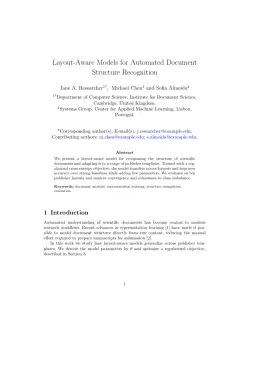
Communications Materials template — frequently asked questions

How do I write a paper in the Communications Materials format?
In DocuGuru you write your manuscript in a normal editor — no LaTeX setup required — and select the Communications Materials template. When you export, DocuGuru compiles the paper into the official Springer Nature format and hands you a submission-ready PDF along with the editable LaTeX source.
What reference style does Communications Materials use?
Communications Materials uses Superscript numbered (Nature) references, shown as superscript numerals in the text. DocuGuru formats every in-text citation and the reference list in this exact style automatically. A reference appears like this: 1. Smith, A., Jones, B. & Lee, C. A representative article title. Communications Materials 12, 45–58 (2023).
Do I need to know LaTeX to submit to Communications Materials?
No. DocuGuru generates the sn-jnl LaTeX class and compiles the PDF for you in the background, so you get a Springer Nature-ready Communications Materials document without writing any LaTeX. If you do want it, the LaTeX source is included in the export.
Can I import an existing draft into the Communications Materials template?
Yes. Paste or upload your current manuscript — Word, LaTeX, Markdown, or plain text — and DocuGuru reflows it into the Communications Materials format with correct headings, figures, tables, and superscript citations.
What is Communications Materials?
Nature Portfolio journal (Springer Nature). It is a multidisciplinary journal, published by Springer Nature.
Can I export a submission-ready Communications Materials PDF?
Yes — DocuGuru produces a PDF built with the official Communications Materials template (the sn-jnl class) that is ready to submit to Springer Nature, together with the matching LaTeX source files.
How much does the Communications Materials template cost?
You can start writing in the Communications Materials template for free. Exporting the final submission-ready Communications Materials PDF and LaTeX source is part of DocuGuru's paid plans — see the app for current pricing.
Use the Communications Materials template
