Springer Nature

EURASIP Journal on Information Security Template

Write in a clean editor, then format for EURASIP Journal on Information Security in one click — DocuGuru applies the official Springer Nature template with superscript references and exports a submission-ready PDF plus the editable LaTeX source. Free to start.

About the EURASIP Journal on Information Security format

EURASIP Journal on Information Security is a peer-reviewed journal published by Springer Nature, covering Network Security and Intrusion Detection, Advanced Malware Detection Techniques, Digital Media Forensic Detection.

PublisherSpringer Nature
Reference styleSuperscript numbered (Nature)
Superscript — small raised numerals in the text
1. Smith, A., Jones, B. & Lee, C. A representative article title. EURASIP Journal on Information Security 12, 45–58 (2023).

Formats any DOI in EURASIP Journal on Information Security style. No sign-up.

Publishes research inNetwork Security and Intrusion Detection Advanced Malware Detection Techniques Digital Media Forensic Detection Advanced Steganography and Watermarking Techniques Internet Traffic Analysis and Secure E-voting
ISSN2510-523X
Citation impact (2-yr)4.68
h-index24
i10-index61
Total citations2,591
Article processing charge$809
Open accessYes
Top institutions publishing hereCentre National de la Recherche Scientifique
Journal websitejis-eurasipjournals.springeropen.com
You getA submission-ready PDF and the editable LaTeX source — ready to submit.

Papers published in EURASIP Journal on Information Security per year

13
2017
13
2018
16
2019
15
2020
12
2021
9
2022
12
2023
36
2024
38
2025

Citation impact of EURASIP Journal on Information Security by publication year

469
2017
284
2018
590
2019
414
2020
270
2021
91
2022
101
2023
174
2024
136
2025

Citations each year’s papers have accumulated so far — the most recent years are still building up.

Most-cited papers in EURASIP Journal on Information Security

VISION: a video and image dataset for source identification

Dasara Shullani, Marco Fontani, Massimo Iuliani et al. · 3 Oct 2017

Forensic research community keeps proposing new techniques to analyze digital images and videos. However, the performance of proposed tools are usually tested on data that are far from reality in terms of resolution, source device, and processing history. Remarkably, in the latest years, portable devices became the preferred means to capture images and videos, and…

IoT cyber risk: a holistic analysis of cyber risk assessment frameworks, risk vectors, and risk ranking process

Kamalanathan Kandasamy, Sethuraman Srinivas, Krishnashree Achuthan et al. · 26 May 2020

Abstract Security vulnerabilities of the modern Internet of Things (IoT) systems are unique, mainly due to the complexity and heterogeneity of the technology and data. The risks born out of these IoT systems cannot easily fit into an existing risk framework. There are many cybersecurity risk assessment approaches and frameworks that are under deployment in…

Transfer learning for detecting unknown network attacks

Juan Zhao, Sachin Shetty, Jan Wei Pan et al. · 21 Feb 2019

Network attacks are serious concerns in today’s increasingly interconnected society. Recent studies have applied conventional machine learning to network attack detection by learning the patterns of the network behaviors and training a classification model. These models usually require large labeled datasets; however, the rapid pace and unpredictability of cyber attacks make this labeling impossible in…

Implementing a blockchain from scratch: why, how, and what we learned

Fabian Knirsch, Andreas Unterweger, Dominik Engel · 11 Mar 2019

Blockchains are proposed for many application domains apart from financial transactions. While there are generic blockchains that can be molded for specific use cases, they often lack a lightweight and easy-to-customize implementation. In this paper, we introduce the core concepts of blockchain technology and investigate a real-world use case from the energy domain, where customers…

A deep learning framework for predicting cyber attacks rates

Xing Fang, Maochao Xu, Shouhuai Xu et al. · 22 May 2019

Like how useful weather forecasting is, the capability of forecasting or predicting cyber threats can never be overestimated. Previous investigations show that cyber attack data exhibits interesting phenomena, such as long-range dependence and high nonlinearity, which impose a particular challenge on modeling and predicting cyber attack rates. Deviating from the statistical approach that is utilized…

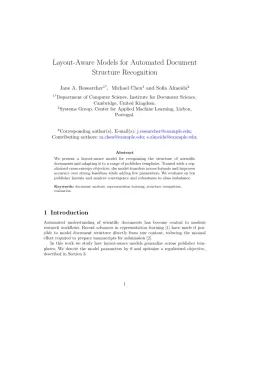
EURASIP Journal on Information Security template — frequently asked questions

How do I write a paper in the EURASIP Journal on Information Security format?
In DocuGuru you write your manuscript in a normal editor — no LaTeX setup required — and select the EURASIP Journal on Information Security template. When you export, DocuGuru compiles the paper into the official Springer Nature format and hands you a submission-ready PDF along with the editable LaTeX source.
What reference style does EURASIP Journal on Information Security use?
EURASIP Journal on Information Security uses Superscript numbered (Nature) references, shown as superscript numerals in the text. DocuGuru formats every in-text citation and the reference list in this exact style automatically. A reference appears like this: 1. Smith, A., Jones, B. & Lee, C. A representative article title. EURASIP Journal on Information Security 12, 45–58 (2023).
Do I need to know LaTeX to submit to EURASIP Journal on Information Security?
No. DocuGuru generates the sn-jnl LaTeX class and compiles the PDF for you in the background, so you get a Springer Nature-ready EURASIP Journal on Information Security document without writing any LaTeX. If you do want it, the LaTeX source is included in the export.
Can I import an existing draft into the EURASIP Journal on Information Security template?
Yes. Paste or upload your current manuscript — Word, LaTeX, Markdown, or plain text — and DocuGuru reflows it into the EURASIP Journal on Information Security format with correct headings, figures, tables, and superscript citations.
Who publishes EURASIP Journal on Information Security?
EURASIP Journal on Information Security is a multidisciplinary journal published by Springer Nature. DocuGuru's EURASIP Journal on Information Security template matches Springer Nature's official submission format.
Can I export a submission-ready EURASIP Journal on Information Security PDF?
Yes — DocuGuru produces a PDF built with the official EURASIP Journal on Information Security template (the sn-jnl class) that is ready to submit to Springer Nature, together with the matching LaTeX source files.
How much does the EURASIP Journal on Information Security template cost?
You can start writing in the EURASIP Journal on Information Security template for free. Exporting the final submission-ready EURASIP Journal on Information Security PDF and LaTeX source is part of DocuGuru's paid plans — see the app for current pricing.
Use the EURASIP Journal on Information Security template