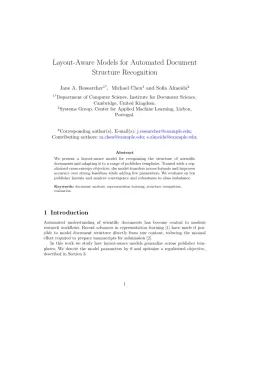
About the Digital Society format
Digital Society is a peer-reviewed journal published by Springer Nature, covering Ethics and Social Impacts of AI, Privacy, Security, and Data Protection, Artificial Intelligence in Healthcare and Education.
| Publisher | Springer Nature |
|---|
| Reference style | Superscript numbered (Nature) Superscript — small raised numerals in the text
1. Smith, A., Jones, B. & Lee, C. A representative article title. Digital Society 12, 45–58 (2023).
Formats any DOI in Digital Society style. No sign-up.
|
|---|
| Publishes research in | Ethics and Social Impacts of AI Privacy, Security, and Data Protection Artificial Intelligence in Healthcare and Education Neuroethics, Human Enhancement, Biomedical Innovations Blockchain Technology Applications and Security |
|---|
| ISSN | 2731-4650 |
|---|
| Citation impact (2-yr) | 4.12 |
|---|
| h-index | 24 |
|---|
| i10-index | 61 |
|---|
| Total citations | 2,203 |
|---|
| Top institutions publishing here | Utrecht University |
|---|
| You get | A submission-ready PDF and the editable LaTeX source — ready to submit. |
|---|
Papers published in Digital Society per year
Citation impact of Digital Society by publication year
Citations each year’s papers have accumulated so far — the most recent years are still building up.
Most-cited papers in Digital Society
Deepfakes and Democracy (Theory): How Synthetic Audio-Visual Media for Disinformation and Hate Speech Threaten Core Democratic Functions
Maria Pawelec · 1 Sep 2022
Observers fear that deepfakes will shake the very foundations of democracy. Notwithstanding, in-depth scholarly analyses of deepfakes' political impact are rare, and do not consider theories of democracy. This contribution helps close this research gap, drawing on Warren's problem-oriented democracy theory, as well as theories of deliberative democracy and contributions on the role of trust…
AI Ethics, Ethics Washing, and the Need to Politicize Data Ethics
Gijs van Maanen · 2 Aug 2022
Many commercial actors in the tech sector publish ethics guidelines as a means to 'wash away' concerns raised about their policies. For some academics, this phenomenon is reason to replace ethics with other tools and methods in an attempt to make sure that the tech sector does not cross any moral Rubicons. Others warn against…
Auditing of AI: Legal, Ethical and Technical Approaches
Jakob Mökander · 8 Nov 2023
Abstract AI auditing is a rapidly growing field of research and practice. This review article, which doubles as an editorial to Digital Society’s topical collection on ‘Auditing of AI’, provides an overview of previous work in the field. Three key points emerge from the review. First, contemporary attempts to audit AI systems have much to…
AI Risk Assessment: A Scenario-Based, Proportional Methodology for the AI Act
Claudio Novelli, Federico Casolari, Antonino Rotolo et al. · 7 Mar 2024
Abstract The EU Artificial Intelligence Act (AIA) defines four risk categories for AI systems: unacceptable, high, limited, and minimal. However, it lacks a clear methodology for the assessment of these risks in concrete situations. Risks are broadly categorized based on the application areas of AI systems and ambiguous risk factors. This paper suggests a methodology…
Continuous Auditing of Artificial Intelligence: a Conceptualization and Assessment of Tools and Frameworks
Matti Minkkinen, Joakim Laine, Matti Mäntymäki · 4 Oct 2022
Abstract Artificial intelligence (AI), which refers to both a research field and a set of technologies, is rapidly growing and has already spread to application areas ranging from policing to healthcare and transport. The increasing AI capabilities bring novel risks and potential harms to individuals and societies, which auditing of AI seeks to address. However,…