Springer Nature

Computational Brain & Behavior Template

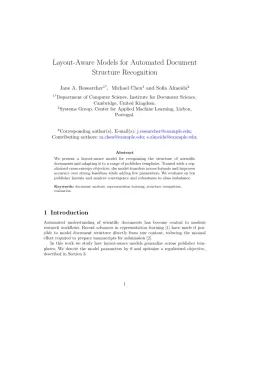
Write in a clean editor, then format for Computational Brain & Behavior in one click — DocuGuru applies the official Springer Nature template with superscript references and exports a submission-ready PDF plus the editable LaTeX source. Free to start.

About the Computational Brain & Behavior format

Computational Brain & Behavior is a peer-reviewed journal published by Springer Nature, covering Neural and Behavioral Psychology Studies, Decision-Making and Behavioral Economics, Neural dynamics and brain function.

PublisherSpringer Nature
Reference styleSuperscript numbered (Nature)
Superscript — small raised numerals in the text
1. Smith, A., Jones, B. & Lee, C. A representative article title. Computational Brain & Behavior 12, 45–58 (2023).

Formats any DOI in Computational Brain & Behavior style. No sign-up.

Publishes research inNeural and Behavioral Psychology Studies Decision-Making and Behavioral Economics Neural dynamics and brain function Mental Health Research Topics Philosophy and History of Science
ISSN2522-0861
Citation impact (2-yr)2.43
h-index30
i10-index97
Total citations3,540
Article processing charge$2,990
Top institutions publishing hereUniversity of Amsterdam
Journal websitewww.springer.com
You getA submission-ready PDF and the editable LaTeX source — ready to submit.

Papers published in Computational Brain & Behavior per year

21
2018
51
2019
26
2020
24
2021
39
2022
31
2023
41
2024
32
2025

Citation impact of Computational Brain & Behavior by publication year

862
2018
792
2019
500
2020
359
2021
466
2022
257
2023
223
2024
35
2025

Citations each year’s papers have accumulated so far — the most recent years are still building up.

Most-cited papers in Computational Brain & Behavior

Limitations of Bayesian Leave-One-Out Cross-Validation for Model Selection

Quentin F. Gronau, Eric‐Jan Wagenmakers · 27 Sep 2018

Cross-validation (CV) is increasingly popular as a generic method to adjudicate between mathematical models of cognition and behavior. In order to measure model generalizability, CV quantifies out-of-sample predictive performance, and the CV preference goes to the model that predicted the out-of-sample data best. The advantages of CV include theoretic simplicity and practical feasibility. Despite its…

Limitations of “Limitations of Bayesian Leave-one-out Cross-Validation for Model Selection”

Aki Vehtari, Daniel Simpson, Yuling Yao et al. · 30 Nov 2018

In an earlier article in this journal, Gronau and Wagenmakers (2018) discuss some problems with leave-one-out cross-validation (LOO) for Bayesian model selection. However, the variant of LOO that Gronau and Wagenmakers discuss is at odds with a long literature on how to use LOO well. In this discussion, we discuss the use of LOO in…

On Logical Inference over Brains, Behaviour, and Artificial Neural Networks

Olivia Guest, Andrea E. Martin · 13 Feb 2023

Abstract In the cognitive, computational, and neuro-sciences, practitioners often reason about what computational models represent or learn, as well as what algorithm is instantiated. The putative goal of such reasoning is to generalize claims about the model in question, to claims about the mind and brain, and the neurocognitive capacities of those systems. Such inference…

Computational Brain & Behavior template — frequently asked questions

How do I write a paper in the Computational Brain & Behavior format?
In DocuGuru you write your manuscript in a normal editor — no LaTeX setup required — and select the Computational Brain & Behavior template. When you export, DocuGuru compiles the paper into the official Springer Nature format and hands you a submission-ready PDF along with the editable LaTeX source.
What reference style does Computational Brain & Behavior use?
Computational Brain & Behavior uses Superscript numbered (Nature) references, shown as superscript numerals in the text. DocuGuru formats every in-text citation and the reference list in this exact style automatically. A reference appears like this: 1. Smith, A., Jones, B. & Lee, C. A representative article title. Computational Brain & Behavior 12, 45–58 (2023).
Do I need to know LaTeX to submit to Computational Brain & Behavior?
No. DocuGuru generates the sn-jnl LaTeX class and compiles the PDF for you in the background, so you get a Springer Nature-ready Computational Brain & Behavior document without writing any LaTeX. If you do want it, the LaTeX source is included in the export.
Can I import an existing draft into the Computational Brain & Behavior template?
Yes. Paste or upload your current manuscript — Word, LaTeX, Markdown, or plain text — and DocuGuru reflows it into the Computational Brain & Behavior format with correct headings, figures, tables, and superscript citations.
Who publishes Computational Brain & Behavior?
Computational Brain & Behavior is a multidisciplinary journal published by Springer Nature. DocuGuru's Computational Brain & Behavior template matches Springer Nature's official submission format.
Can I export a submission-ready Computational Brain & Behavior PDF?
Yes — DocuGuru produces a PDF built with the official Computational Brain & Behavior template (the sn-jnl class) that is ready to submit to Springer Nature, together with the matching LaTeX source files.
How much does the Computational Brain & Behavior template cost?
You can start writing in the Computational Brain & Behavior template for free. Exporting the final submission-ready Computational Brain & Behavior PDF and LaTeX source is part of DocuGuru's paid plans — see the app for current pricing.

Use the Computational Brain & Behavior template