
325 citations
Cite
SaveGo to paper →
Springer Nature
Clinical and Translational Imaging Template
Write in a clean editor, then format for Clinical and Translational Imaging in one click — DocuGuru applies the official Springer Nature template with numbered references and exports a submission-ready PDF plus the editable LaTeX source. Free to start.
About the Clinical and Translational Imaging format
Clinical and Translational Imaging is a peer-reviewed journal published by Springer Nature, covering Medical Imaging Techniques and Applications, Radiomics and Machine Learning in Medical Imaging, Radiopharmaceutical Chemistry and Applications.
| Publisher | Springer Nature |
|---|---|
| Reference style | Numbered (Springer Basic) Numbered — [1], [2] in the text 1. Smith A, Jones B, Lee C (2023) A representative article title. Clinical and Translational Imaging 12:45–58
Formats any DOI in Clinical and Translational Imaging style. No sign-up. |
| Publishes research in | Medical Imaging Techniques and Applications Radiomics and Machine Learning in Medical Imaging Radiopharmaceutical Chemistry and Applications Prostate Cancer Treatment and Research Advanced MRI Techniques and Applications |
| ISSN | 2281-5872 |
| Citation impact (2-yr) | 1.21 |
| h-index | 46 |
| i10-index | 183 |
| Total citations | 8,392 |
| Article processing charge | $3,860 |
| Top institutions publishing here | Istituti di Ricovero e Cura a Carattere Scientifico |
| Journal website | link.springer.com |
| You get | A submission-ready PDF and the editable LaTeX source — ready to submit. |
Papers published in Clinical and Translational Imaging per year
Citation impact of Clinical and Translational Imaging by publication year
Citations each year’s papers have accumulated so far — the most recent years are still building up.
Most-cited papers in Clinical and Translational Imaging
F)-labeled stilbene derivative that was developed as a positron emission tomography (PET) tracer for routine clinical application to visualize β-amyloid plaques in the Alzheimer's disease (AD) brain. The tracer successfully completed a global multicenter phase 0-III development program and was, as a consequence, recently approved by the US Food and Drug Administration and the European…
183 citations
Cite
SaveGo to paper →
To provide an overview on positron emission tomography (PET) imaging of tau pathology in Alzheimer’s disease (AD) and other neurodegenerative disorders. Different classes of tau tracers such as flortaucipir, THK5317, and PBB3 have been developed and utilized in previous clinical studies. In AD, the topographical distribution of tracer binding follows the known distribution of neurofibrillary…
182 citations
Cite
SaveGo to paper →
171 citations
Cite
SaveGo to paper →
PURPOSE: Hypoxia is a condition of insufficient oxygen to support metabolism which occurs when the vascular supply is interrupted, or when a tumour outgrows its vascular supply. It is a negative prognostic factor due to its association with an aggressive tumour phenotype and therapeutic resistance. This review provides an overview of hypoxia imaging with Positron…
161 citations
Cite
SaveGo to paper →
Related journal templates
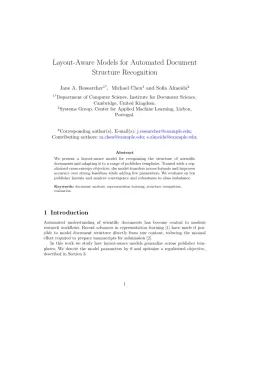
Clinical and Translational Imaging template — frequently asked questions
How do I write a paper in the Clinical and Translational Imaging format?
In DocuGuru you write your manuscript in a normal editor — no LaTeX setup required — and select the Clinical and Translational Imaging template. When you export, DocuGuru compiles the paper into the official Springer Nature format and hands you a submission-ready PDF along with the editable LaTeX source.
What reference style does Clinical and Translational Imaging use?
Clinical and Translational Imaging uses Numbered (Springer Basic) references, shown as numbered [1], [2] markers in the text. DocuGuru formats every in-text citation and the reference list in this exact style automatically. A reference appears like this: 1. Smith A, Jones B, Lee C (2023) A representative article title. Clinical and Translational Imaging 12:45–58
Do I need to know LaTeX to submit to Clinical and Translational Imaging?
No. DocuGuru generates the sn-jnl LaTeX class and compiles the PDF for you in the background, so you get a Springer Nature-ready Clinical and Translational Imaging document without writing any LaTeX. If you do want it, the LaTeX source is included in the export.
Can I import an existing draft into the Clinical and Translational Imaging template?
Yes. Paste or upload your current manuscript — Word, LaTeX, Markdown, or plain text — and DocuGuru reflows it into the Clinical and Translational Imaging format with correct headings, figures, tables, and numbered citations.
Who publishes Clinical and Translational Imaging?
Clinical and Translational Imaging is a multidisciplinary journal published by Springer Nature. DocuGuru's Clinical and Translational Imaging template matches Springer Nature's official submission format.
Can I export a submission-ready Clinical and Translational Imaging PDF?
Yes — DocuGuru produces a PDF built with the official Clinical and Translational Imaging template (the sn-jnl class) that is ready to submit to Springer Nature, together with the matching LaTeX source files.
How much does the Clinical and Translational Imaging template cost?
You can start writing in the Clinical and Translational Imaging template for free. Exporting the final submission-ready Clinical and Translational Imaging PDF and LaTeX source is part of DocuGuru's paid plans — see the app for current pricing.