SAGE

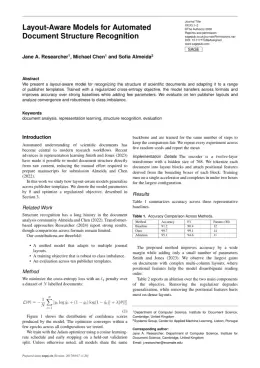
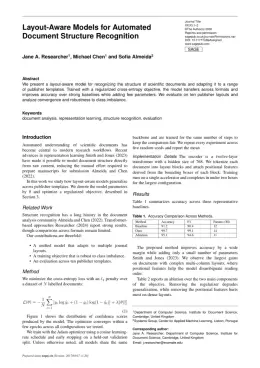
Personality and Social Psychology Review Template

Write in a clean editor, then format for Personality and Social Psychology Review in one click — DocuGuru applies the official SAGE template with author–year references and exports a submission-ready PDF plus the editable LaTeX source. Free to start.

About the Personality and Social Psychology Review format

Personality and Social Psychology Review is a peer-reviewed journal published by SAGE, covering Social and Intergroup Psychology, Cultural Differences and Values, Behavioral Health and Interventions. Over its lifetime it has published 615 papers, which have received 178,196 citations.

PublisherSAGE
Reference styleAuthor–year (Harvard)
Author–year — (Smith, 2023) in the text
Smith, A., Jones, B. and Lee, C. (2023) 'A representative article title', Personality and Social Psychology Review, 12(3), pp. 45–58.

Formats any DOI in Personality and Social Psychology Review style. No sign-up.

Publishes research inSocial and Intergroup Psychology Cultural Differences and Values Behavioral Health and Interventions Psychology of Moral and Emotional Judgment Evolutionary Psychology and Human Behavior
ISSN1088-8683
Citation impact (2-yr)10.77
h-index226
i10-index519
Top institutions publishing hereUniversity of Southern California
Journal websitepsr.sagepub.com
You getA submission-ready PDF and the editable LaTeX source — ready to submit.

Papers published in Personality and Social Psychology Review per year

26
2014
22
2015
12
2016
13
2017
16
2018
11
2019
10
2020
13
2021
20
2022
14
2023
19
2024
22
2025

Citation impact of Personality and Social Psychology Review by publication year

7K
2014
4.5K
2015
2.9K
2016
3.3K
2017
2.3K
2018
1.6K
2019
906
2020
845
2021
1.1K
2022
675
2023
464
2024
59
2025

Citations each year’s papers have accumulated so far — the most recent years are still building up.

Most-cited papers in Personality and Social Psychology Review

Negativity Bias, Negativity Dominance, and Contagion

Paul Rozin, Edward B. Royzman · 1 Nov 2001

We hypothesize that there is a general bias, based on both innatepredispositions and experience, in animals and humans, to give greater weight to negative entities (e.g., events, objects, personal traits). This is manifested in 4 ways: (a) negative potency (negative entities are stronger than the equivalent positive entities), (b) steeper negative gradients (the negativity of…

4,289 citations Cite SaveGo to paper →
Reflective and Impulsive Determinants of Social Behavior

Fritz Strack, Roland Deutsch · 1 Aug 2004

This article describes a 2-systems model that explains social behavior as a joint function of reflective and impulsive processes. In particular, it is assumed that social behavior is controlled by 2 interacting systems that follow different operating principles. The reflective system generates behavioral decisions that are based on knowledge about facts and values, whereas the…

3,988 citations Cite SaveGo to paper →
Moral Disengagement in the Perpetration of Inhumanities

Albert Bandura · 1 Aug 1999

Moral agency is manifested in both the power to refrain from behaving inhumanely and the proactive power to behave humanely. Moral agency is embedded in a broader sociocognitive self theory encompassing self-organizing, proactive, self-reflective, and self-regulatory mechanisms rooted in personal standards linked to self-sanctions. The self-regulatory mechanisms governing moral conduct do not come into play…

3,966 citations Cite SaveGo to paper →
Dehumanization: An Integrative Review

Nick Haslam · 22 Jul 2006

The concept of dehumanization lacks a systematic theoretical basis, and research that addresses it has yet to be integrated. Manifestations and theories of dehumanization are reviewed, and a new model is developed. Two forms of dehumanization are proposed, involving the denial to others of 2 distinct senses of humanness: characteristics that are uniquely human and…

2,853 citations Cite SaveGo to paper →
Processing Fluency and Aesthetic Pleasure: Is Beauty in the Perceiver's Processing Experience?

Rolf Reber, Norbert Schwarz, Piotr Winkielman · 1 Nov 2004

We propose that aesthetic pleasure is a function of the perceiver's processing dynamics: The more fluently perceivers can process an object, the more positive their aesthetic response. We review variables known to influence aesthetic judgments, such as figural goodness, figure-ground contrast, stimulus repetition, symmetry, and prototypicality, and trace their effects to changes in processing fluency.…

2,815 citations Cite SaveGo to paper →

Personality and Social Psychology Review template — frequently asked questions

How do I write a paper in the Personality and Social Psychology Review format?
In DocuGuru you write your manuscript in a normal editor — no LaTeX setup required — and select the Personality and Social Psychology Review template. When you export, DocuGuru compiles the paper into the official SAGE format and hands you a submission-ready PDF along with the editable LaTeX source.
What reference style does Personality and Social Psychology Review use?
Personality and Social Psychology Review uses Author–year (Harvard) references, shown as author–year markers such as (Smith, 2023) in the text. DocuGuru formats every in-text citation and the reference list in this exact style automatically. A reference appears like this: Smith, A., Jones, B. and Lee, C. (2023) 'A representative article title', Personality and Social Psychology Review, 12(3), pp. 45–58.
Do I need to know LaTeX to submit to Personality and Social Psychology Review?
No. DocuGuru generates the sagej LaTeX class and compiles the PDF for you in the background, so you get a SAGE-ready Personality and Social Psychology Review document without writing any LaTeX. If you do want it, the LaTeX source is included in the export.
Can I import an existing draft into the Personality and Social Psychology Review template?
Yes. Paste or upload your current manuscript — Word, LaTeX, Markdown, or plain text — and DocuGuru reflows it into the Personality and Social Psychology Review format with correct headings, figures, tables, and author–year citations.
What is Personality and Social Psychology Review?
SAGE journal (sagej). It is a multidisciplinary journal, published by SAGE.
Can I export a submission-ready Personality and Social Psychology Review PDF?
Yes — DocuGuru produces a PDF built with the official Personality and Social Psychology Review template (the sagej class) that is ready to submit to SAGE, together with the matching LaTeX source files.
How much does the Personality and Social Psychology Review template cost?
You can start writing in the Personality and Social Psychology Review template for free. Exporting the final submission-ready Personality and Social Psychology Review PDF and LaTeX source is part of DocuGuru's paid plans — see the app for current pricing.
Use the Personality and Social Psychology Review template