SAGE

Journal of Information Science Template

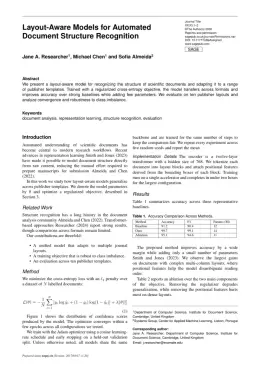
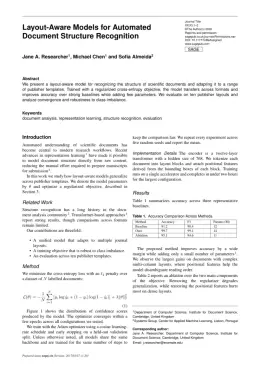
Write in a clean editor, then format for Journal of Information Science in one click — DocuGuru applies the official SAGE template with author–year references and exports a submission-ready PDF plus the editable LaTeX source. Free to start.

About the Journal of Information Science format

Journal of Information Science is a peer-reviewed journal published by SAGE, covering scientometrics and bibliometrics research, Semantic Web and Ontologies, Advanced Text Analysis Techniques.

PublisherSAGE
Reference styleAuthor–year (Harvard)
Author–year — (Smith, 2023) in the text
Smith, A., Jones, B. and Lee, C. (2023) 'A representative article title', Journal of Information Science, 12(3), pp. 45–58.

Formats any DOI in Journal of Information Science style. No sign-up.

Publishes research inscientometrics and bibliometrics research Semantic Web and Ontologies Advanced Text Analysis Techniques Information Retrieval and Search Behavior Topic Modeling
ISSN0165-5515
Citation impact (2-yr)2
h-index109
i10-index1,229
Total citations74,388
Top institutions publishing hereCity, University of London
Journal websitejis.sagepub.com
You getA submission-ready PDF and the editable LaTeX source — ready to submit.

Papers published in Journal of Information Science per year

65
2014
129
2015
113
2016
55
2017
60
2018
80
2019
71
2020
98
2021
142
2022
119
2023
61
2024
72
2025

Citation impact of Journal of Information Science by publication year

1.5K
2014
3.5K
2015
2.8K
2016
1.5K
2017
1.5K
2018
1.8K
2019
1.5K
2020
1.6K
2021
1.4K
2022
1K
2023
270
2024
64
2025

Citations each year’s papers have accumulated so far — the most recent years are still building up.

Most-cited papers in Journal of Information Science

Towards an integrated crowdsourcing definition

Enrique Estellés-Arolas, Fernando González-Ladrón-de-Guevara · 9 Mar 2012

‘Crowdsourcing’ is a relatively recent concept that encompasses many practices. This diversity leads to the blurring of the limits of crowdsourcing that may be identified virtually with any type of internet-based collaborative activity, such as co-creation or user innovation. Varying definitions of crowdsourcing exist, and therefore some authors present certain specific examples of crowdsourcing as…

1,851 citations Cite SaveGo to paper →
Usage patterns of collaborative tagging systems

Scott A. Golder, Bernardo A. Huberman · 21 Mar 2006

Collaborative tagging describes the process by which many users add metadata in the form of keywords to shared content. Recently, collaborative tagging has grown in popularity on the web, on sites that allow users to tag bookmarks, photographs and other content. In this paper we analyze the structure of collaborative tagging systems as well as…

1,830 citations Cite SaveGo to paper →
The wisdom hierarchy: representations of the DIKW hierarchy

Jennifer Rowley · 15 Feb 2007

This paper revisits the data-information-knowledge-wisdom (DIKW) hierarchy by examining the articulation of the hierarchy in a number of widely read textbooks, and analysing their statements about the nature of data, information, knowledge, and wisdom. The hierarchy referred to variously as the ‘Knowledge Hierarchy’, the ‘Information Hierarchy’ and the ‘Knowledge Pyramid’ is one of the fundamental,…

1,758 citations Cite SaveGo to paper →
Social network analysis: a powerful strategy, also for the information sciences

Evelien Otte, Ronald Rousseau · 1 Dec 2002

Social network analysis (SNA) is not a formal theory in sociology but rather a strategy for investigating social structures. As it is an idea that can be applied in many fields, we study, in particular, its influence in the information sciences. Information scientists study publication, citation and co-citation networks, collaboration structures and other forms of…

1,641 citations Cite SaveGo to paper →
The dark side of information: overload, anxiety and other paradoxes and pathologies

David Bawden, Lyn Robinson · 21 Nov 2008

This review article identifies and discusses some of main issues and potential problems — paradoxes and pathologies — around the communication of recorded information, and points to some possible solutions. The article considers the changing contexts of information communication, with some caveats about the identification of `pathologies of information', and analyses the changes over time…

1,373 citations Cite SaveGo to paper →

Journal of Information Science template — frequently asked questions

How do I write a paper in the Journal of Information Science format?
In DocuGuru you write your manuscript in a normal editor — no LaTeX setup required — and select the Journal of Information Science template. When you export, DocuGuru compiles the paper into the official SAGE format and hands you a submission-ready PDF along with the editable LaTeX source.
What reference style does Journal of Information Science use?
Journal of Information Science uses Author–year (Harvard) references, shown as author–year markers such as (Smith, 2023) in the text. DocuGuru formats every in-text citation and the reference list in this exact style automatically. A reference appears like this: Smith, A., Jones, B. and Lee, C. (2023) 'A representative article title', Journal of Information Science, 12(3), pp. 45–58.
Do I need to know LaTeX to submit to Journal of Information Science?
No. DocuGuru generates the sagej LaTeX class and compiles the PDF for you in the background, so you get a SAGE-ready Journal of Information Science document without writing any LaTeX. If you do want it, the LaTeX source is included in the export.
Can I import an existing draft into the Journal of Information Science template?
Yes. Paste or upload your current manuscript — Word, LaTeX, Markdown, or plain text — and DocuGuru reflows it into the Journal of Information Science format with correct headings, figures, tables, and author–year citations.
Who publishes Journal of Information Science?
Journal of Information Science is a multidisciplinary journal published by SAGE. DocuGuru's Journal of Information Science template matches SAGE's official submission format.
Can I export a submission-ready Journal of Information Science PDF?
Yes — DocuGuru produces a PDF built with the official Journal of Information Science template (the sagej class) that is ready to submit to SAGE, together with the matching LaTeX source files.
How much does the Journal of Information Science template cost?
You can start writing in the Journal of Information Science template for free. Exporting the final submission-ready Journal of Information Science PDF and LaTeX source is part of DocuGuru's paid plans — see the app for current pricing.
Use the Journal of Information Science template