SAGE

Biomedical Informatics Insights Template

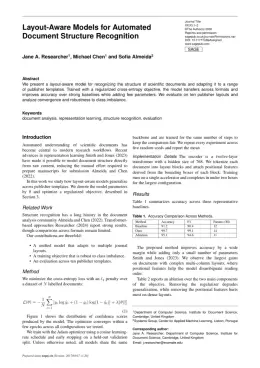
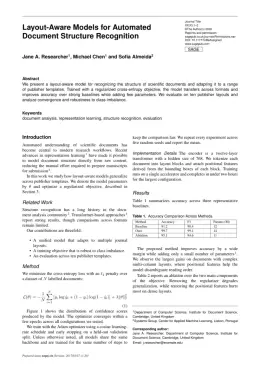
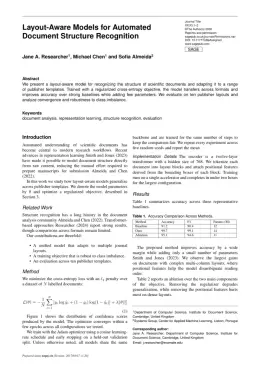
Write in a clean editor, then format for Biomedical Informatics Insights in one click — DocuGuru applies the official SAGE template with author–year references and exports a submission-ready PDF plus the editable LaTeX source. Free to start.

About the Biomedical Informatics Insights format

Biomedical Informatics Insights is a peer-reviewed journal published by SAGE, covering Topic Modeling, Sentiment Analysis and Opinion Mining, Mental Health via Writing.

PublisherSAGE
Reference styleAuthor–year (Harvard)
Author–year — (Smith, 2023) in the text
Smith, A., Jones, B. and Lee, C. (2023) 'A representative article title', Biomedical Informatics Insights, 12(3), pp. 45–58.

Formats any DOI in Biomedical Informatics Insights style. No sign-up.

Publishes research inTopic Modeling Sentiment Analysis and Opinion Mining Mental Health via Writing Electronic Health Records Systems Biomedical Text Mining and Ontologies
ISSN1178-2226
h-index23
i10-index44
Total citations3,148
Open accessYes
Top institutions publishing hereCincinnati Children's Hospital Medical Center
Journal websitewww.ncbi.nlm.nih.gov
You getA submission-ready PDF and the editable LaTeX source — ready to submit.

Papers published in Biomedical Informatics Insights per year

5
2008
4
2009
4
2010
1
2011
23
2012
11
2013
1
2015
10
2016
10
2017
11
2018
10
2019

Citation impact of Biomedical Informatics Insights by publication year

18
2008
102
2009
251
2010
5
2011
678
2012
87
2013
38
2015
812
2016
204
2017
612
2018
331
2019

Citations each year’s papers have accumulated so far — the most recent years are still building up.

Most-cited papers in Biomedical Informatics Insights

Big Data Application in Biomedical Research and Health Care: A Literature Review

Jake Luo, Min Wu, Deepika Gopukumar et al. · 1 Jan 2016

Big data technologies are increasingly used for biomedical and health-care informatics research. Large amounts of biological and clinical data have been generated and collected at an unprecedented speed and scale. For example, the new generation of sequencing technologies enables the processing of billions of DNA sequence data per day, and the application of electronic health…

Natural Language Processing of Social Media as Screening for Suicide Risk

Glen Coppersmith, R. Bret Leary, Patrick Crutchley et al. · 1 Jan 2018

Suicide is among the 10 most common causes of death, as assessed by the World Health Organization. For every death by suicide, an estimated 138 people's lives are meaningfully affected, and almost any other statistic around suicide deaths is equally alarming. The pervasiveness of social media-and the near-ubiquity of mobile devices used to access social…

Can Your Phone Be Your Therapist? Young People’s Ethical Perspectives on the Use of Fully Automated Conversational Agents (Chatbots) in Mental Health Support

Kira Kretzschmar, Holly Tyroll, Gabriela Pavarini et al. · 1 Jan 2019

Over the last decade, there has been an explosion of digital interventions that aim to either supplement or replace face-to-face mental health services. More recently, a number of automated conversational agents have also been made available, which respond to users in ways that mirror a real-life interaction. What are the social and ethical concerns that…

Suicide Note Classification Using Natural Language Processing: A Content Analysis

John Pestian, Henry A. Nasrallah, Paweł Matykiewicz et al. · 1 Jan 2010

Suicide is the second leading cause of death among 25-34 year olds and the third leading cause of death among 15-25 year olds in the United States. In the Emergency Department, where suicidal patients often present, estimating the risk of repeated attempts is generally left to clinical judgment. This paper presents our second attempt to…

Sentiment Analysis of Suicide Notes: A Shared Task

John Pestian, Paweł Matykiewicz, Michelle Linn-Gust et al. · 1 Jan 2012

This paper reports on a shared task involving the assignment of emotions to suicide notes. Two features distinguished this task from previous shared tasks in the biomedical domain. One is that it resulted in the corpus of fully anonymized clinical text and annotated suicide notes. This resource is permanently available and will (we hope) facilitate…

Biomedical Informatics Insights template — frequently asked questions

How do I write a paper in the Biomedical Informatics Insights format?
In DocuGuru you write your manuscript in a normal editor — no LaTeX setup required — and select the Biomedical Informatics Insights template. When you export, DocuGuru compiles the paper into the official SAGE format and hands you a submission-ready PDF along with the editable LaTeX source.
What reference style does Biomedical Informatics Insights use?
Biomedical Informatics Insights uses Author–year (Harvard) references, shown as author–year markers such as (Smith, 2023) in the text. DocuGuru formats every in-text citation and the reference list in this exact style automatically. A reference appears like this: Smith, A., Jones, B. and Lee, C. (2023) 'A representative article title', Biomedical Informatics Insights, 12(3), pp. 45–58.
Do I need to know LaTeX to submit to Biomedical Informatics Insights?
No. DocuGuru generates the sagej LaTeX class and compiles the PDF for you in the background, so you get a SAGE-ready Biomedical Informatics Insights document without writing any LaTeX. If you do want it, the LaTeX source is included in the export.
Can I import an existing draft into the Biomedical Informatics Insights template?
Yes. Paste or upload your current manuscript — Word, LaTeX, Markdown, or plain text — and DocuGuru reflows it into the Biomedical Informatics Insights format with correct headings, figures, tables, and author–year citations.
Who publishes Biomedical Informatics Insights?
Biomedical Informatics Insights is a multidisciplinary journal published by SAGE. DocuGuru's Biomedical Informatics Insights template matches SAGE's official submission format.
Can I export a submission-ready Biomedical Informatics Insights PDF?
Yes — DocuGuru produces a PDF built with the official Biomedical Informatics Insights template (the sagej class) that is ready to submit to SAGE, together with the matching LaTeX source files.
How much does the Biomedical Informatics Insights template cost?
You can start writing in the Biomedical Informatics Insights template for free. Exporting the final submission-ready Biomedical Informatics Insights PDF and LaTeX source is part of DocuGuru's paid plans — see the app for current pricing.

Use the Biomedical Informatics Insights template