SAGE

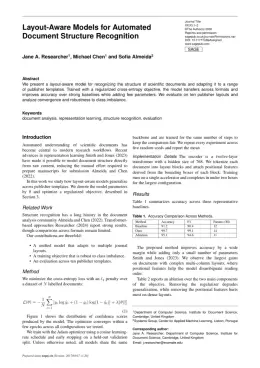
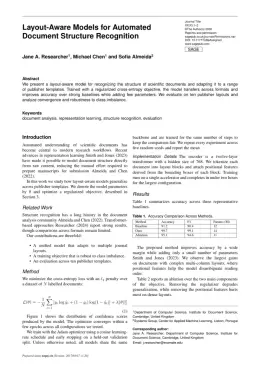
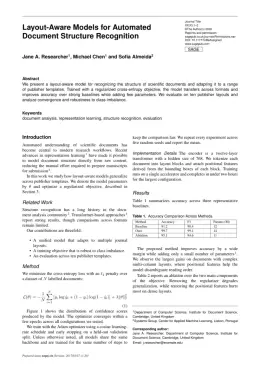
Applied Spectroscopy Template

Write in a clean editor, then format for Applied Spectroscopy in one click — DocuGuru applies the official SAGE template with author–year references and exports a submission-ready PDF plus the editable LaTeX source. Free to start.

About the Applied Spectroscopy format

Applied Spectroscopy is a peer-reviewed journal published by SAGE, covering Spectroscopy and Chemometric Analyses, Spectroscopy Techniques in Biomedical and Chemical Research, Water Quality Monitoring and Analysis.

PublisherSAGE
Reference styleAuthor–year (Harvard)
Author–year — (Smith, 2023) in the text
Smith, A., Jones, B. and Lee, C. (2023) 'A representative article title', Applied Spectroscopy, 12(3), pp. 45–58.

Formats any DOI in Applied Spectroscopy style. No sign-up.

Publishes research inSpectroscopy and Chemometric Analyses Spectroscopy Techniques in Biomedical and Chemical Research Water Quality Monitoring and Analysis Analytical chemistry methods development Spectroscopy and Laser Applications
ISSN0003-7028
Citation impact (2-yr)2.15
h-index163
i10-index6,750
Total citations296,829
Top institutions publishing hereUniversity of Florida
Journal websitewww.opticsinfobase.org
You getA submission-ready PDF and the editable LaTeX source — ready to submit.

Papers published in Applied Spectroscopy per year

218
2014
228
2015
341
2016
232
2017
162
2018
138
2019
151
2020
121
2021
150
2022
109
2023
175
2024
113
2025

Citation impact of Applied Spectroscopy by publication year

3.6K
2014
3.4K
2015
5.4K
2016
4.7K
2017
3.1K
2018
1.8K
2019
4.6K
2020
1.7K
2021
1.2K
2022
659
2023
585
2024
141
2025

Citations each year’s papers have accumulated so far — the most recent years are still building up.

Most-cited papers in Applied Spectroscopy

Standard Normal Variate Transformation and De-Trending of Near-Infrared Diffuse Reflectance Spectra

Richard Barnes, M.S. Dhanoa, S.J. Lister · 1 Jul 1989

Particle size, scatter, and multi-collinearity are long-standing problems encountered in diffuse reflectance spectrometry. Multiplicative combinations of these effects are the major factor inhibiting the interpretation of near-infrared diffuse reflectance spectra. Sample particle size accounts for the majority of the variance, while variance due to chemical composition is small. Procedures are presented whereby physical and chemical…

3,751 citations Cite SaveGo to paper →
Generalized Two-Dimensional Correlation Method Applicable to Infrared, Raman, and other Types of Spectroscopy

Isao Noda · 1 Sep 1993

A two-dimensional (2D) correlation method generally applicable to various types of spectroscopy, including IR and Raman spectroscopy, is introduced. In the proposed 2D correlation scheme, an external perturbation is applied to a system while being monitored by an electromagnetic probe. With the application of a correlation analysis to spectral intensity fluctuations induced by the perturbation,…

1,947 citations Cite SaveGo to paper →
Linearization and Scatter-Correction for Near-Infrared Reflectance Spectra of Meat

Paul Geladi, Douglas B. MacDougall, Harald Martens · 1 May 1985

This paper is concerned with the quantitative analysis of multicomponent mixtures by diffuse reflectance spectroscopy. Near-infrared reflectance (NIRR) measurements are related to chemical composition but in a nonlinear way, and light scatter distorts the data. Various response linearizations of reflectance (R) are compared ( R with Saunderson correction for internal reflectance, log 1/ R, and…

1,482 citations Cite SaveGo to paper →
Laser-Induced Breakdown Spectroscopy (LIBS), Part II: Review of Instrumental and Methodological Approaches to Material Analysis and Applications to Different Fields

David W. Hahn, N. Omenetto · 26 Mar 2012

The first part of this two-part review focused on the fundamental and diagnostics aspects of laser-induced plasmas, only touching briefly upon concepts such as sensitivity and detection limits and largely omitting any discussion of the vast panorama of the practical applications of the technique. Clearly a true LIBS community has emerged, which promises to quicken…

1,463 citations Cite SaveGo to paper →
Interval Partial Least-Squares Regression ( <i>i</i> PLS): A Comparative Chemometric Study with an Example from Near-Infrared Spectroscopy

Lars Nørgaard, Arild Saudland, Joachim Wagner et al. · 1 Mar 2000

A new graphically oriented local modeling procedure called interval partial least-squares ( iPLS) is presented for use on spectral data. The iPLS method is compared to full-spectrum partial least-squares and the variable selection methods principal variables (PV), forward stepwise selection (FSS), and recursively weighted regression (RWR). The methods are tested on a near-infrared (NIR) spectral…

1,347 citations Cite SaveGo to paper →

Applied Spectroscopy template — frequently asked questions

How do I write a paper in the Applied Spectroscopy format?
In DocuGuru you write your manuscript in a normal editor — no LaTeX setup required — and select the Applied Spectroscopy template. When you export, DocuGuru compiles the paper into the official SAGE format and hands you a submission-ready PDF along with the editable LaTeX source.
What reference style does Applied Spectroscopy use?
Applied Spectroscopy uses Author–year (Harvard) references, shown as author–year markers such as (Smith, 2023) in the text. DocuGuru formats every in-text citation and the reference list in this exact style automatically. A reference appears like this: Smith, A., Jones, B. and Lee, C. (2023) 'A representative article title', Applied Spectroscopy, 12(3), pp. 45–58.
Do I need to know LaTeX to submit to Applied Spectroscopy?
No. DocuGuru generates the sagej LaTeX class and compiles the PDF for you in the background, so you get a SAGE-ready Applied Spectroscopy document without writing any LaTeX. If you do want it, the LaTeX source is included in the export.
Can I import an existing draft into the Applied Spectroscopy template?
Yes. Paste or upload your current manuscript — Word, LaTeX, Markdown, or plain text — and DocuGuru reflows it into the Applied Spectroscopy format with correct headings, figures, tables, and author–year citations.
Who publishes Applied Spectroscopy?
Applied Spectroscopy is a multidisciplinary journal published by SAGE. DocuGuru's Applied Spectroscopy template matches SAGE's official submission format.
Can I export a submission-ready Applied Spectroscopy PDF?
Yes — DocuGuru produces a PDF built with the official Applied Spectroscopy template (the sagej class) that is ready to submit to SAGE, together with the matching LaTeX source files.
How much does the Applied Spectroscopy template cost?
You can start writing in the Applied Spectroscopy template for free. Exporting the final submission-ready Applied Spectroscopy PDF and LaTeX source is part of DocuGuru's paid plans — see the app for current pricing.

Use the Applied Spectroscopy template