IEEE

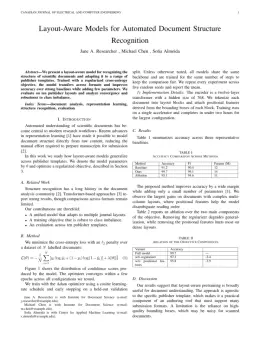
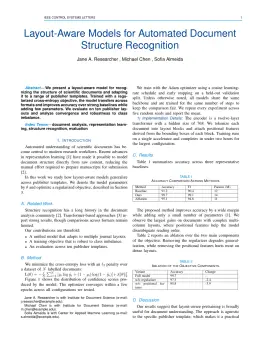
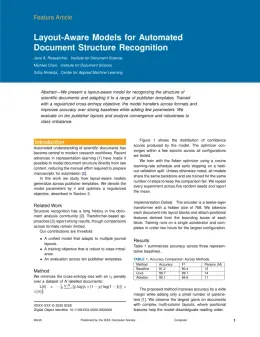
IEEE Transactions on Speech and Audio Processing Template

Write in a clean editor, then format for IEEE Transactions on Speech and Audio Processing in one click — DocuGuru applies the official IEEE template with numbered references and exports a submission-ready PDF plus the editable LaTeX source. Free to start.

About the IEEE Transactions on Speech and Audio Processing format

IEEE Transactions on Speech and Audio Processing is a peer-reviewed journal published by IEEE, covering Speech and Audio Processing, Speech Recognition and Synthesis, Advanced Adaptive Filtering Techniques.

PublisherIEEE
Reference styleNumbered (IEEE)
Numbered — [1], [2] in the text
[1] A. Smith, B. Jones, and C. Lee, "A representative article title," IEEE Transactions on Speech and Audio Processing, vol. 12, no. 3, pp. 45–58, 2023.

Formats any DOI in IEEE Transactions on Speech and Audio Processing style. No sign-up.

Publishes research inSpeech and Audio Processing Speech Recognition and Synthesis Advanced Adaptive Filtering Techniques Music and Audio Processing Advanced Data Compression Techniques
ISSN1063-6676
h-index141
i10-index729
Total citations81,094
Top institutions publishing hereAT&T (United States)
Journal websiteieeexplore.ieee.org
You getA submission-ready PDF and the editable LaTeX source — ready to submit.

Papers published in IEEE Transactions on Speech and Audio Processing per year

53
1995
52
1996
61
1997
57
1998
78
1999
81
2000
94
2001
64
2002
79
2003
108
2004
149
2005
1
2023

Citation impact of IEEE Transactions on Speech and Audio Processing by publication year

7.3K
1995
4.1K
1996
4K
1997
5.1K
1998
5.5K
1999
8.2K
2000
8.5K
2001
6.5K
2002
7K
2003
5.3K
2004
7.6K
2005
133
2023

Citations each year’s papers have accumulated so far — the most recent years are still building up.

Most-cited papers in IEEE Transactions on Speech and Audio Processing

Robust text-independent speaker identification using Gaussian mixture speaker models

D.A. Reynolds, Richard C. Rose · 1 Jan 1995

This paper introduces and motivates the use of Gaussian mixture models (GMM) for robust text-independent speaker identification. The individual Gaussian components of a GMM are shown to represent some general speaker-dependent spectral shapes that are effective for modeling speaker identity. The focus of this work is on applications which require high identification rates using short…

2,865 citations Cite SaveGo to paper →
Musical genre classification of audio signals

George Tzanetakis, Patrick Cook · 1 Jul 2002

Musical genres are categorical labels created by humans to characterize pieces of music. A musical genre is characterized by the common characteristics shared by its members. These characteristics typically are related to the instrumentation, rhythmic structure, and harmonic content of the music. Genre hierarchies are commonly used to structure the large collections of music available…

2,792 citations Cite SaveGo to paper →
Maximum a posteriori estimation for multivariate Gaussian mixture observations of Markov chains

J.-L. Gauvain, Chin‐Hui Lee · 1 Apr 1994

In this paper, a framework for maximum a posteriori (MAP) estimation of hidden Markov models (HMM) is presented. Three key issues of MAP estimation, namely, the choice of prior distribution family, the specification of the parameters of prior densities, and the evaluation of the MAP estimates, are addressed. Using HMM's with Gaussian mixture state observation…

2,111 citations Cite SaveGo to paper →
RASTA processing of speech

Hynek Heřmanský, N. Morgan · 1 Jan 1994

Performance of even the best current stochastic recognizers severely degrades in an unexpected communications environment. In some cases, the environmental effect can be modeled by a set of simple transformations and, in particular, by convolution with an environmental impulse response and the addition of some environmental noise. Often, the temporal properties of these environmental effects…

1,824 citations Cite SaveGo to paper →
Noise power spectral density estimation based on optimal smoothing and minimum statistics

Rainer Martin · 1 Jul 2001

We describe a method to estimate the power spectral density of nonstationary noise when a noisy speech signal is given. The method can be combined with any speech enhancement algorithm which requires a noise power spectral density estimate. In contrast to other methods, our approach does not use a voice activity detector. Instead it tracks…

1,508 citations Cite SaveGo to paper →

IEEE Transactions on Speech and Audio Processing template — frequently asked questions

How do I write a paper in the IEEE Transactions on Speech and Audio Processing format?
In DocuGuru you write your manuscript in a normal editor — no LaTeX setup required — and select the IEEE Transactions on Speech and Audio Processing template. When you export, DocuGuru compiles the paper into the official IEEE format and hands you a submission-ready PDF along with the editable LaTeX source.
What reference style does IEEE Transactions on Speech and Audio Processing use?
IEEE Transactions on Speech and Audio Processing uses Numbered (IEEE) references, shown as numbered [1], [2] markers in the text. DocuGuru formats every in-text citation and the reference list in this exact style automatically. A reference appears like this: [1] A. Smith, B. Jones, and C. Lee, "A representative article title," IEEE Transactions on Speech and Audio Processing, vol. 12, no. 3, pp. 45–58, 2023.
Do I need to know LaTeX to submit to IEEE Transactions on Speech and Audio Processing?
No. DocuGuru generates the IEEEtran LaTeX class and compiles the PDF for you in the background, so you get a IEEE-ready IEEE Transactions on Speech and Audio Processing document without writing any LaTeX. If you do want it, the LaTeX source is included in the export.
Can I import an existing draft into the IEEE Transactions on Speech and Audio Processing template?
Yes. Paste or upload your current manuscript — Word, LaTeX, Markdown, or plain text — and DocuGuru reflows it into the IEEE Transactions on Speech and Audio Processing format with correct headings, figures, tables, and numbered citations.
Who publishes IEEE Transactions on Speech and Audio Processing?
IEEE Transactions on Speech and Audio Processing is a engineering and computer science journal published by IEEE. DocuGuru's IEEE Transactions on Speech and Audio Processing template matches IEEE's official submission format.
Can I export a submission-ready IEEE Transactions on Speech and Audio Processing PDF?
Yes — DocuGuru produces a PDF built with the official IEEE Transactions on Speech and Audio Processing template (the IEEEtran class) that is ready to submit to IEEE, together with the matching LaTeX source files.
How much does the IEEE Transactions on Speech and Audio Processing template cost?
You can start writing in the IEEE Transactions on Speech and Audio Processing template for free. Exporting the final submission-ready IEEE Transactions on Speech and Audio Processing PDF and LaTeX source is part of DocuGuru's paid plans — see the app for current pricing.

Use the IEEE Transactions on Speech and Audio Processing template