IEEE

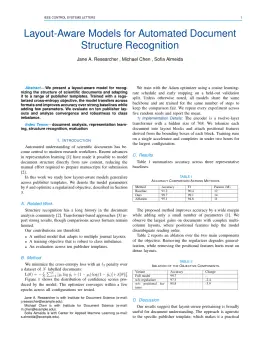
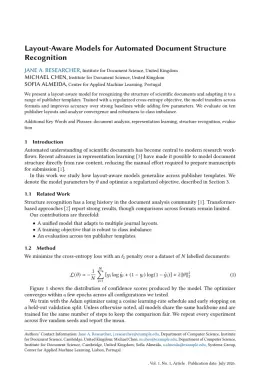
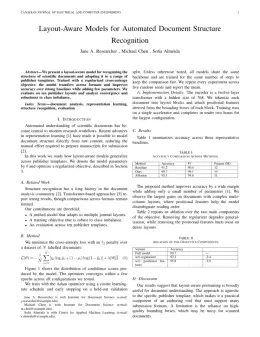
IEEE Transactions on Computational Social Systems Template

Write in a clean editor, then format for IEEE Transactions on Computational Social Systems in one click — DocuGuru applies the official IEEE template with numbered references and exports a submission-ready PDF plus the editable LaTeX source. Free to start.

About the IEEE Transactions on Computational Social Systems format

IEEE Transactions on Computational Social Systems is a peer-reviewed journal published by IEEE, covering Complex Network Analysis Techniques, Opinion Dynamics and Social Influence, Advanced Graph Neural Networks. Over its lifetime it has published 2,935 papers, which have received 45,217 citations.

PublisherIEEE
Reference styleNumbered (IEEE)
Numbered — [1], [2] in the text
[1] A. Smith, B. Jones, and C. Lee, "A representative article title," IEEE Transactions on Computational Social Systems, vol. 12, no. 3, pp. 45–58, 2023.

Formats any DOI in IEEE Transactions on Computational Social Systems style. No sign-up.

Abbreviation (ISO-4)TCSS
Publishes research inComplex Network Analysis Techniques Opinion Dynamics and Social Influence Advanced Graph Neural Networks Sentiment Analysis and Opinion Mining Misinformation and Its Impacts
ISSN2329-924X
Citation impact (2-yr)3.16
h-index89
i10-index1,108
Top institutions publishing hereChinese Academy of Sciences
Journal websiteieeexplore.ieee.org
You getA submission-ready PDF and the editable LaTeX source — ready to submit.

Papers published in IEEE Transactions on Computational Social Systems per year

30
2014
34
2015
43
2016
54
2017
102
2018
165
2019
180
2020
252
2021
404
2022
349
2023
477
2024
533
2025

Citation impact of IEEE Transactions on Computational Social Systems by publication year

834
2014
888
2015
412
2016
1.1K
2017
3.5K
2018
5.7K
2019
5.8K
2020
7.2K
2021
9.1K
2022
6.1K
2023
2.9K
2024
968
2025

Citations each year’s papers have accumulated so far — the most recent years are still building up.

Most-cited papers in IEEE Transactions on Computational Social Systems

Characterizing the Propagation of Situational Information in Social Media During COVID-19 Epidemic: A Case Study on Weibo

Lifang Li, Qingpeng Zhang, Xiao Wang et al. · 20 Mar 2020

During the ongoing outbreak of coronavirus disease (COVID-19), people use social media to acquire and exchange various types of information at a historic and unprecedented scale. Only the situational information are valuable for the public and authorities to response to the epidemic. Therefore, it is important to identify such situational information and to understand how…

Decentralized Autonomous Organizations: Concept, Model, and Applications

Shuai Wang, Wenwen Ding, Juanjuan Li et al. · 13 Sep 2019

Decentralized autonomy is a long-standing research topic in information sciences and social sciences. The self-organization phenomenon in natural ecosystems, the Cyber Movement Organizations (CMOs) on the Internet, and the Distributed Artificial Intelligence (DAI), and so on, can all be regarded as its early manifestations. In recent years, the rapid development of blockchain technology has spawned…

COVIDSenti: A Large-Scale Benchmark Twitter Data Set for COVID-19 Sentiment Analysis

Usman Naseem, Imran Razzak, Matloob Khushi et al. · 29 Jan 2021

Social media (and the world at large) have been awash with news of the COVID-19 pandemic. With the passage of time, news and awareness about COVID-19 spread like the pandemic itself, with an explosion of messages, updates, videos, and posts. Mass hysteria manifest as another concern in addition to the health risk that COVID-19 presented.…

Blockchain-Powered Parallel Healthcare Systems Based on the ACP Approach

Shuai Wang, Jing Wang, Xiao Wang et al. · 29 Aug 2018

To improve the accuracy of diagnosis and the effectiveness of treatment, a framework of parallel healthcare systems (PHSs) based on the artificial systems + computational experiments + parallel execution (ACP) approach is proposed in this paper. PHS uses artificial healthcare systems to model and represent patients’ conditions, diagnosis, and treatment process, then applies computational experiments…

Community Detection via Maximization of Modularity and Its Variants

Mingming Chen, Konstantin Kuzmin, Bolesław K. Szymański · 1 Mar 2014

In this paper, we first discuss the definition of modularity (Q) used as a metric for community quality and then we review the modularity maximization approaches which were used for community detection in the last decade. Then, we discuss two opposite yet coexisting problems of modularity optimization; in some cases, it tends to favor small…

IEEE Transactions on Computational Social Systems template — frequently asked questions

How do I write a paper in the IEEE Transactions on Computational Social Systems format?
In DocuGuru you write your manuscript in a normal editor — no LaTeX setup required — and select the IEEE Transactions on Computational Social Systems template. When you export, DocuGuru compiles the paper into the official IEEE format and hands you a submission-ready PDF along with the editable LaTeX source.
What reference style does IEEE Transactions on Computational Social Systems use?
IEEE Transactions on Computational Social Systems uses Numbered (IEEE) references, shown as numbered [1], [2] markers in the text. DocuGuru formats every in-text citation and the reference list in this exact style automatically. A reference appears like this: [1] A. Smith, B. Jones, and C. Lee, "A representative article title," IEEE Transactions on Computational Social Systems, vol. 12, no. 3, pp. 45–58, 2023.
Do I need to know LaTeX to submit to IEEE Transactions on Computational Social Systems?
No. DocuGuru generates the IEEEtran LaTeX class and compiles the PDF for you in the background, so you get a IEEE-ready IEEE Transactions on Computational Social Systems document without writing any LaTeX. If you do want it, the LaTeX source is included in the export.
Can I import an existing draft into the IEEE Transactions on Computational Social Systems template?
Yes. Paste or upload your current manuscript — Word, LaTeX, Markdown, or plain text — and DocuGuru reflows it into the IEEE Transactions on Computational Social Systems format with correct headings, figures, tables, and numbered citations.
Who publishes IEEE Transactions on Computational Social Systems?
IEEE Transactions on Computational Social Systems is a engineering and computer science journal published by IEEE. DocuGuru's IEEE Transactions on Computational Social Systems template matches IEEE's official submission format.
Can I export a submission-ready IEEE Transactions on Computational Social Systems PDF?
Yes — DocuGuru produces a PDF built with the official IEEE Transactions on Computational Social Systems template (the IEEEtran class) that is ready to submit to IEEE, together with the matching LaTeX source files.
How much does the IEEE Transactions on Computational Social Systems template cost?
You can start writing in the IEEE Transactions on Computational Social Systems template for free. Exporting the final submission-ready IEEE Transactions on Computational Social Systems PDF and LaTeX source is part of DocuGuru's paid plans — see the app for current pricing.
Use the IEEE Transactions on Computational Social Systems template