IEEE

IEEE Transactions on Circuits and Systems I: Regular Papers Template

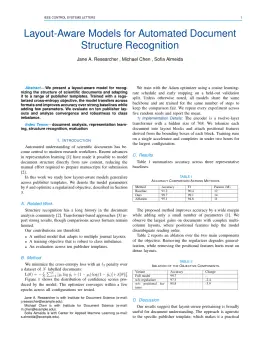
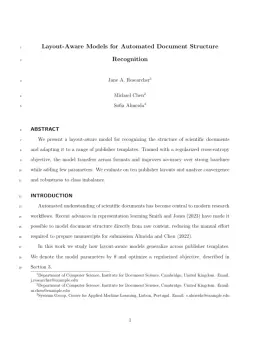
Write in a clean editor, then format for IEEE Transactions on Circuits and Systems I: Regular Papers in one click — DocuGuru applies the official IEEE template with numbered references and exports a submission-ready PDF plus the editable LaTeX source. Free to start.

About the IEEE Transactions on Circuits and Systems I: Regular Papers format

IEEE Transactions on Circuits and Systems I: Regular Papers is a peer-reviewed journal published by IEEE, covering Analog and Mixed-Signal Circuit Design, Radio Frequency Integrated Circuit Design, Advancements in Semiconductor Devices and Circuit Design. Over its lifetime it has published 8,807 papers, which have received 209,984 citations.

PublisherIEEE
Reference styleNumbered (IEEE)
Numbered — [1], [2] in the text
[1] A. Smith, B. Jones, and C. Lee, "A representative article title," IEEE Transactions on Circuits and Systems I: Regular Papers, vol. 12, no. 3, pp. 45–58, 2023.

Formats any DOI in IEEE Transactions on Circuits and Systems I: Regular Papers style. No sign-up.

Abbreviation (ISO-4)TCAS-I
Publishes research inAnalog and Mixed-Signal Circuit Design Radio Frequency Integrated Circuit Design Advancements in Semiconductor Devices and Circuit Design Advancements in PLL and VCO Technologies Low-power high-performance VLSI design
ISSN1549-8328
Citation impact (2-yr)4.26
h-index148
i10-index4,555
Top institutions publishing hereNanyang Technological University
You getA submission-ready PDF and the editable LaTeX source — ready to submit.

Papers published in IEEE Transactions on Circuits and Systems I: Regular Papers per year

400
2014
295
2015
371
2016
438
2017
411
2018
422
2019
549
2020
523
2021
500
2022
536
2023
707
2024
808
2025

Citation impact of IEEE Transactions on Circuits and Systems I: Regular Papers by publication year

12.1K
2014
8K
2015
11K
2016
12.8K
2017
12.3K
2018
10.4K
2019
14.9K
2020
14.5K
2021
9.9K
2022
7K
2023
5.6K
2024
1.8K
2025

Citations each year’s papers have accumulated so far — the most recent years are still building up.

Most-cited papers in IEEE Transactions on Circuits and Systems I: Regular Papers

Consensus of Multiagent Systems and Synchronization of Complex Networks: A Unified Viewpoint

Zhongkui Li, Zhisheng Duan, Guanrong Chen et al. · 2 Jun 2009

This paper addresses the consensus problem of multiagent systems with a time-invariant communication topology consisting of general linear node dynamics. A distributed observer-type consensus protocol based on relative output measurements is proposed. A new framework is introduced to address in a unified way the consensus of multiagent systems and the synchronization of complex networks. Under…

2,400 citations Cite SaveGo to paper →
Switched-Capacitor/Switched-Inductor Structures for Getting Transformerless Hybrid DC–DC PWM Converters

B. Axelrod, Y. Berkovich, A. Ioinovici · 1 Mar 2008

A few simple switching structures, formed by either two capacitors and two-three diodes (C-switching), or two inductors and two-three diodes (L-switching) are proposed. These structures can be of two types: ldquostep-downrdquo and ldquostep-up.rdquo These blocks are inserted in classical converters: buck, boost, buck-boost, Cuk, Zeta, Sepic. The ldquostep-downrdquo C- or L-switching structures can be combined…

1,370 citations Cite SaveGo to paper →
TEAM: ThrEshold Adaptive Memristor Model

Shahar Kvatinsky, Eby G. Friedman, Avinoam Kolodny et al. · 14 Nov 2012

Memristive devices are novel devices, which can be used in applications ranging from memory and logic to neuromorphic systems. A memristive device offers several advantages: nonvolatility, good scalability, effectively no leakage current, and compatibility with CMOS technology, both electrically and in terms of manufacturing. Several models for memristive devices have been developed and are discussed…

Consensus Tracking of Multi-Agent Systems With Lipschitz-Type Node Dynamics and Switching Topologies

Guanghui Wen, Zhisheng Duan, Guanrong Chen et al. · 12 Sep 2013

Distributed consensus tracking is addressed in this paper for multi-agent systems with Lipschitz-type node dynamics. The main contribution of this work is solving the consensus tracking problem without the assumption that the topology among followers is strongly connected and fixed. By using tools from M-matrix theory, a class of consensus tracking protocols based only on…

Three Fingerprints of Memristor

Shyam Prasad Adhikari, Maheshwar Pd. Sah, Hyongsuk Kim et al. · 28 Jun 2013

This paper illustrates that for a device to be a memristor it should exhibit three characteristic fingerprints: 1) When driven by a bipolar periodic signal the device must exhibit a “pinched hysteresis loop” in the voltage-current plane, assuming the response is periodic. 2) Starting from some critical frequency, the hysteresis lobe area should decrease monotonically…

IEEE Transactions on Circuits and Systems I: Regular Papers template — frequently asked questions

How do I write a paper in the IEEE Transactions on Circuits and Systems I: Regular Papers format?
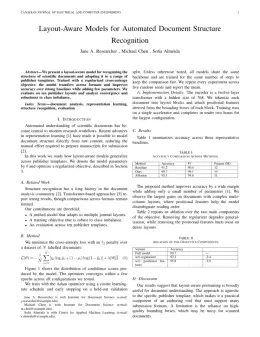
In DocuGuru you write your manuscript in a normal editor — no LaTeX setup required — and select the IEEE Transactions on Circuits and Systems I: Regular Papers template. When you export, DocuGuru compiles the paper into the official IEEE format and hands you a submission-ready PDF along with the editable LaTeX source.
What reference style does IEEE Transactions on Circuits and Systems I: Regular Papers use?
IEEE Transactions on Circuits and Systems I: Regular Papers uses Numbered (IEEE) references, shown as numbered [1], [2] markers in the text. DocuGuru formats every in-text citation and the reference list in this exact style automatically. A reference appears like this: [1] A. Smith, B. Jones, and C. Lee, "A representative article title," IEEE Transactions on Circuits and Systems I: Regular Papers, vol. 12, no. 3, pp. 45–58, 2023.
Do I need to know LaTeX to submit to IEEE Transactions on Circuits and Systems I: Regular Papers?
No. DocuGuru generates the IEEEtran LaTeX class and compiles the PDF for you in the background, so you get a IEEE-ready IEEE Transactions on Circuits and Systems I: Regular Papers document without writing any LaTeX. If you do want it, the LaTeX source is included in the export.
Can I import an existing draft into the IEEE Transactions on Circuits and Systems I: Regular Papers template?
Yes. Paste or upload your current manuscript — Word, LaTeX, Markdown, or plain text — and DocuGuru reflows it into the IEEE Transactions on Circuits and Systems I: Regular Papers format with correct headings, figures, tables, and numbered citations.
Who publishes IEEE Transactions on Circuits and Systems I: Regular Papers?
IEEE Transactions on Circuits and Systems I: Regular Papers is a engineering and computer science journal published by IEEE. DocuGuru's IEEE Transactions on Circuits and Systems I: Regular Papers template matches IEEE's official submission format.
Can I export a submission-ready IEEE Transactions on Circuits and Systems I: Regular Papers PDF?
Yes — DocuGuru produces a PDF built with the official IEEE Transactions on Circuits and Systems I: Regular Papers template (the IEEEtran class) that is ready to submit to IEEE, together with the matching LaTeX source files.
How much does the IEEE Transactions on Circuits and Systems I: Regular Papers template cost?
You can start writing in the IEEE Transactions on Circuits and Systems I: Regular Papers template for free. Exporting the final submission-ready IEEE Transactions on Circuits and Systems I: Regular Papers PDF and LaTeX source is part of DocuGuru's paid plans — see the app for current pricing.
Use the IEEE Transactions on Circuits and Systems I: Regular Papers template