IEEE

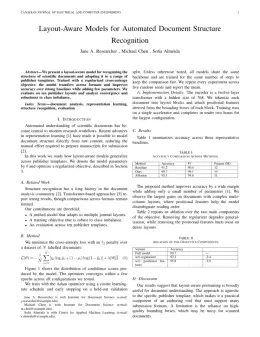
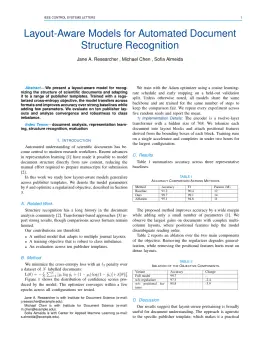
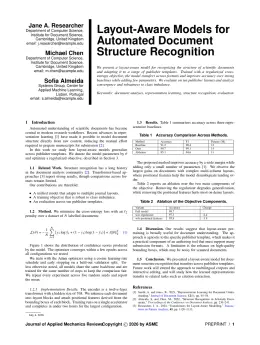
IEEE Signal Processing Magazine Template

Write in a clean editor, then format for IEEE Signal Processing Magazine in one click — DocuGuru applies the official IEEE template with numbered references and exports a submission-ready PDF plus the editable LaTeX source. Free to start.

About the IEEE Signal Processing Magazine format

IEEE Signal Processing Magazine is a peer-reviewed journal published by IEEE, covering Diverse Scientific and Economic Studies, Human auditory perception and evaluation, Neural Networks and Applications. Over its lifetime it has published 3,930 papers, which have received 329,090 citations.

PublisherIEEE
Reference styleNumbered (IEEE)
Numbered — [1], [2] in the text
[1] A. Smith, B. Jones, and C. Lee, "A representative article title," IEEE Signal Processing Magazine, vol. 12, no. 3, pp. 45–58, 2023.

Formats any DOI in IEEE Signal Processing Magazine style. No sign-up.

Publishes research inDiverse Scientific and Economic Studies Human auditory perception and evaluation Neural Networks and Applications Blind Source Separation Techniques Image and Signal Denoising Methods
ISSN1053-5888
Citation impact (2-yr)2.3
h-index257
i10-index1,527
Top institutions publishing hereSignal Processing (United States)
Journal websiteieeexplore.ieee.org
You getA submission-ready PDF and the editable LaTeX source — ready to submit.

Papers published in IEEE Signal Processing Magazine per year

142
2014
158
2015
125
2016
166
2017
177
2018
120
2019
174
2020
138
2021
96
2022
162
2023
137
2024
133
2025

Citation impact of IEEE Signal Processing Magazine by publication year

9.8K
2014
11.3K
2015
4.3K
2016
15.4K
2017
14.1K
2018
7.2K
2019
12.4K
2020
3K
2021
2.3K
2022
2.9K
2023
547
2024
164
2025

Citations each year’s papers have accumulated so far — the most recent years are still building up.

Most-cited papers in IEEE Signal Processing Magazine

Deep Neural Networks for Acoustic Modeling in Speech Recognition: The Shared Views of Four Research Groups

Geoffrey E. Hinton, Li Deng, Dong Yu et al. · 19 Oct 2012

Most current speech recognition systems use hidden Markov models (HMMs) to deal with the temporal variability of speech and Gaussian mixture models (GMMs) to determine how well each state of each HMM fits a frame or a short window of frames of coefficients that represents the acoustic input. An alternative way to evaluate the fit…

10,345 citations Cite SaveGo to paper →
An Introduction To Compressive Sampling

Emmanuel J. Candès, Michael B. Wakin · 1 Mar 2008

Conventional approaches to sampling signals or images follow Shannon's theorem: the sampling rate must be at least twice the maximum frequency present in the signal (Nyquist rate). In the field of data conversion, standard analog-to-digital converter (ADC) technology implements the usual quantized Shannon representation - the signal is uniformly sampled at or above the Nyquist…

10,051 citations Cite SaveGo to paper →
Federated Learning: Challenges, Methods, and Future Directions

Tian Li, Anit Kumar Sahu, Ameet Talwalkar et al. · 1 May 2020

Federated learning involves training statistical models over remote devices or siloed data centers, such as mobile phones or hospitals, while keeping data localized. Training in heterogeneous and potentially massive networks introduces novel challenges that require a fundamental departure from standard approaches for large-scale machine learning, distributed optimization, and privacy-preserving data analysis. In this article, we…

4,732 citations Cite SaveGo to paper →
Two decades of array signal processing research: the parametric approach

Hamid Krim, Mats Viberg · 1 Jul 1996

The quintessential goal of sensor array signal processing is the estimation of parameters by fusing temporal and spatial information, captured via sampling a wavefield with a set of judiciously placed antenna sensors. The wavefield is assumed to be generated by a finite number of emitters, and contains information about signal parameters characterizing the emitters. A…

4,673 citations Cite SaveGo to paper →

IEEE Signal Processing Magazine template — frequently asked questions

How do I write a paper in the IEEE Signal Processing Magazine format?
In DocuGuru you write your manuscript in a normal editor — no LaTeX setup required — and select the IEEE Signal Processing Magazine template. When you export, DocuGuru compiles the paper into the official IEEE format and hands you a submission-ready PDF along with the editable LaTeX source.
What reference style does IEEE Signal Processing Magazine use?
IEEE Signal Processing Magazine uses Numbered (IEEE) references, shown as numbered [1], [2] markers in the text. DocuGuru formats every in-text citation and the reference list in this exact style automatically. A reference appears like this: [1] A. Smith, B. Jones, and C. Lee, "A representative article title," IEEE Signal Processing Magazine, vol. 12, no. 3, pp. 45–58, 2023.
Do I need to know LaTeX to submit to IEEE Signal Processing Magazine?
No. DocuGuru generates the IEEEtran LaTeX class and compiles the PDF for you in the background, so you get a IEEE-ready IEEE Signal Processing Magazine document without writing any LaTeX. If you do want it, the LaTeX source is included in the export.
Can I import an existing draft into the IEEE Signal Processing Magazine template?
Yes. Paste or upload your current manuscript — Word, LaTeX, Markdown, or plain text — and DocuGuru reflows it into the IEEE Signal Processing Magazine format with correct headings, figures, tables, and numbered citations.
What is IEEE Signal Processing Magazine?
IEEE Signal Processing Magazine, published by IEEE. It is a engineering and computer science journal, published by IEEE.
Can I export a submission-ready IEEE Signal Processing Magazine PDF?
Yes — DocuGuru produces a PDF built with the official IEEE Signal Processing Magazine template (the IEEEtran class) that is ready to submit to IEEE, together with the matching LaTeX source files.
How much does the IEEE Signal Processing Magazine template cost?
You can start writing in the IEEE Signal Processing Magazine template for free. Exporting the final submission-ready IEEE Signal Processing Magazine PDF and LaTeX source is part of DocuGuru's paid plans — see the app for current pricing.
Use the IEEE Signal Processing Magazine template