ASME

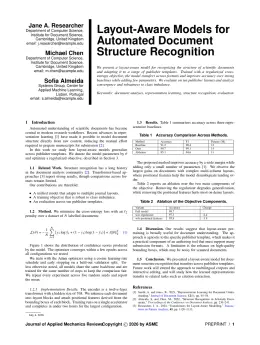
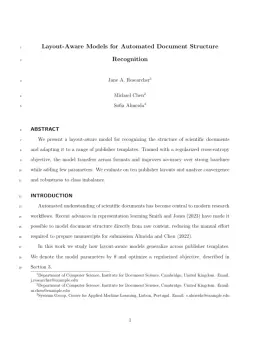
Journal of Computational and Nonlinear Dynamics Template

Write in a clean editor, then format for Journal of Computational and Nonlinear Dynamics in one click — DocuGuru applies the official ASME template with numbered references and exports a submission-ready PDF plus the editable LaTeX source. Free to start.

About the Journal of Computational and Nonlinear Dynamics format

Journal of Computational and Nonlinear Dynamics is a peer-reviewed journal published by ASME, covering Dynamics and Control of Mechanical Systems, Fractional Differential Equations Solutions, Vibration and Dynamic Analysis. Over its lifetime it has published 1,860 papers, which have received 27,873 citations.

PublisherASME
Reference styleNumbered (ASME)
Numbered — [1], [2] in the text
[1] Smith, A., Jones, B., and Lee, C., 2023, "A Representative Article Title," Journal of Computational and Nonlinear Dynamics, 12(3), pp. 45–58.

Formats any DOI in Journal of Computational and Nonlinear Dynamics style. No sign-up.

Publishes research inDynamics and Control of Mechanical Systems Fractional Differential Equations Solutions Vibration and Dynamic Analysis Chaos control and synchronization Nonlinear Dynamics and Pattern Formation
ISSN1555-1415
Citation impact (2-yr)1.73
h-index65
i10-index810
Top institutions publishing hereUniversity of Illinois Chicago
Journal websitecomputationalnonlinear.asmedigitalcollection.asme.org
You getA submission-ready PDF and the editable LaTeX source — ready to submit.

Papers published in Journal of Computational and Nonlinear Dynamics per year

111
2014
116
2015
133
2016
113
2017
109
2018
119
2019
93
2020
86
2021
88
2022
93
2023
100
2024
116
2025

Citation impact of Journal of Computational and Nonlinear Dynamics by publication year

2.4K
2014
2K
2015
2.3K
2016
1.8K
2017
1.3K
2018
1.2K
2019
1K
2020
680
2021
764
2022
455
2023
332
2024
120
2025

Citations each year’s papers have accumulated so far — the most recent years are still building up.

Most-cited papers in Journal of Computational and Nonlinear Dynamics

Review on the Absolute Nodal Coordinate Formulation for Large Deformation Analysis of Multibody Systems

Johannes Gerstmayr, Hiroyuki Sugiyama, Aki Mikkola · 21 Mar 2013

The aim of this study is to provide a comprehensive review of the finite element absolute nodal coordinate formulation, which can be used to obtain efficient solutions to large deformation problems of constrained multibody systems. In particular, important features of different types of beam and plate elements that have been proposed since 1996 are reviewed.…

Practical Tuning Rule Development for Fractional Order Proportional and Integral Controllers

YangQuan Chen, Tripti Bhaskaran, Dingyü Xue · 24 Jan 2008

This paper presents a new practical tuning method for fractional order proportional and integral (FO-PI) controller. The plant to be controlled is mainly first order plus delay time (FOPDT). The tuning is optimum in the sense that the load disturbance rejection is optimized yet with a constraint on the maximum or peak sensitivity. We generalized…

Fractional Differential Equations With Dependence on the Caputo–Katugampola Derivative

Ricardo Almeida, Agnieszka B. Malinowska, Tatiana Odzijewicz · 18 Aug 2016

In this paper, we present a new type of fractional operator, the Caputo–Katugampola derivative. The Caputo and the Caputo–Hadamard fractional derivatives are special cases of this new operator. An existence and uniqueness theorem for a fractional Cauchy-type problem, with dependence on the Caputo–Katugampola derivative, is proved. A decomposition formula for the Caputo–Katugampola derivative is obtained.…

Review of Classical Approaches for Constraint Enforcement in Multibody Systems

André Laulusa, Olivier A. Bauchau · 2 Nov 2007

A hallmark of multibody dynamics is that most formulations involve a number of constraints. Typically, when redundant generalized coordinates are used, equations of motion are simpler to derive but constraint equations are present. While the dynamic behavior of constrained systems is well understood, the numerical solution of the resulting equations, potentially of differential-algebraic nature, remains…

Review of Contemporary Approaches for Constraint Enforcement in Multibody Systems

Olivier A. Bauchau, André Laulusa · 2 Nov 2007

A hallmark of multibody dynamics is that most formulations involve a number of constraints. Typically, when redundant generalized coordinates are used, equations of motion are simpler to derive but constraint equations are present. Approaches to dealing with high index differential algebraic equations, based on index reduction techniques, are reviewed and discussed. Constraint violation stabilization techniques…

Journal of Computational and Nonlinear Dynamics template — frequently asked questions

How do I write a paper in the Journal of Computational and Nonlinear Dynamics format?
In DocuGuru you write your manuscript in a normal editor — no LaTeX setup required — and select the Journal of Computational and Nonlinear Dynamics template. When you export, DocuGuru compiles the paper into the official ASME format and hands you a submission-ready PDF along with the editable LaTeX source.
What reference style does Journal of Computational and Nonlinear Dynamics use?
Journal of Computational and Nonlinear Dynamics uses Numbered (ASME) references, shown as numbered [1], [2] markers in the text. DocuGuru formats every in-text citation and the reference list in this exact style automatically. A reference appears like this: [1] Smith, A., Jones, B., and Lee, C., 2023, "A Representative Article Title," Journal of Computational and Nonlinear Dynamics, 12(3), pp. 45–58.
Do I need to know LaTeX to submit to Journal of Computational and Nonlinear Dynamics?
No. DocuGuru generates the asmejour LaTeX class and compiles the PDF for you in the background, so you get a ASME-ready Journal of Computational and Nonlinear Dynamics document without writing any LaTeX. If you do want it, the LaTeX source is included in the export.
Can I import an existing draft into the Journal of Computational and Nonlinear Dynamics template?
Yes. Paste or upload your current manuscript — Word, LaTeX, Markdown, or plain text — and DocuGuru reflows it into the Journal of Computational and Nonlinear Dynamics format with correct headings, figures, tables, and numbered citations.
What is Journal of Computational and Nonlinear Dynamics?
ASME journal. It is a engineering and computer science journal, published by ASME.
Can I export a submission-ready Journal of Computational and Nonlinear Dynamics PDF?
Yes — DocuGuru produces a PDF built with the official Journal of Computational and Nonlinear Dynamics template (the asmejour class) that is ready to submit to ASME, together with the matching LaTeX source files.
How much does the Journal of Computational and Nonlinear Dynamics template cost?
You can start writing in the Journal of Computational and Nonlinear Dynamics template for free. Exporting the final submission-ready Journal of Computational and Nonlinear Dynamics PDF and LaTeX source is part of DocuGuru's paid plans — see the app for current pricing.
Use the Journal of Computational and Nonlinear Dynamics template