Frontiers

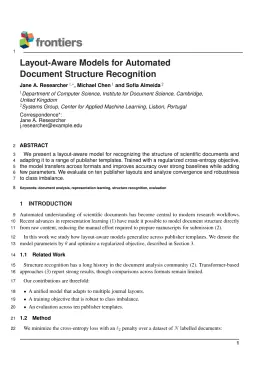
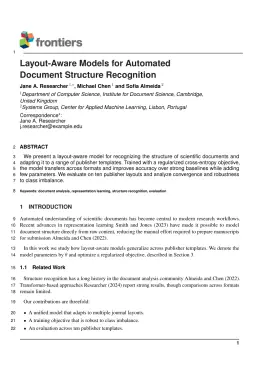
Frontiers in Neuroscience Template

Write in a clean editor, then format for Frontiers in Neuroscience in one click — DocuGuru applies the official Frontiers template with numbered references and exports a submission-ready PDF plus the editable LaTeX source. Free to start.

About the Frontiers in Neuroscience format

Frontiers in Neuroscience is a peer-reviewed journal published by Frontiers, covering Neural dynamics and brain function, Functional Brain Connectivity Studies, EEG and Brain-Computer Interfaces. Over its lifetime it has published 19,479 papers, which have received 493,738 citations.

PublisherFrontiers
Reference styleNumbered (Vancouver)
Numbered — [1], [2] in the text
1. Smith A, Jones B, Lee C. A representative article title. Frontiers in Neuroscience. 2023;12(3):45–58.

Formats any DOI in Frontiers in Neuroscience style. No sign-up.

Publishes research inNeural dynamics and brain function Functional Brain Connectivity Studies EEG and Brain-Computer Interfaces Neuroscience and Neural Engineering Neuroscience and Neuropharmacology Research
ISSN1662-453X
Citation impact (2-yr)3.99
h-index224
i10-index9,745
Article processing charge$2,950
Open accessYes — indexed in DOAJ
Top institutions publishing hereHarvard University
Journal websitewww.frontiersin.org
You getA submission-ready PDF and the editable LaTeX source — ready to submit.

Papers published in Frontiers in Neuroscience per year

492
2014
696
2015
800
2016
875
2017
1.1K
2018
1.5K
2019
1.4K
2020
1.9K
2021
2.4K
2022
2.2K
2023
1.3K
2024
1.1K
2025

Citation impact of Frontiers in Neuroscience by publication year

28.3K
2014
34K
2015
34.5K
2016
37.4K
2017
52.4K
2018
62.2K
2019
51.9K
2020
44.2K
2021
36.1K
2022
24.1K
2023
8.8K
2024
2.8K
2025

Citations each year’s papers have accumulated so far — the most recent years are still building up.

Most-cited papers in Frontiers in Neuroscience

MEG and EEG data analysis with MNE-Python

Alexandre Gramfort · 1 Jan 2013

Magnetoencephalography and electroencephalography (M/EEG) measure the weak electromagnetic signals generated by neuronal activity in the brain. Using these signals to characterize and locate neural activation in the brain is a challenge that requires expertise in physics, signal processing, statistics, and numerical methods. As part of the MNE software suite, MNE-Python is an open-source software package…

4,045 citations Cite SaveGo to paper →
Neuromorphic Silicon Neuron Circuits

Giacomo Indiveri, B. Linares-Barranco, Tara Julia Hamilton et al. · 1 Jan 2011

Hardware implementations of spiking neurons can be extremely useful for a large variety of applications, ranging from high-speed modeling of large-scale neural systems to real-time behaving systems, to bidirectional brain-machine interfaces. The specific circuit solutions used to implement silicon neurons depend on the application requirements. In this paper we describe the most common building blocks…

1,809 citations Cite SaveGo to paper →
101 Labeled Brain Images and a Consistent Human Cortical Labeling Protocol

Arno Klein, Jason A. Tourville · 1 Jan 2012

We introduce the Mindboggle-101 dataset, the largest and most complete set of free, publicly accessible, manually labeled human brain images. To manually label the macroscopic anatomy in magnetic resonance images of 101 healthy participants, we created a new cortical labeling protocol that relies on robust anatomical landmarks and minimal manual edits after initialization with automated…

1,318 citations Cite SaveGo to paper →
The Vagus Nerve at the Interface of the Microbiota-Gut-Brain Axis

Bruno Bonaz, Thomas Bazin, Sonia Pellissier · 7 Feb 2018

The microbiota, the gut, and the brain communicate through the microbiota-gut-brain axis in a bidirectional way that involves the autonomic nervous system. The vagus nerve (VN), the principal component of the parasympathetic nervous system, is a mixed nerve composed of 80% afferent and 20% efferent fibers. The VN, because of its role in interoceptive awareness,…

1,312 citations Cite SaveGo to paper →
Filter Bank Common Spatial Pattern Algorithm on BCI Competition IV Datasets 2a and 2b

Kai Keng Ang, Zheng Yang Chin, Chuanchu Wang et al. · 1 Jan 2012

The Common Spatial Pattern (CSP) algorithm is an effective and popular method for classifying 2-class motor imagery electroencephalogram (EEG) data, but its effectiveness depends on the subject-specific frequency band. This paper presents the Filter Bank Common Spatial Pattern (FBCSP) algorithm to optimize the subject-specific frequency band for CSP on Datasets 2a and 2b of the…

1,236 citations Cite SaveGo to paper →

Frontiers in Neuroscience template — frequently asked questions

How do I write a paper in the Frontiers in Neuroscience format?
In DocuGuru you write your manuscript in a normal editor — no LaTeX setup required — and select the Frontiers in Neuroscience template. When you export, DocuGuru compiles the paper into the official Frontiers format and hands you a submission-ready PDF along with the editable LaTeX source.
What reference style does Frontiers in Neuroscience use?
Frontiers in Neuroscience uses Numbered (Vancouver) references, shown as numbered [1], [2] markers in the text. DocuGuru formats every in-text citation and the reference list in this exact style automatically. A reference appears like this: 1. Smith A, Jones B, Lee C. A representative article title. Frontiers in Neuroscience. 2023;12(3):45–58.
Do I need to know LaTeX to submit to Frontiers in Neuroscience?
No. DocuGuru generates the FrontiersinVancouver LaTeX class and compiles the PDF for you in the background, so you get a Frontiers-ready Frontiers in Neuroscience document without writing any LaTeX. If you do want it, the LaTeX source is included in the export.
Can I import an existing draft into the Frontiers in Neuroscience template?
Yes. Paste or upload your current manuscript — Word, LaTeX, Markdown, or plain text — and DocuGuru reflows it into the Frontiers in Neuroscience format with correct headings, figures, tables, and numbered citations.
What is Frontiers in Neuroscience?
Frontiers in Neuroscience. It is a life sciences and medicine journal, published by Frontiers.
Can I export a submission-ready Frontiers in Neuroscience PDF?
Yes — DocuGuru produces a PDF built with the official Frontiers in Neuroscience template (the FrontiersinVancouver class) that is ready to submit to Frontiers, together with the matching LaTeX source files.
How much does the Frontiers in Neuroscience template cost?
You can start writing in the Frontiers in Neuroscience template for free. Exporting the final submission-ready Frontiers in Neuroscience PDF and LaTeX source is part of DocuGuru's paid plans — see the app for current pricing.
Use the Frontiers in Neuroscience template